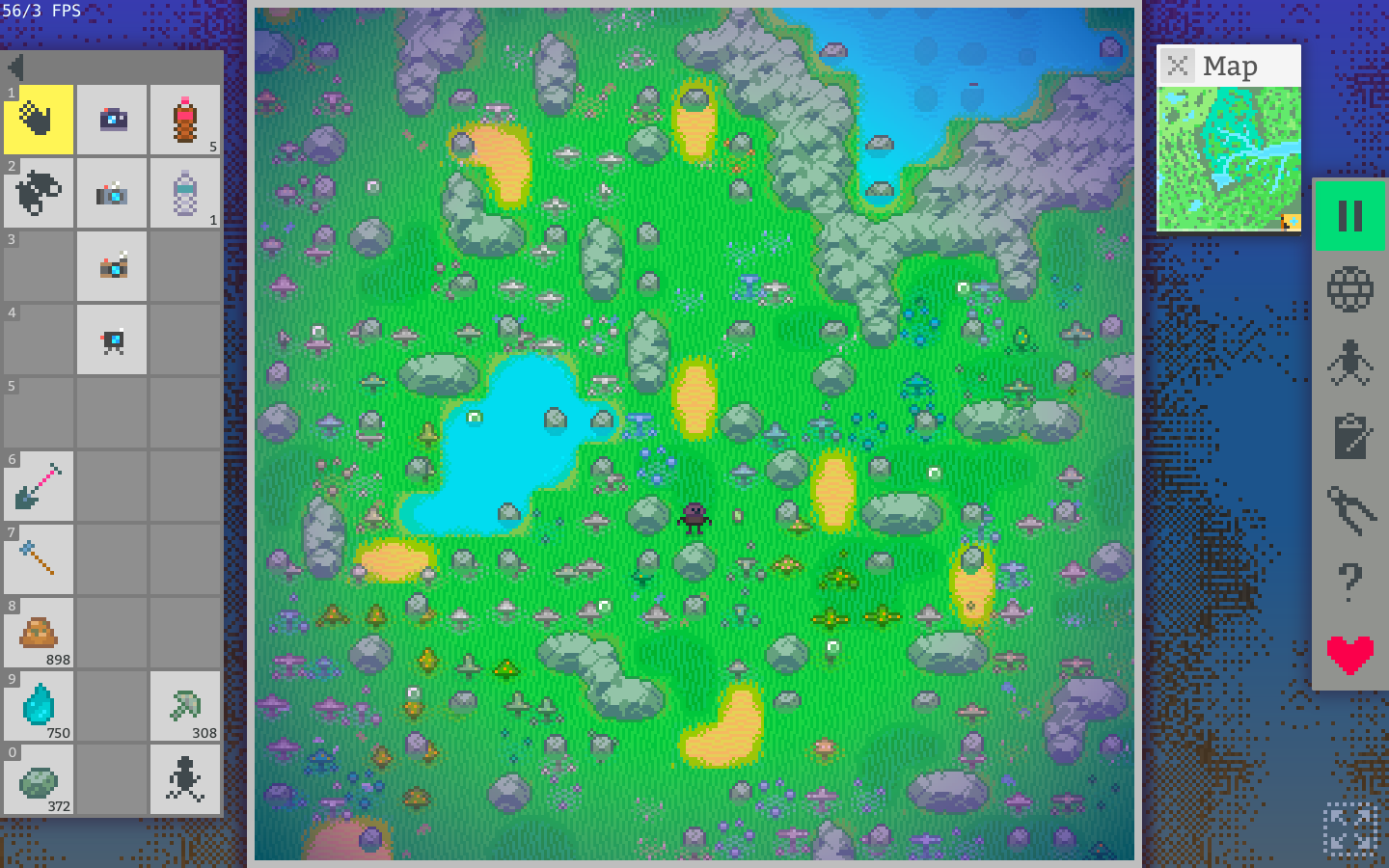
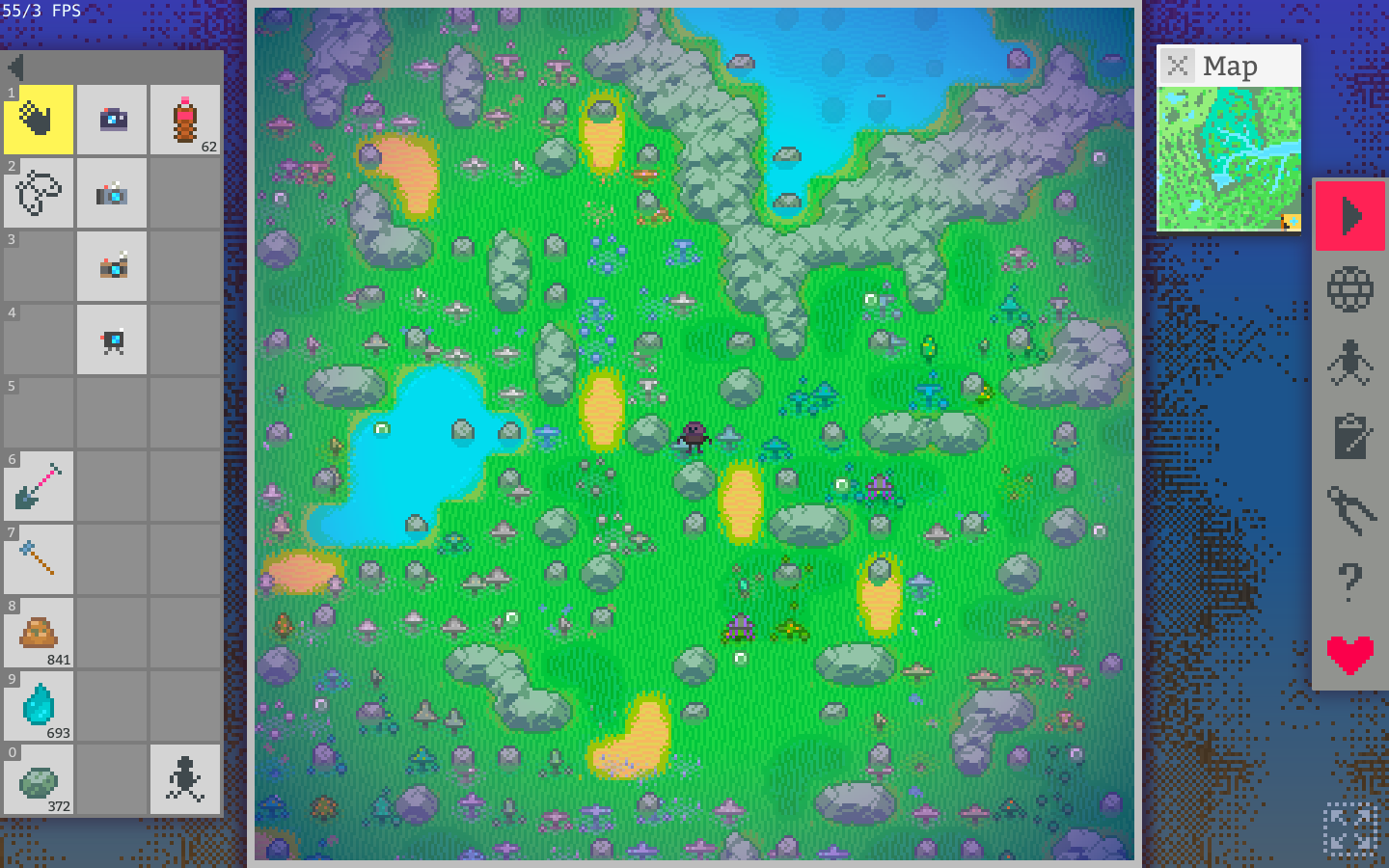
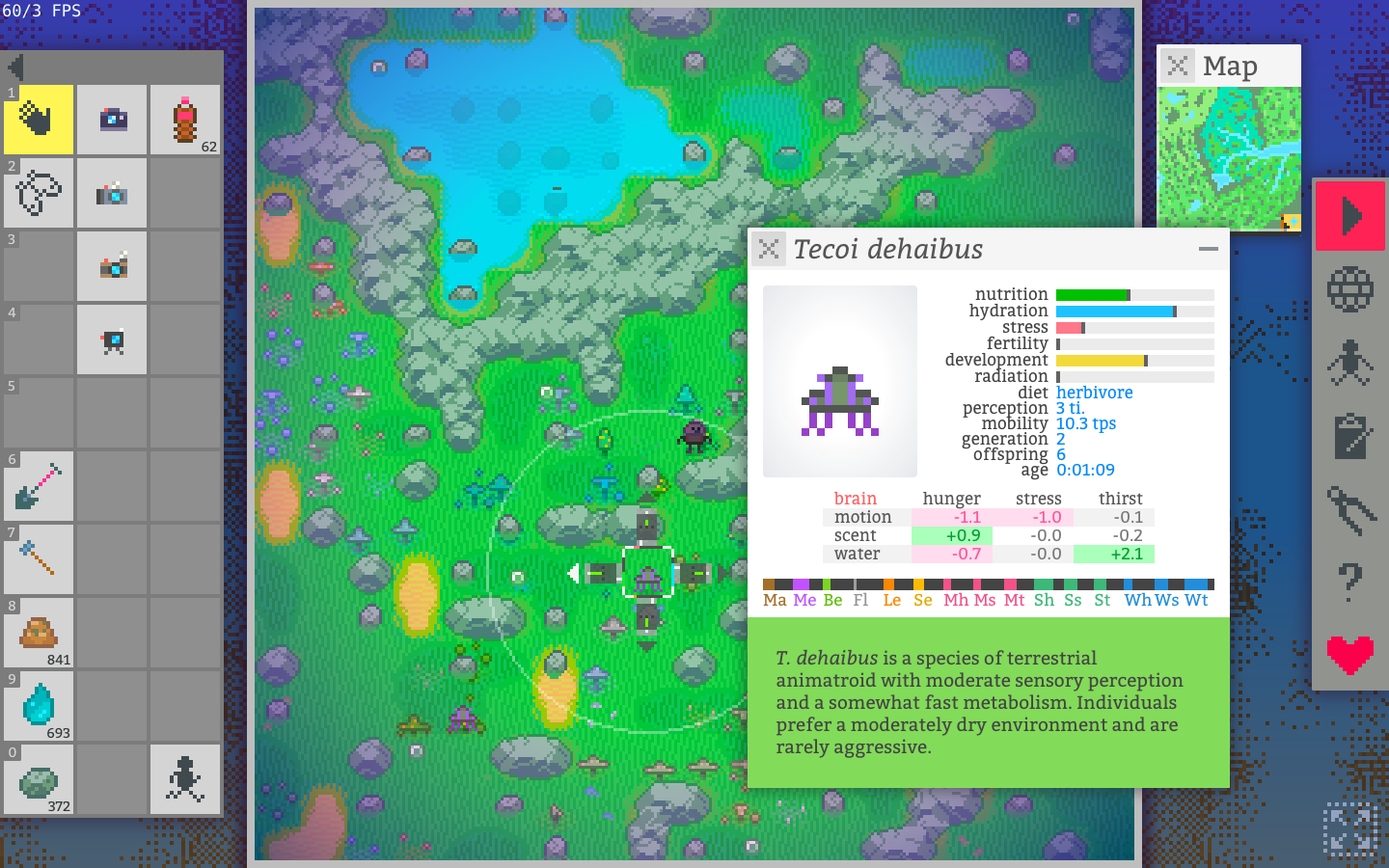
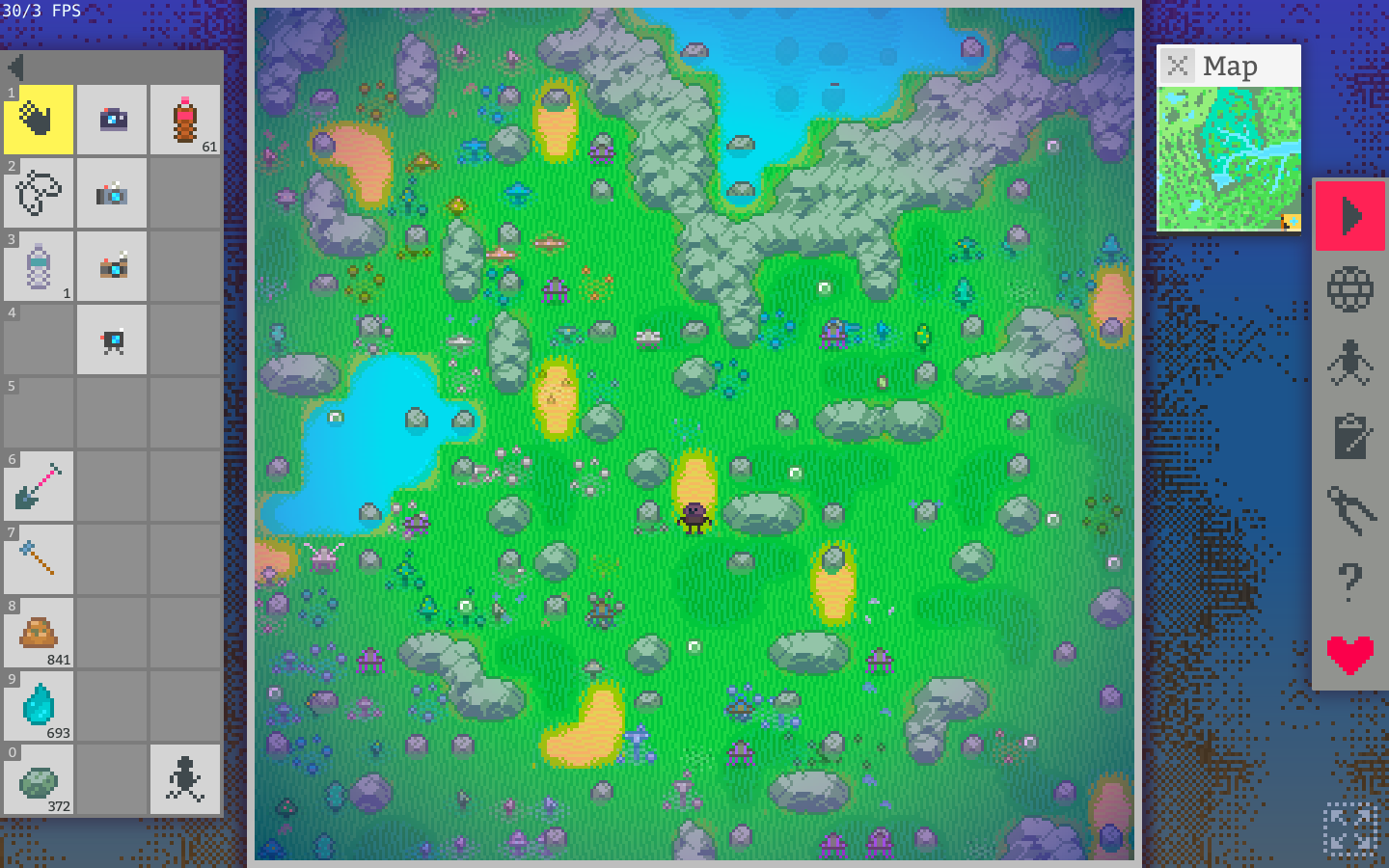
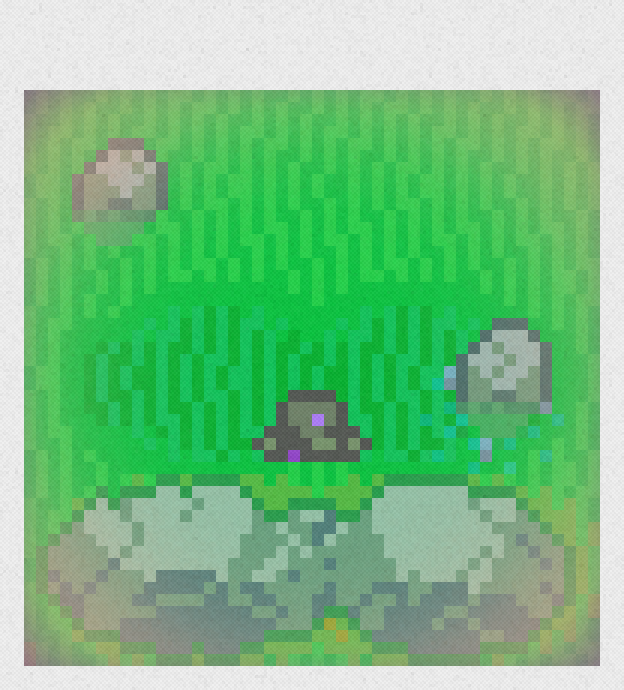
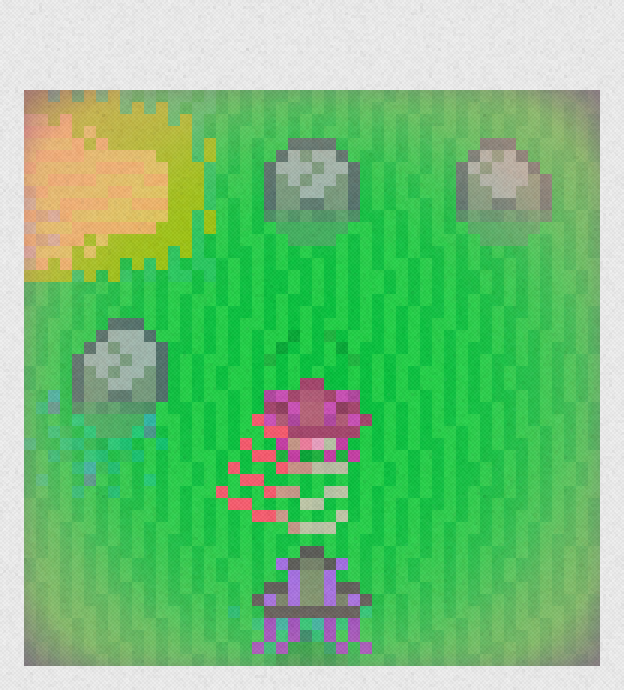
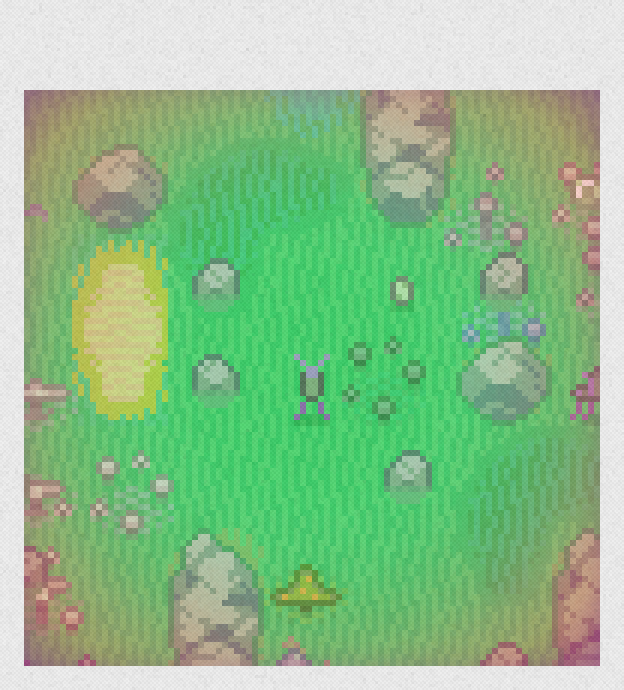
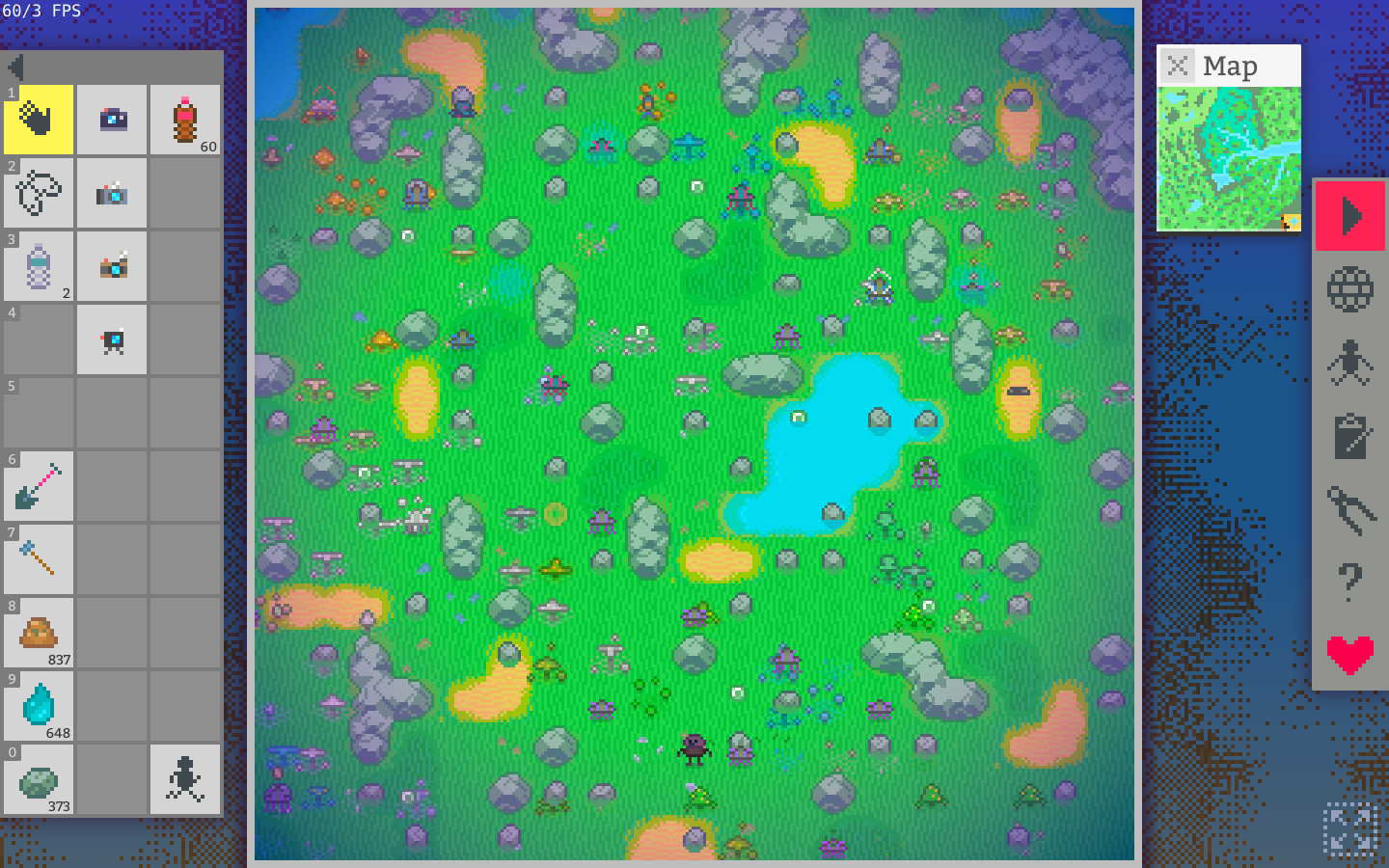
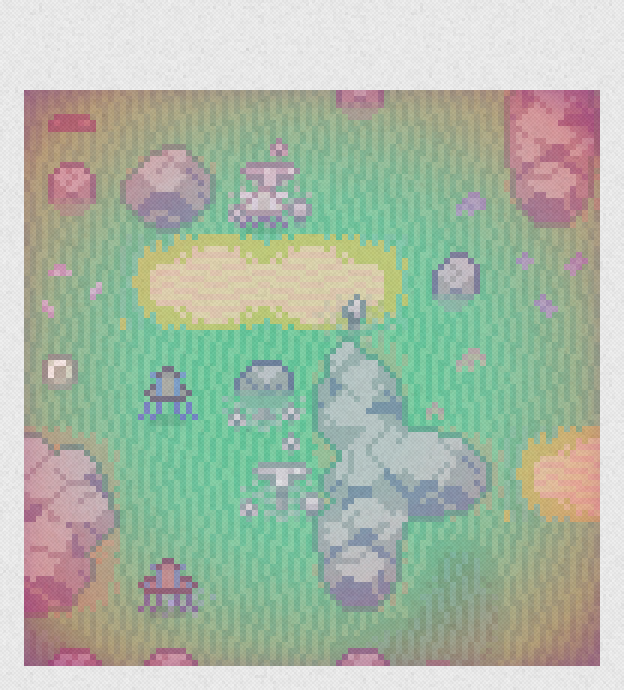
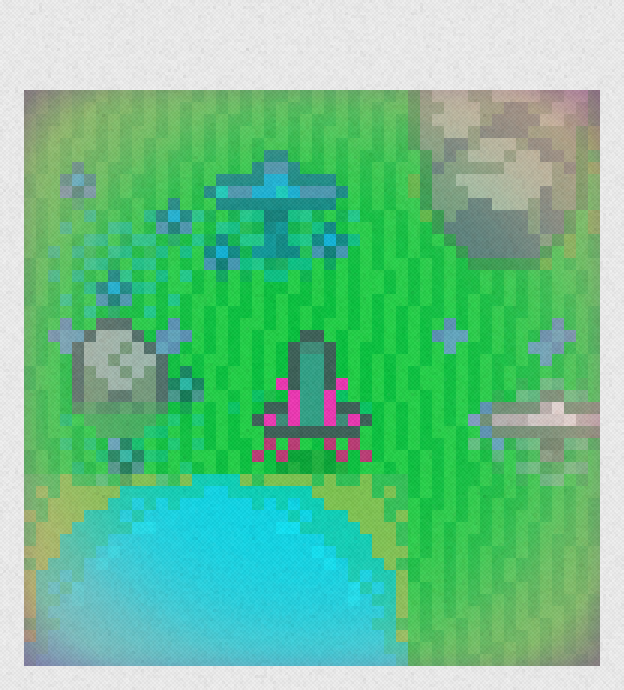
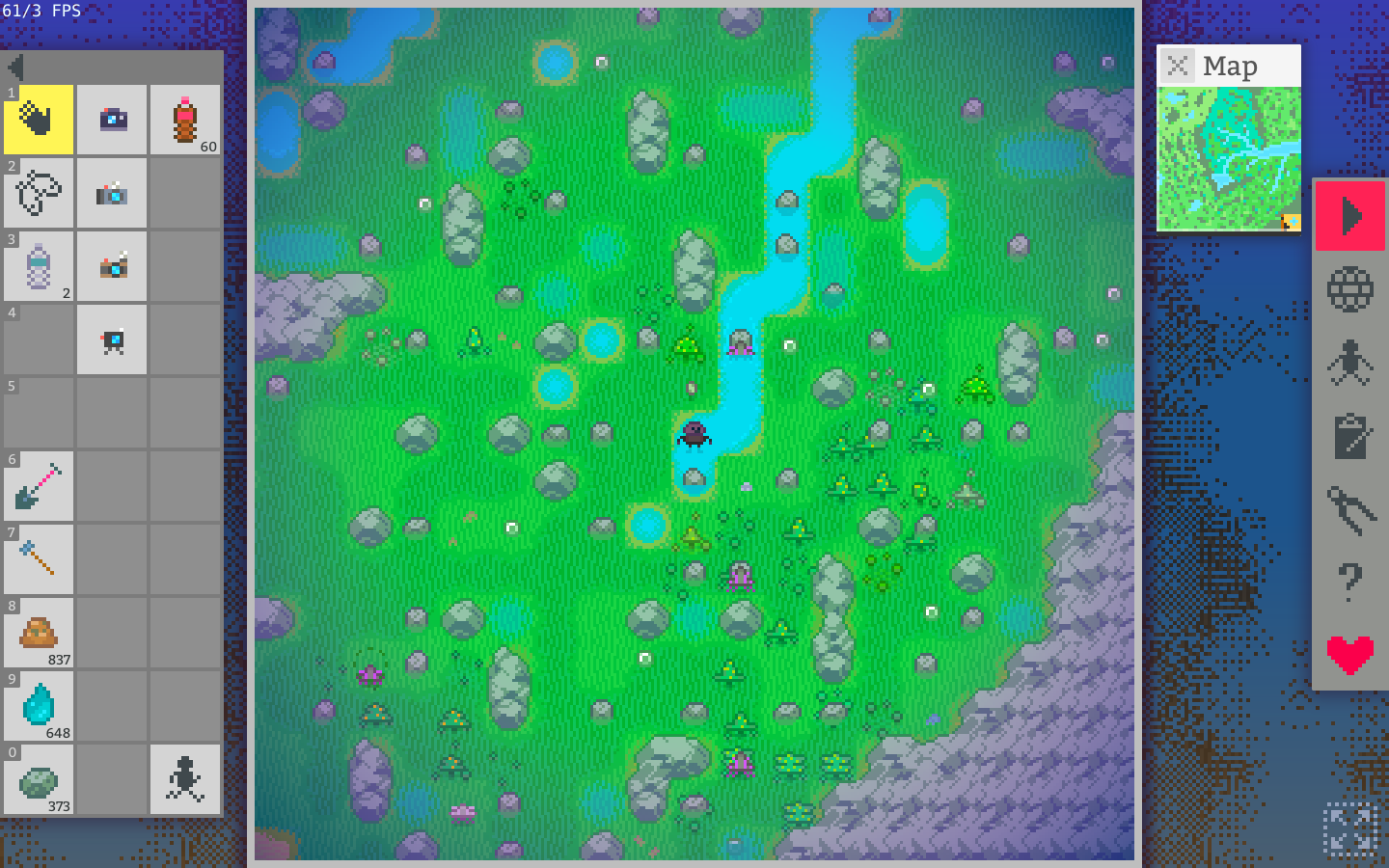
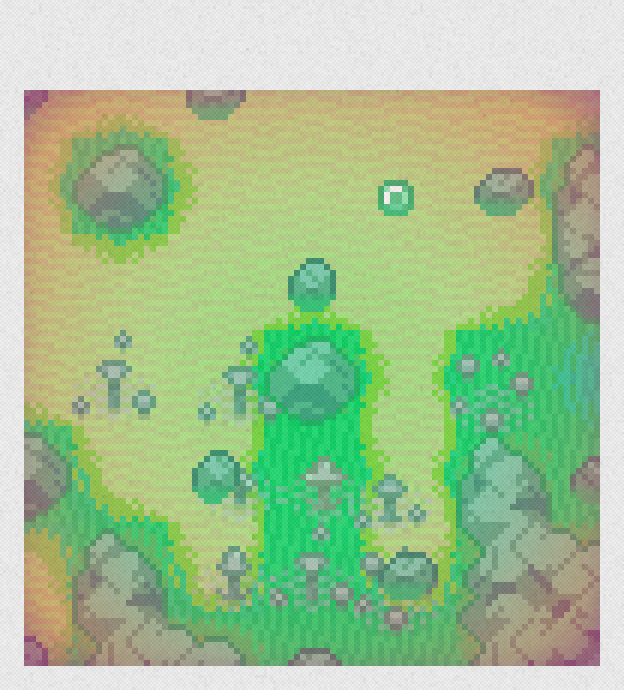
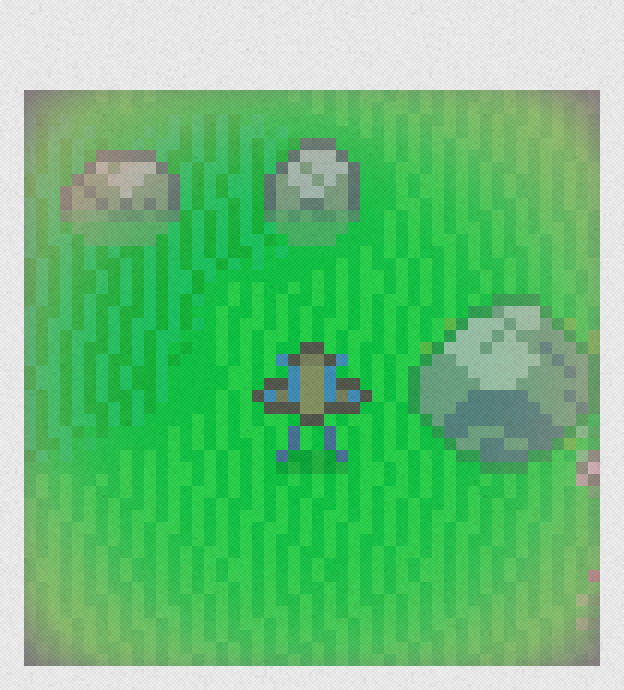
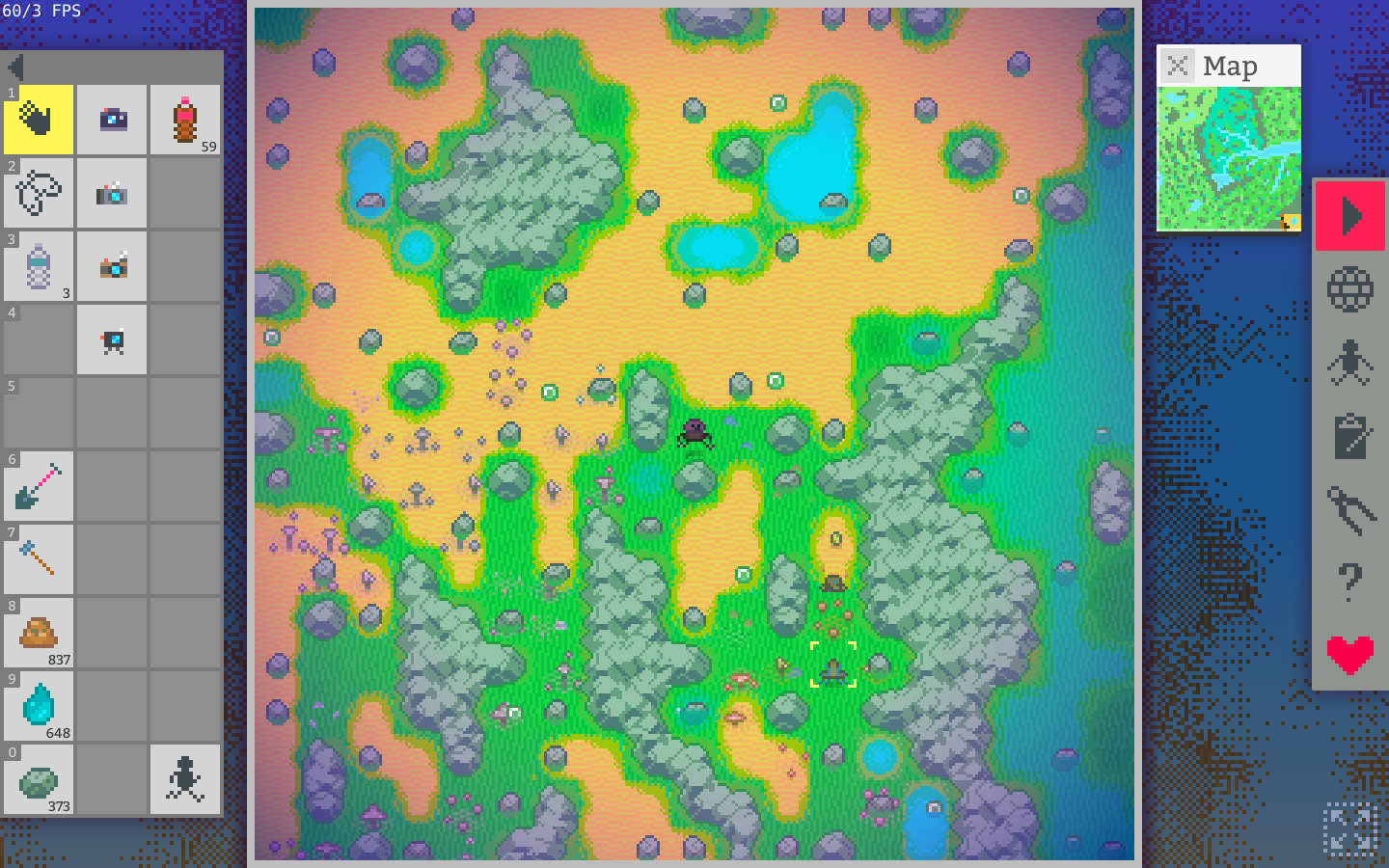
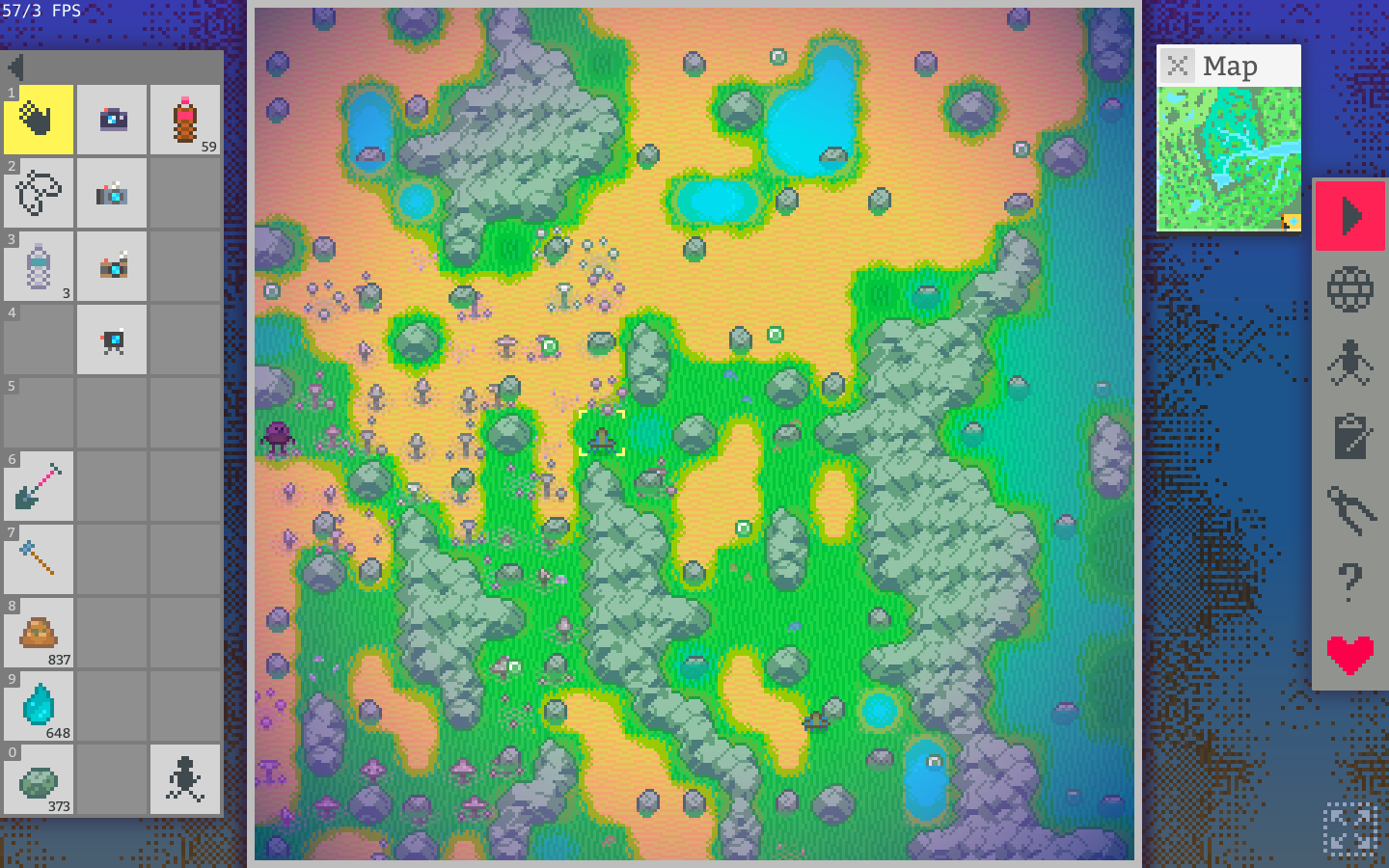
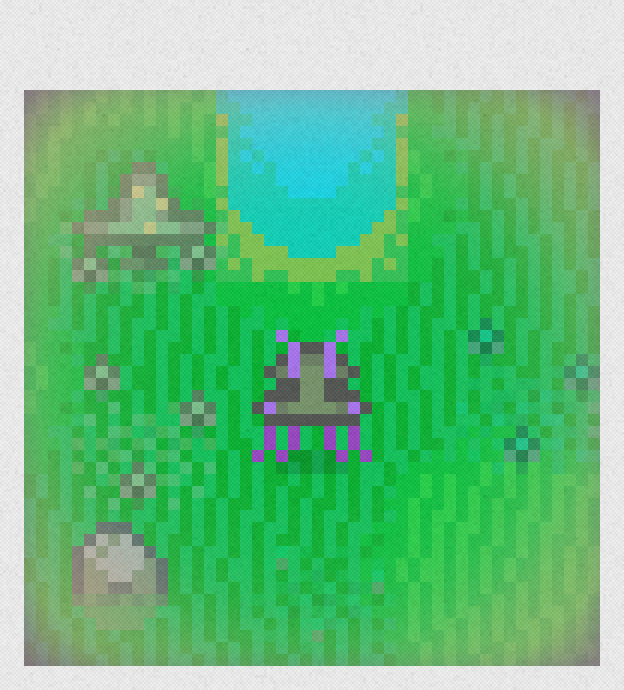
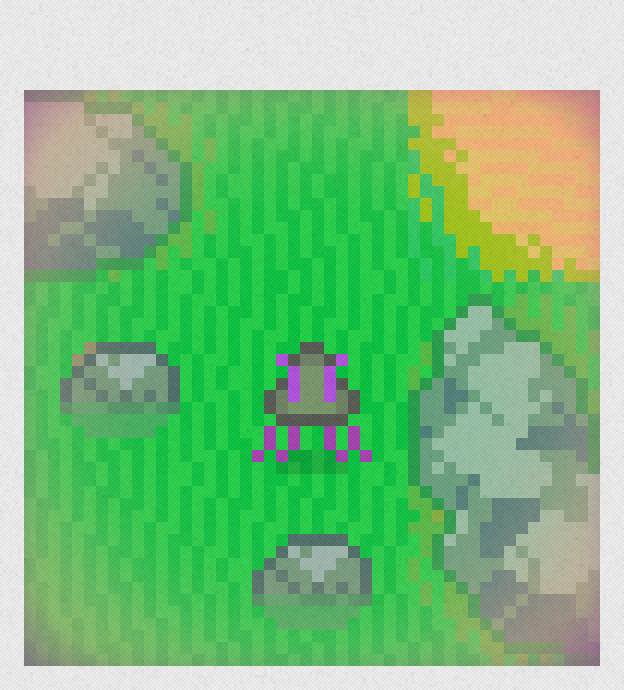
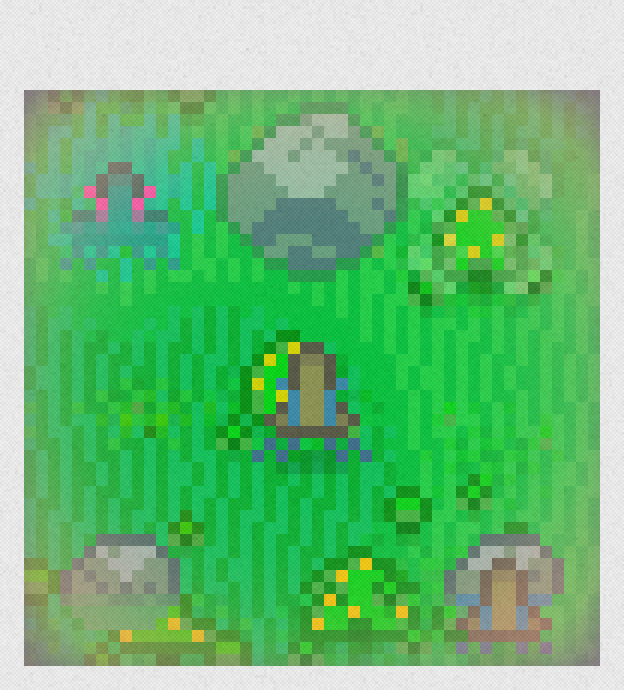
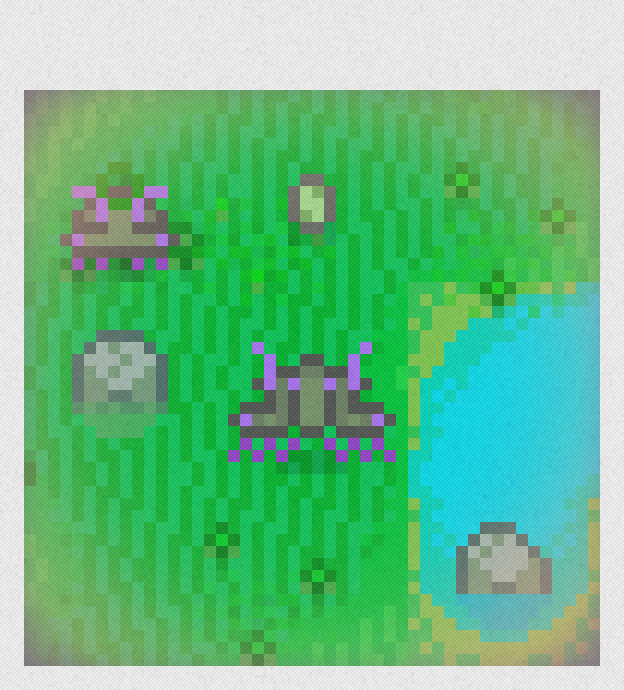
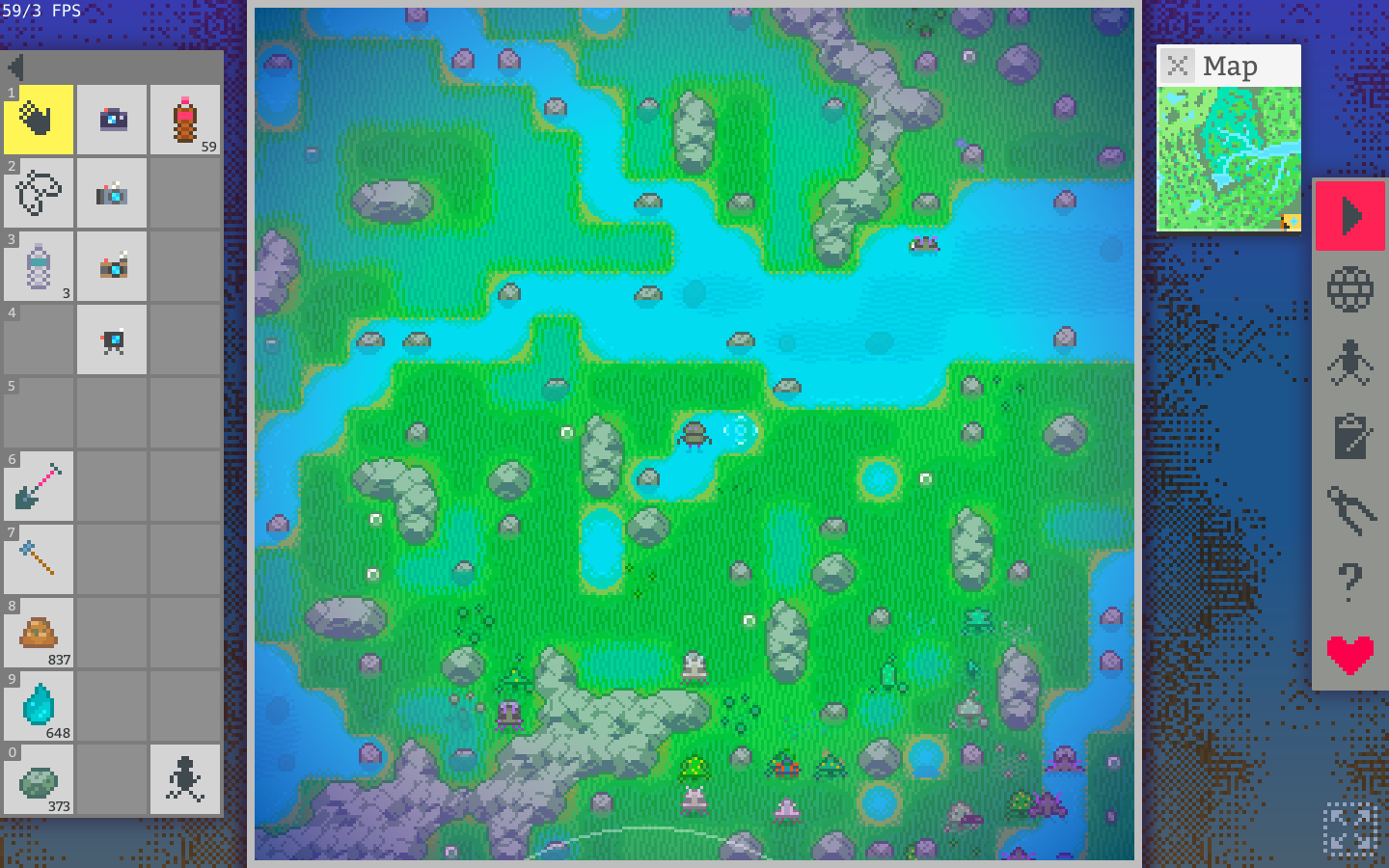
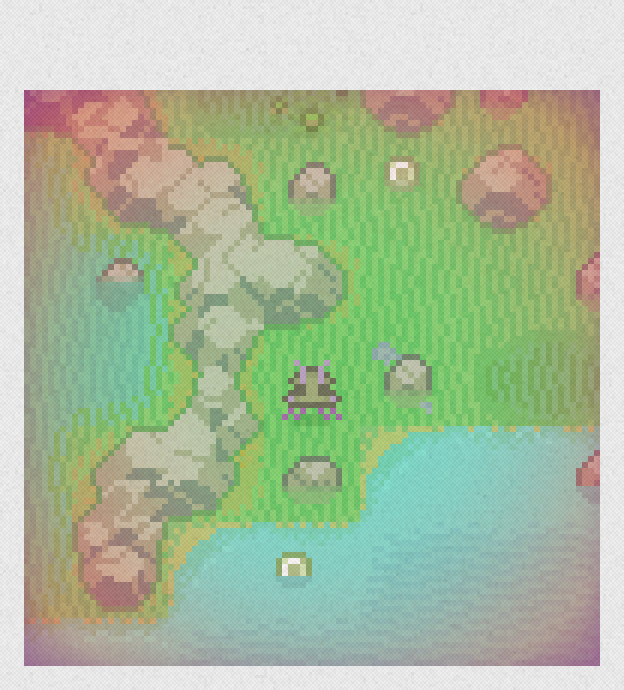
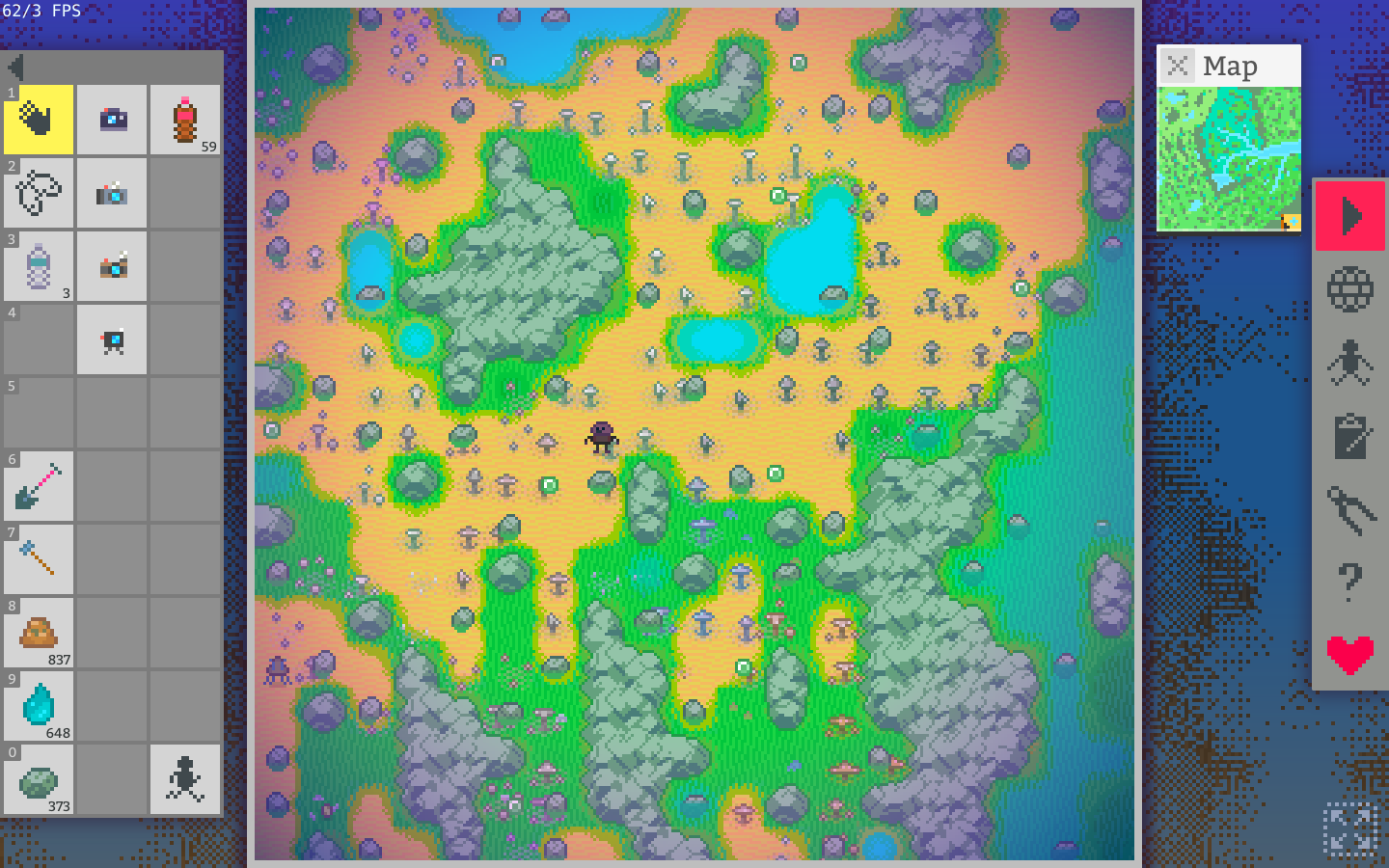
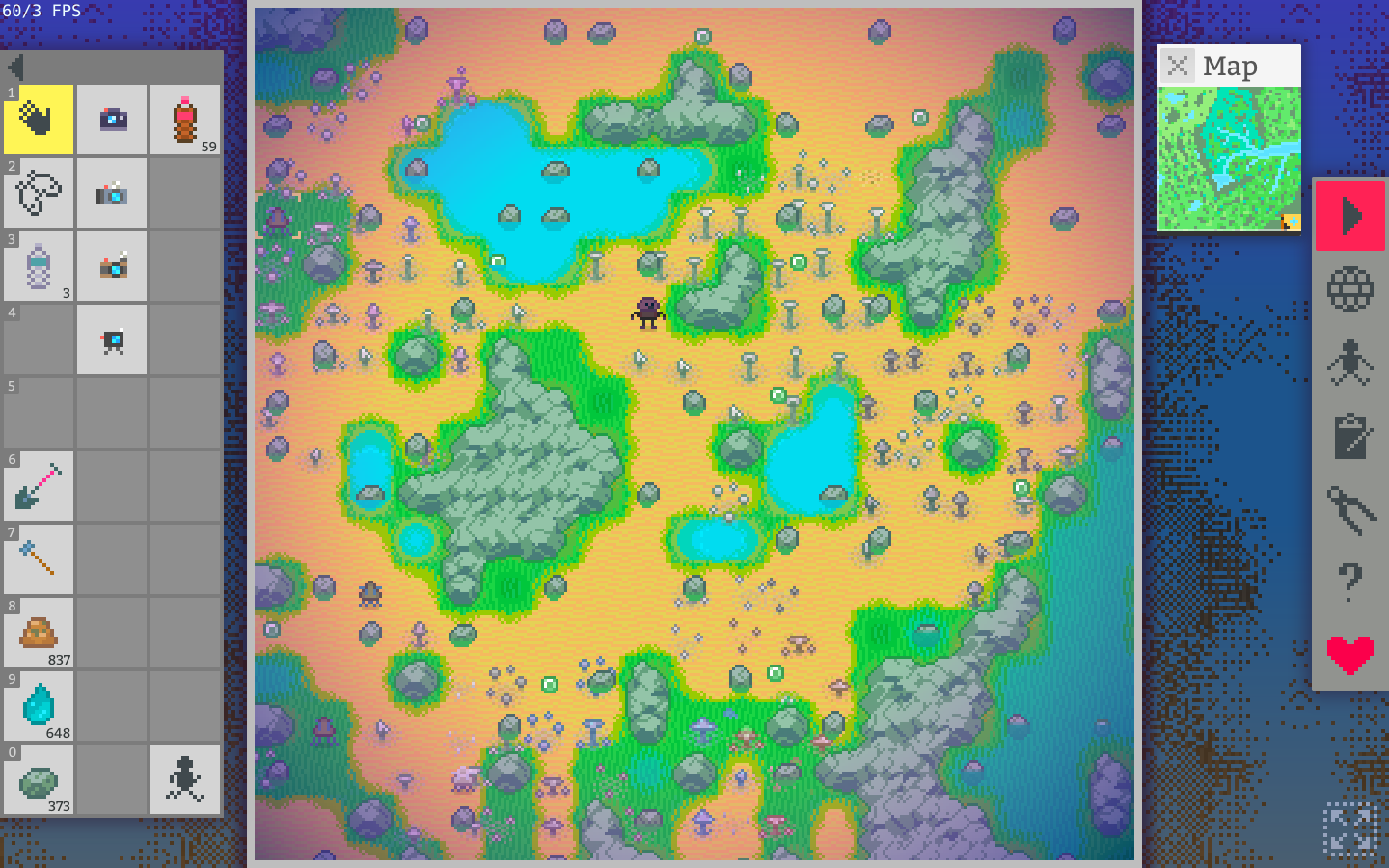
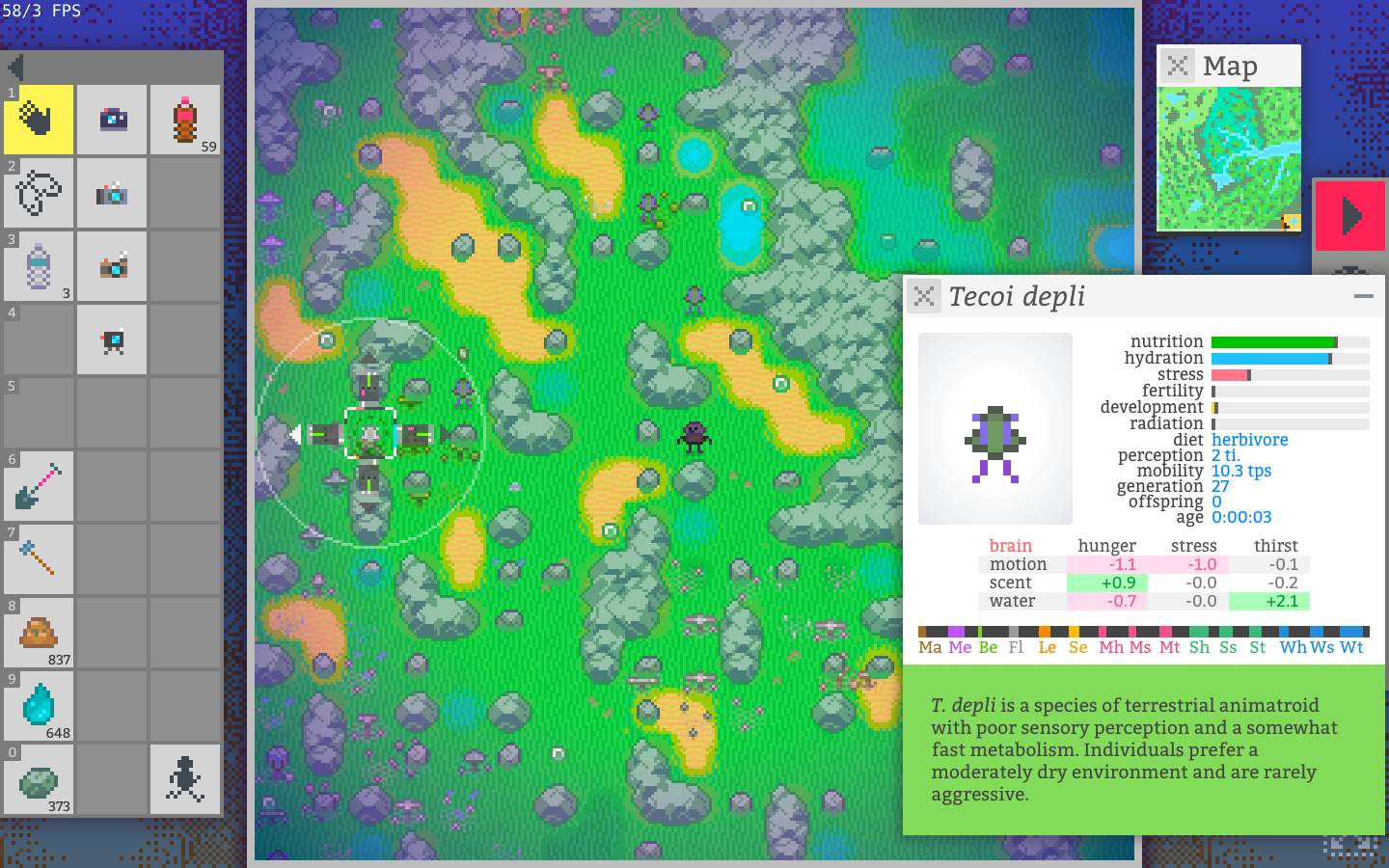
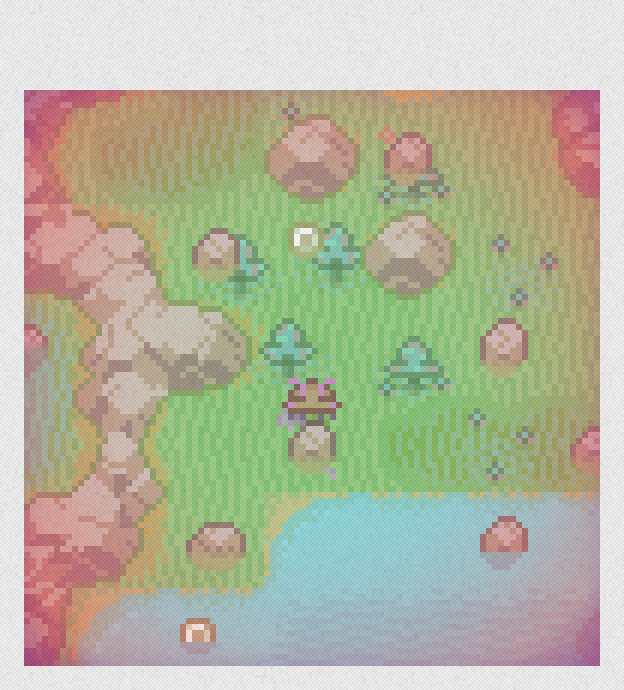
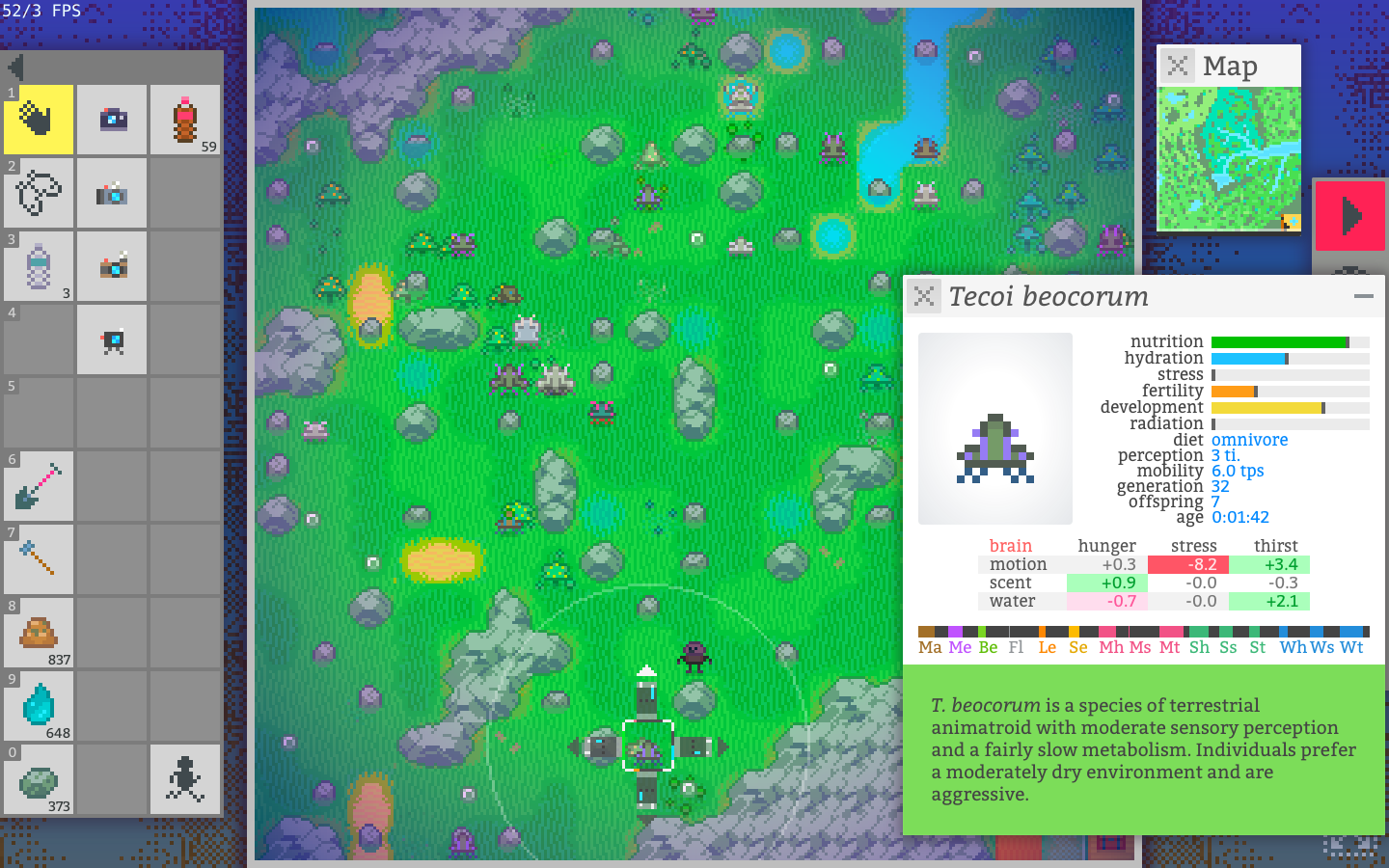
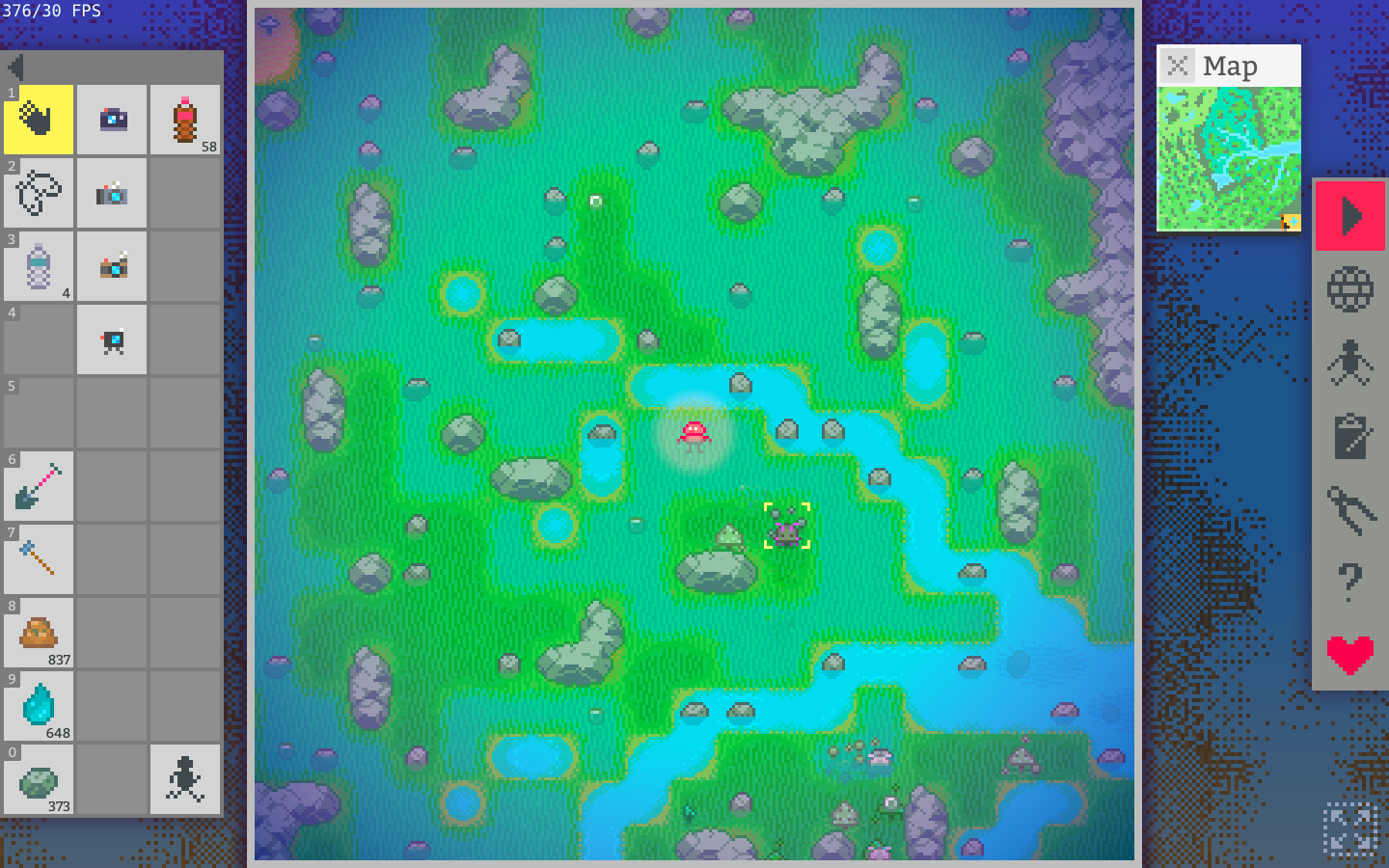
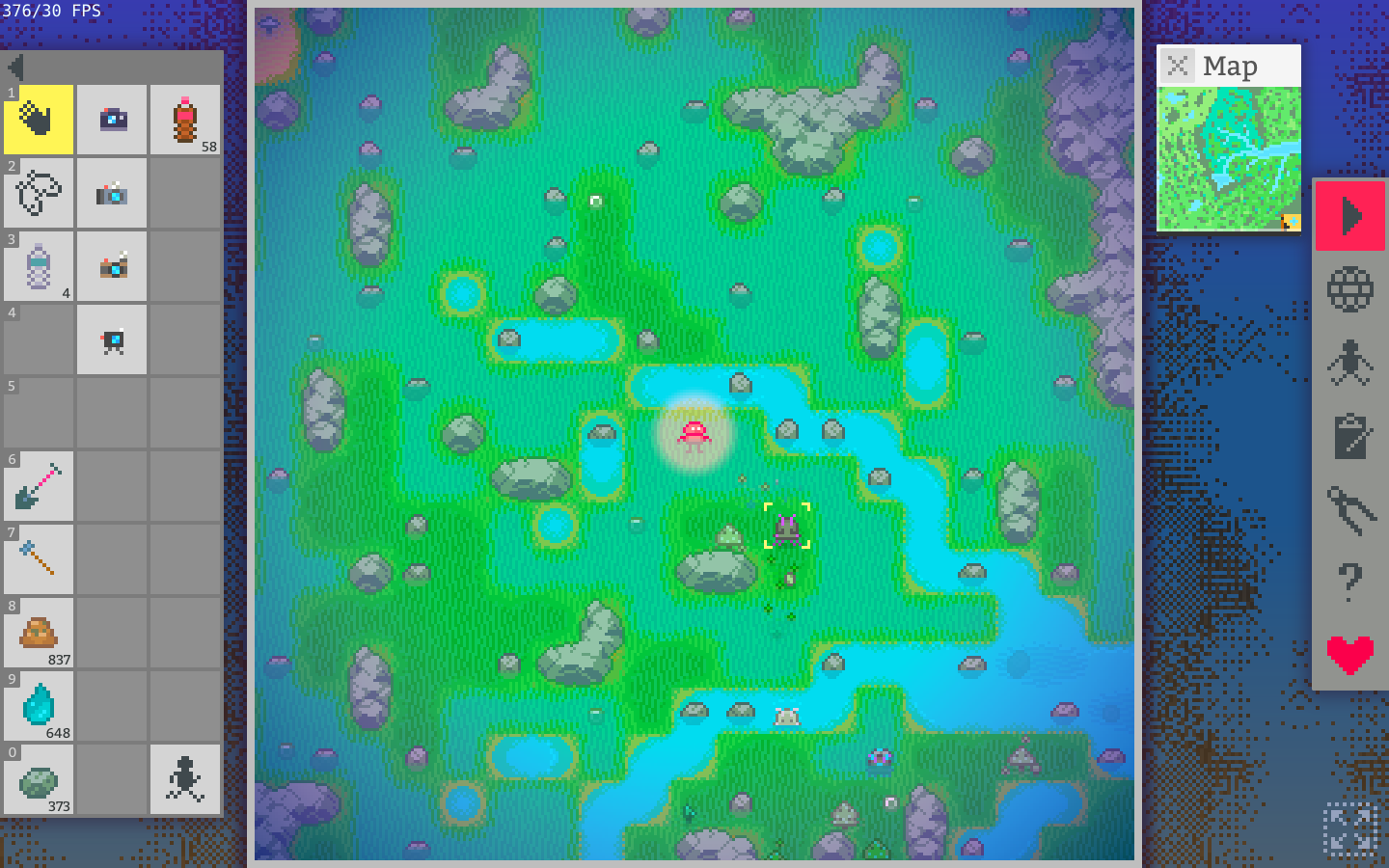
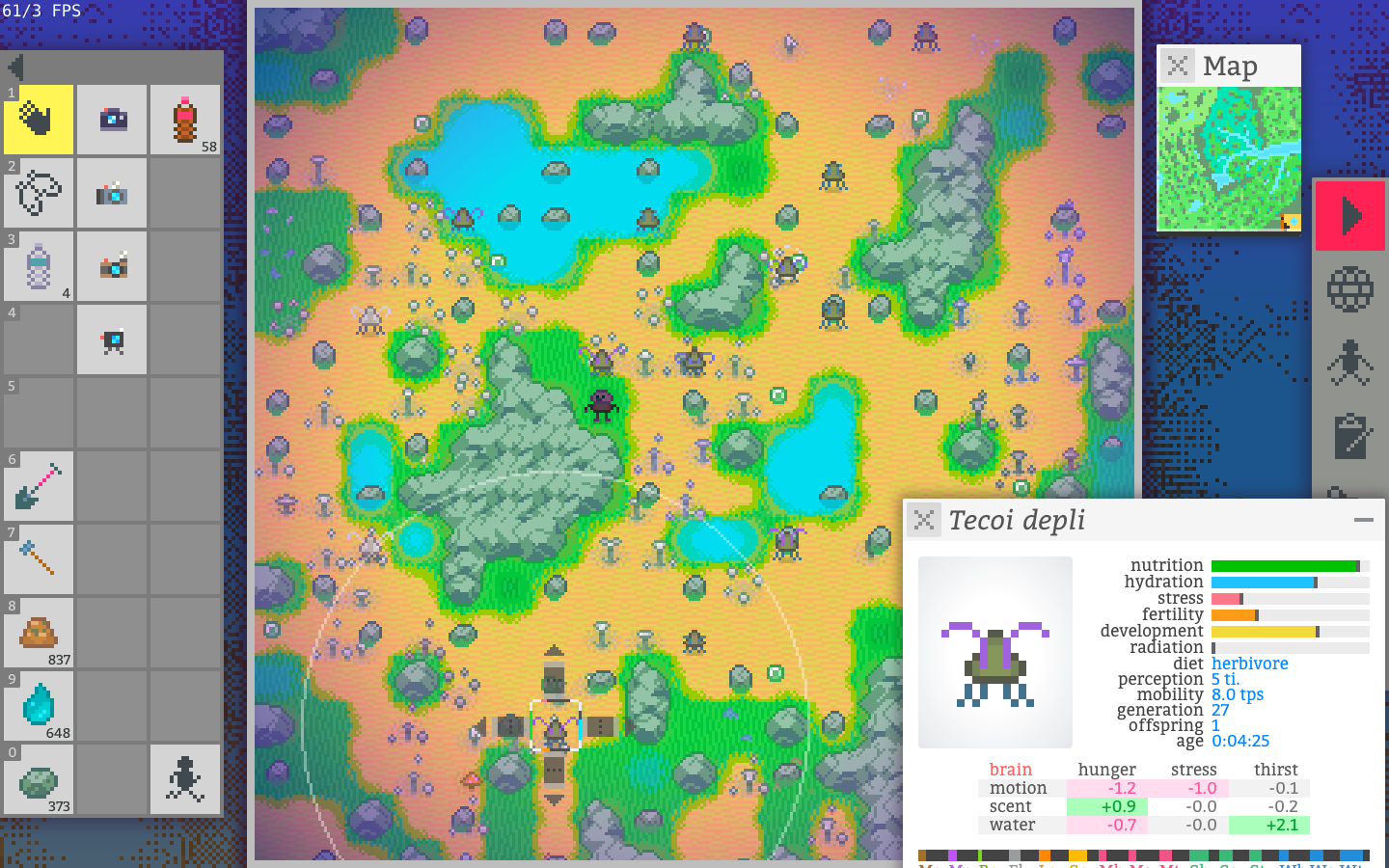
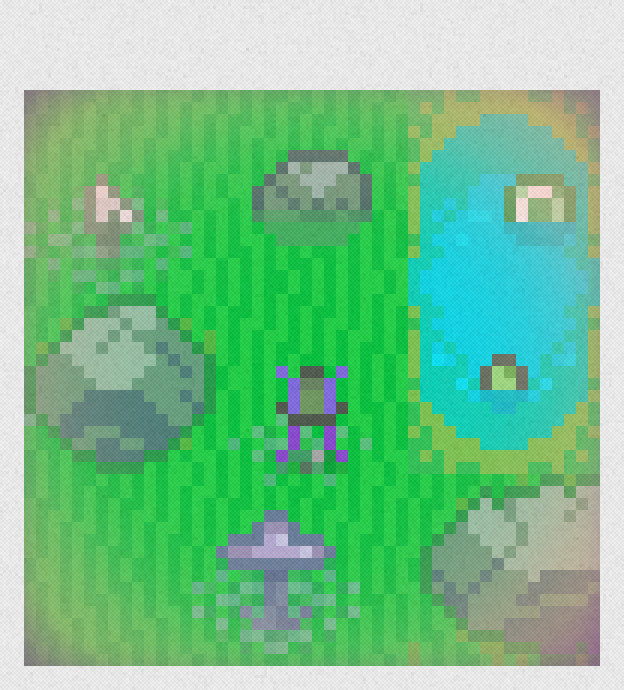
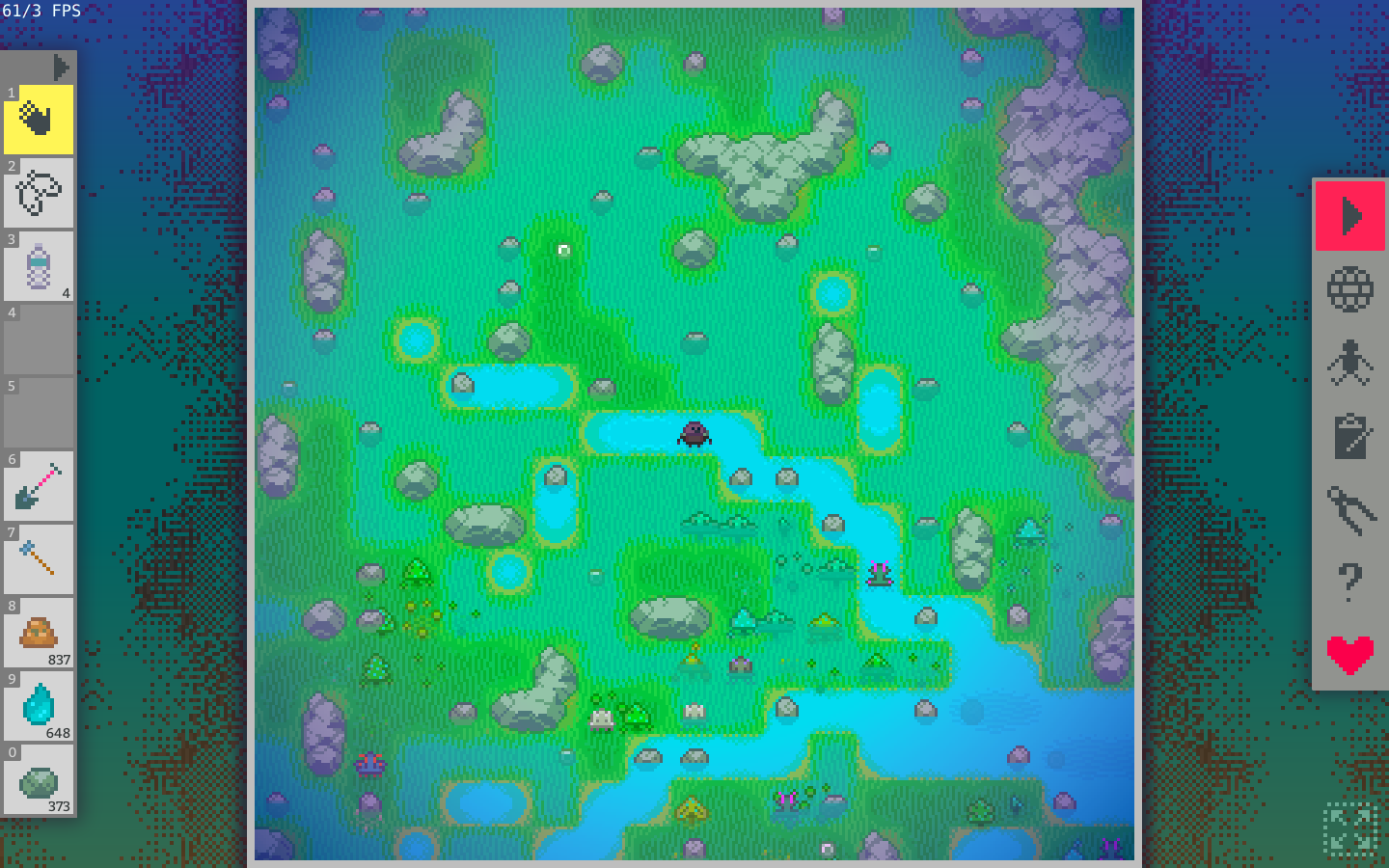
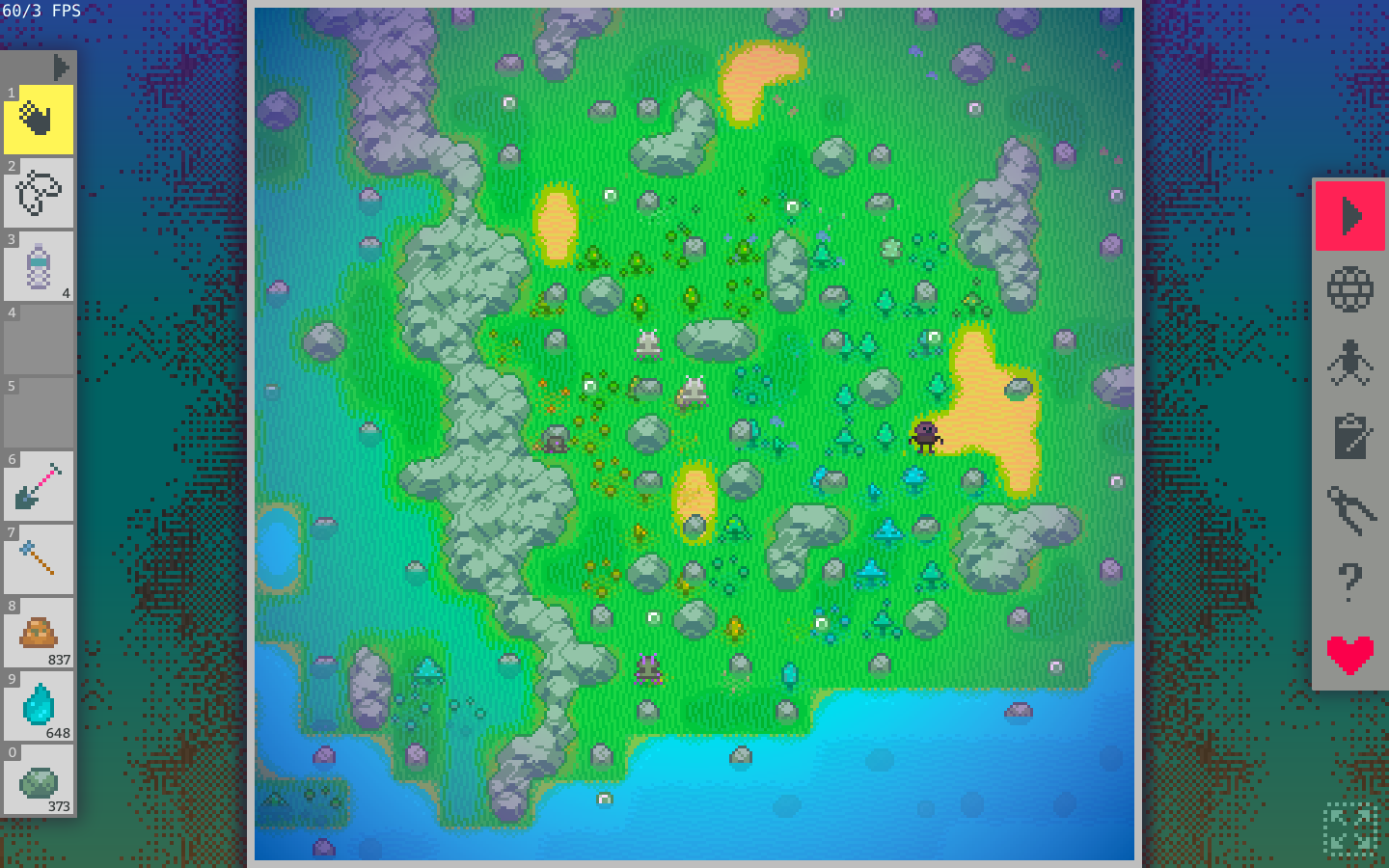
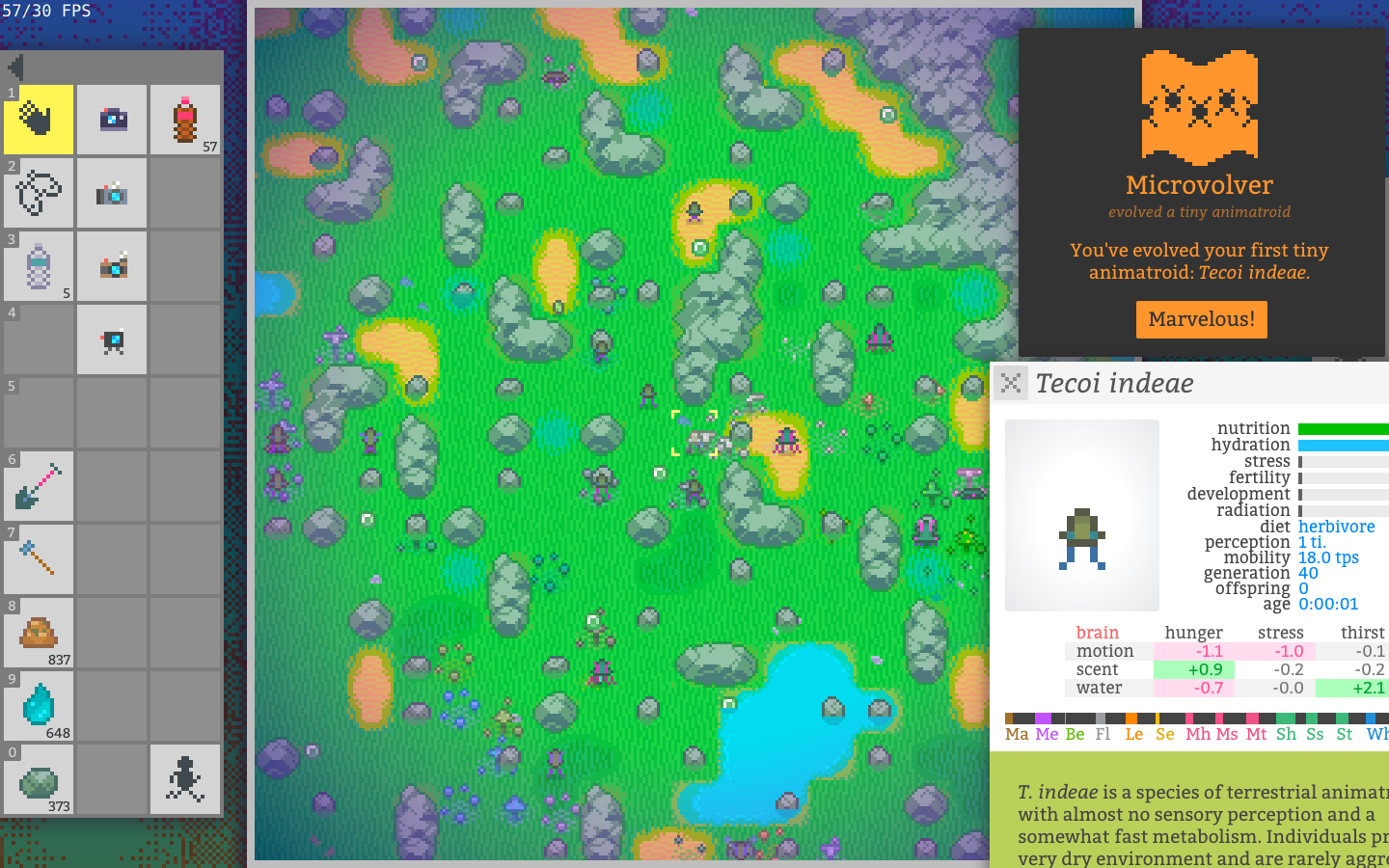
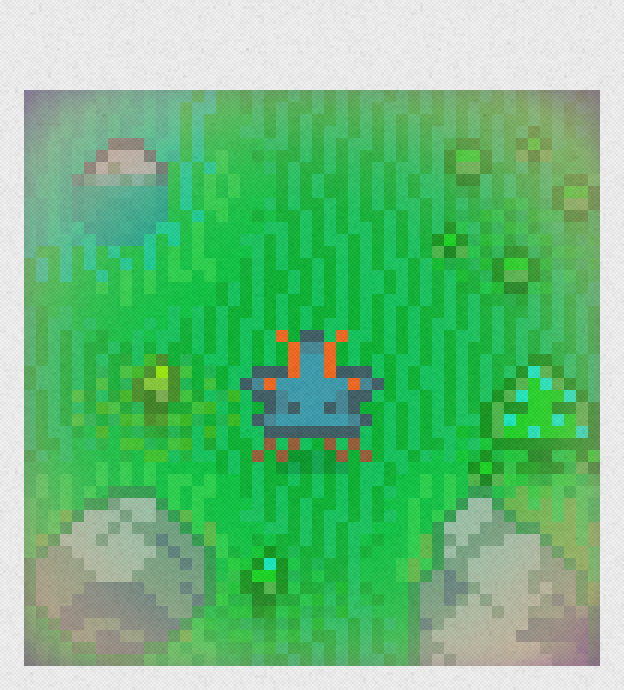
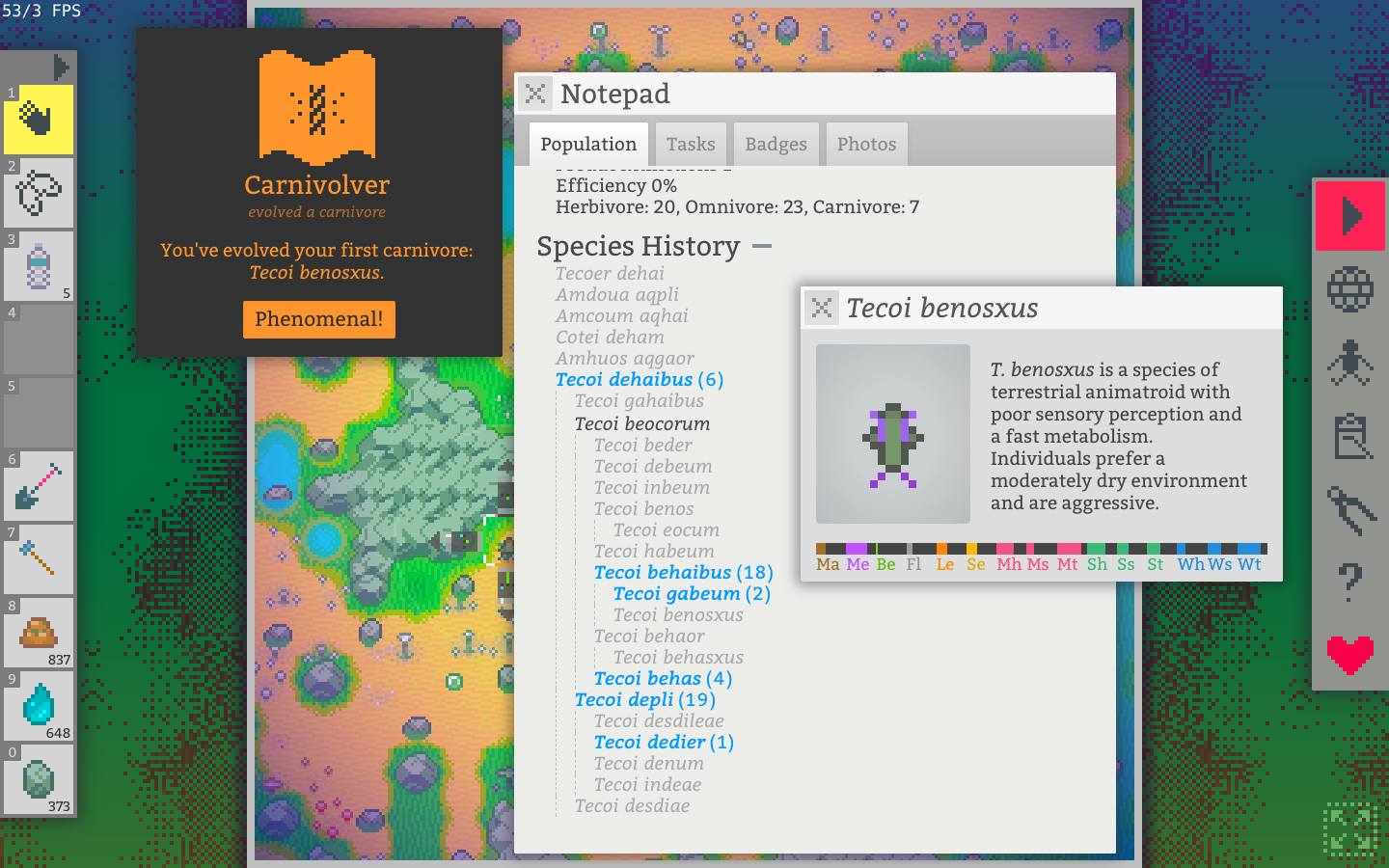
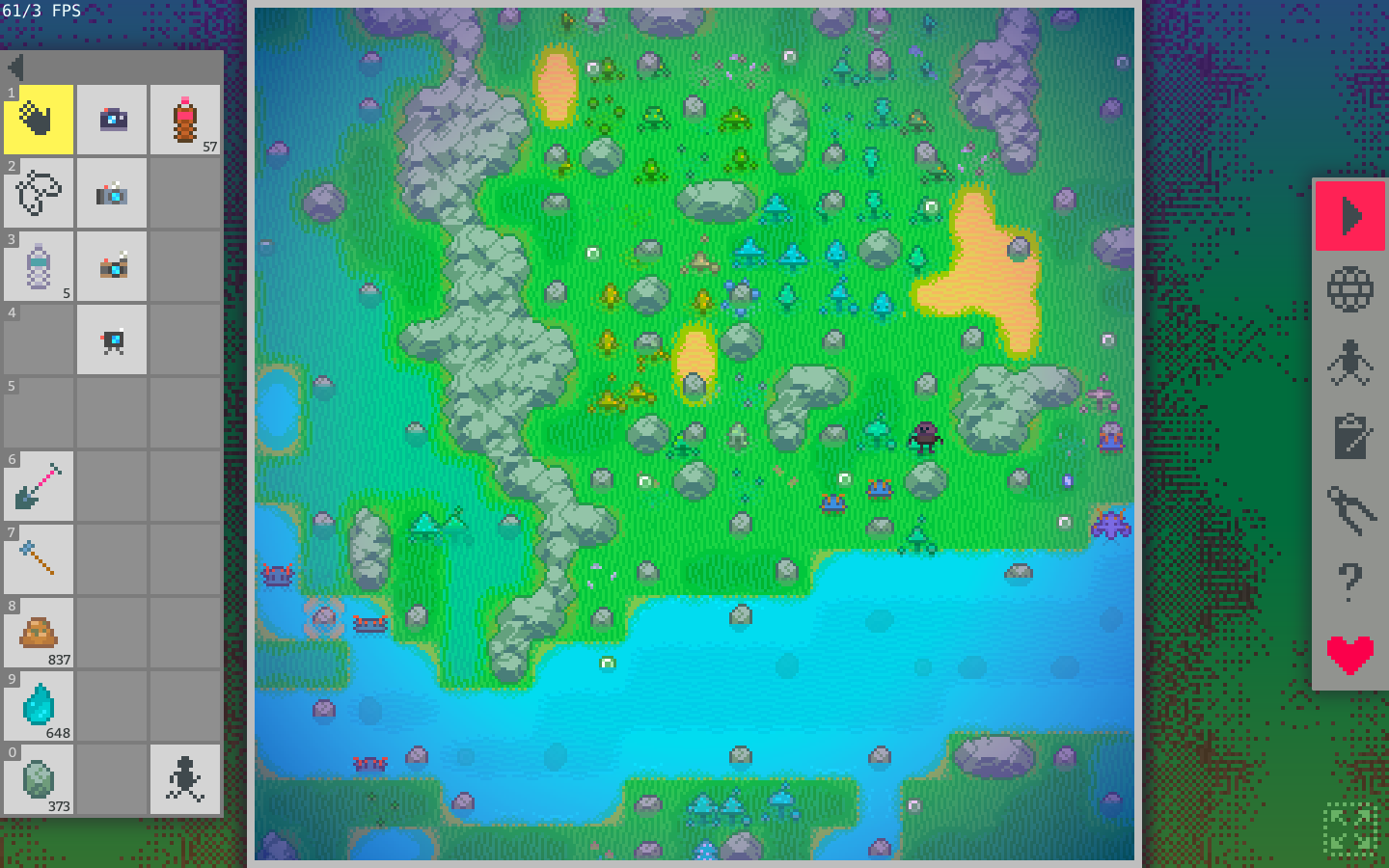
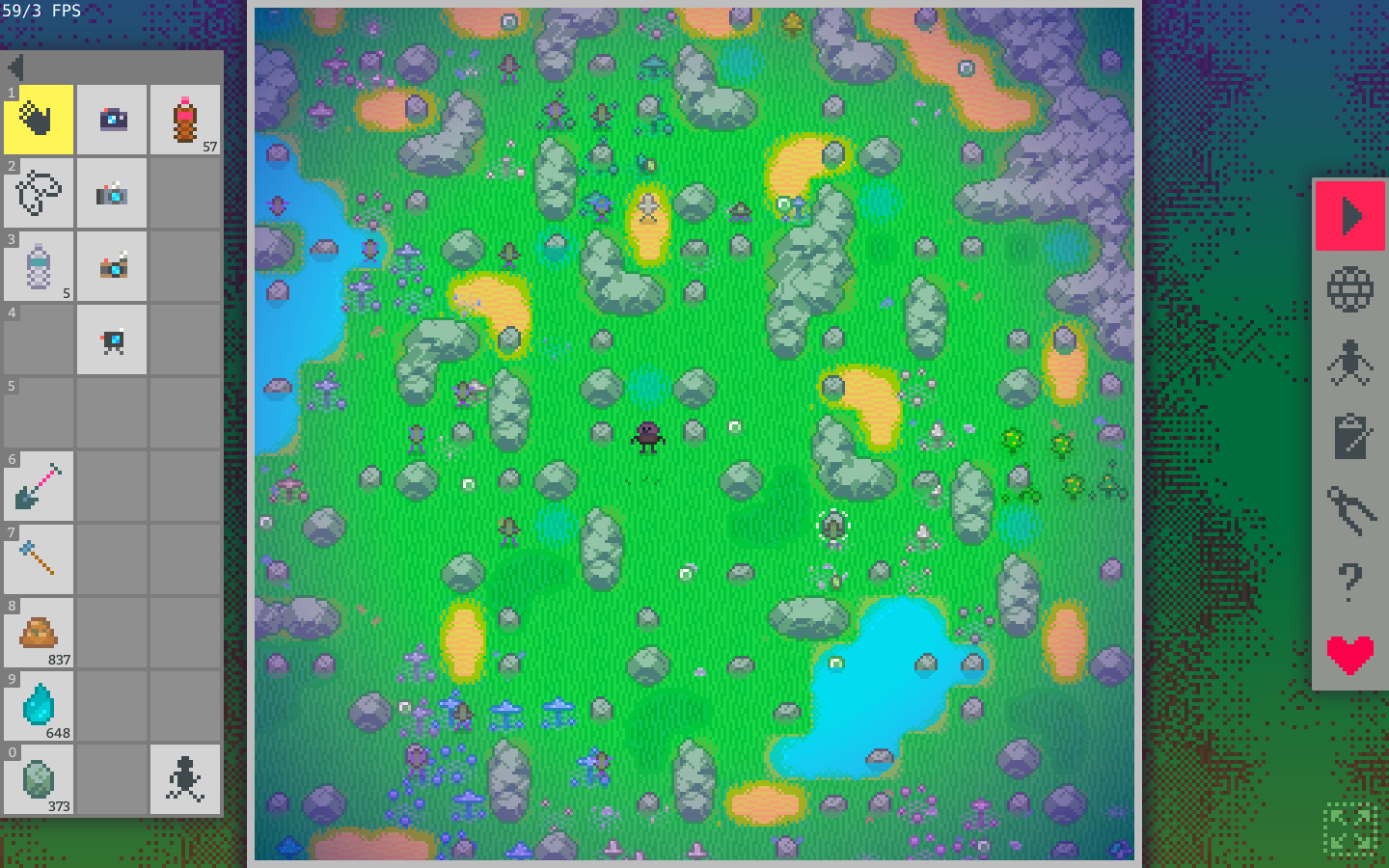
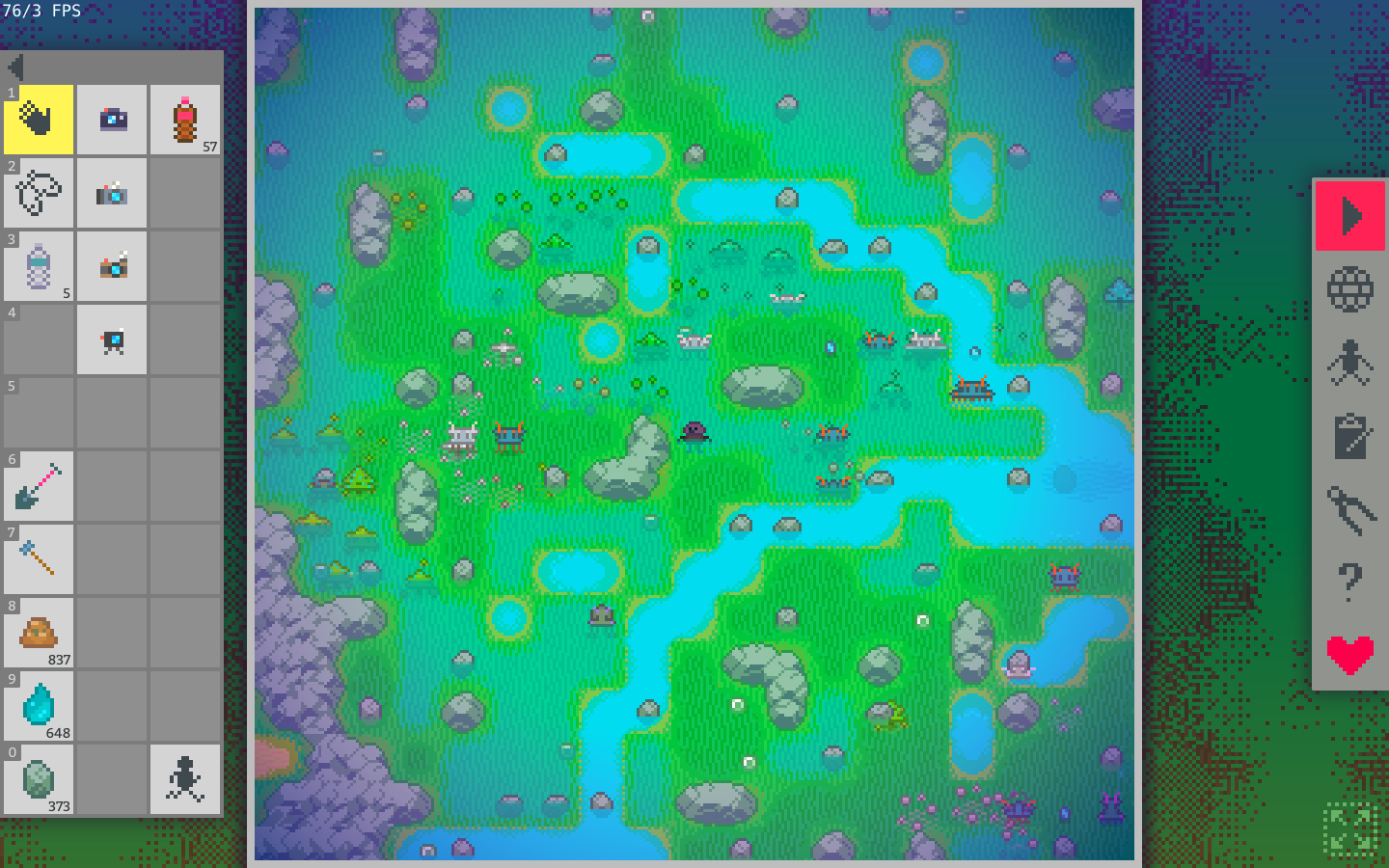
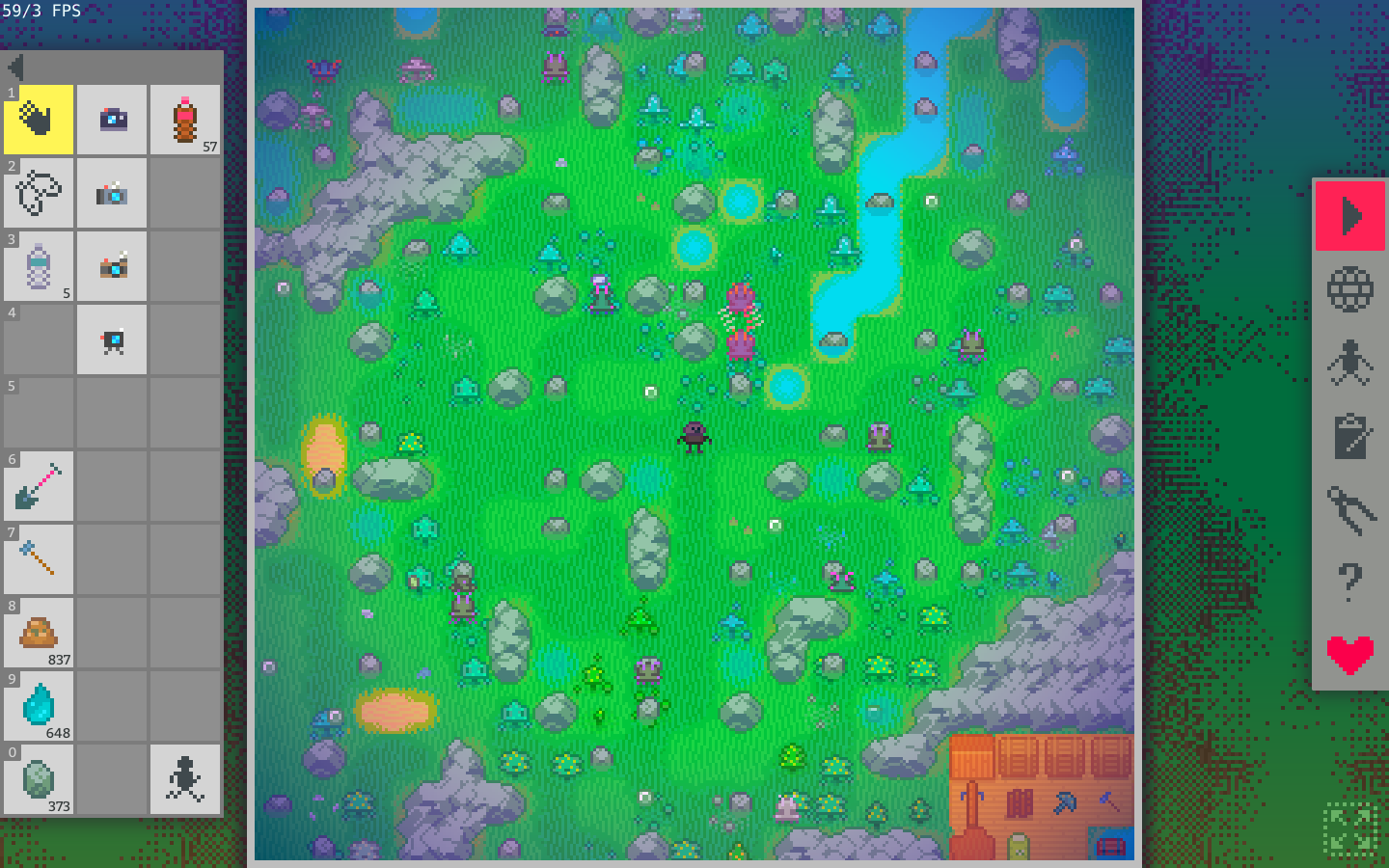
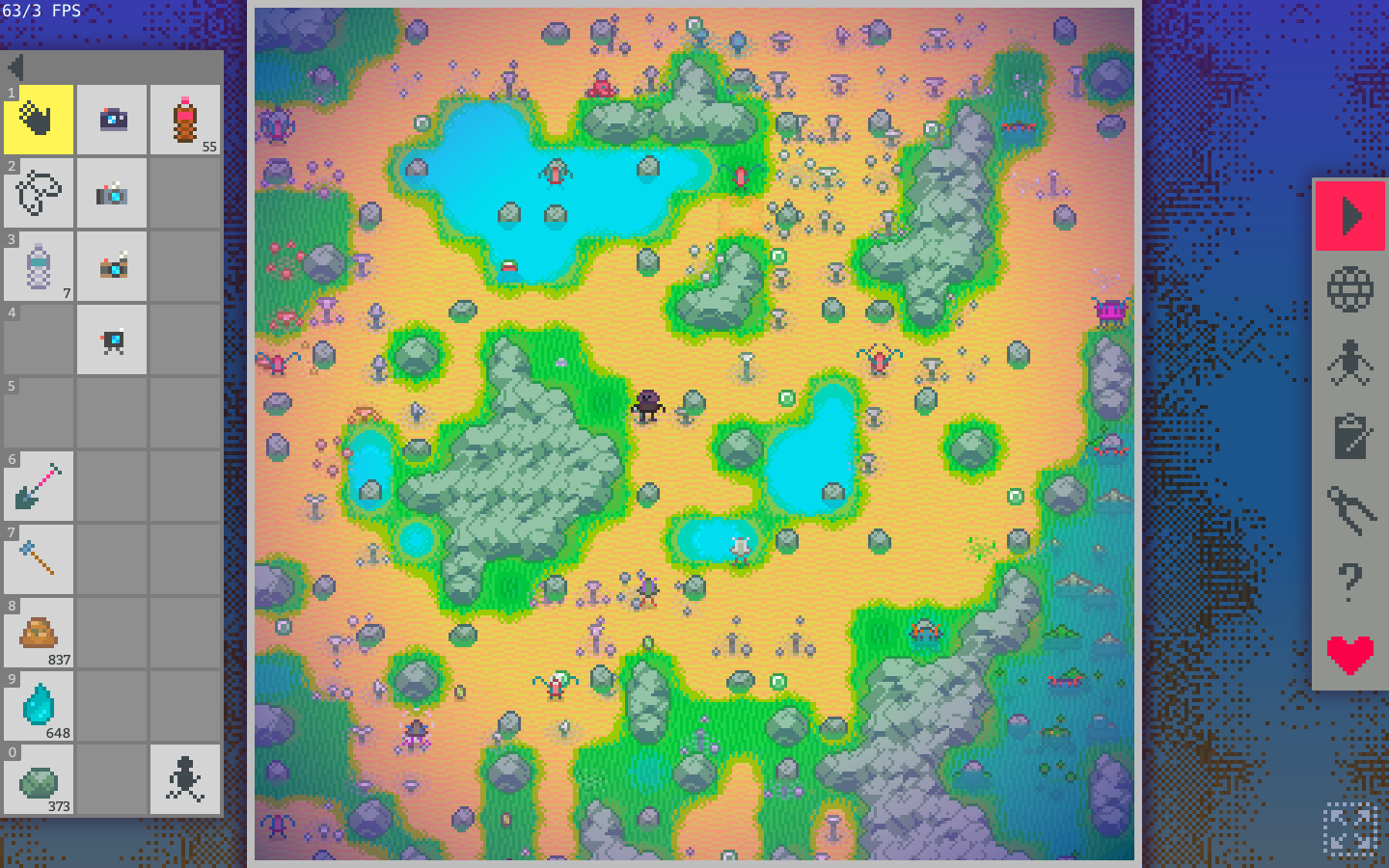
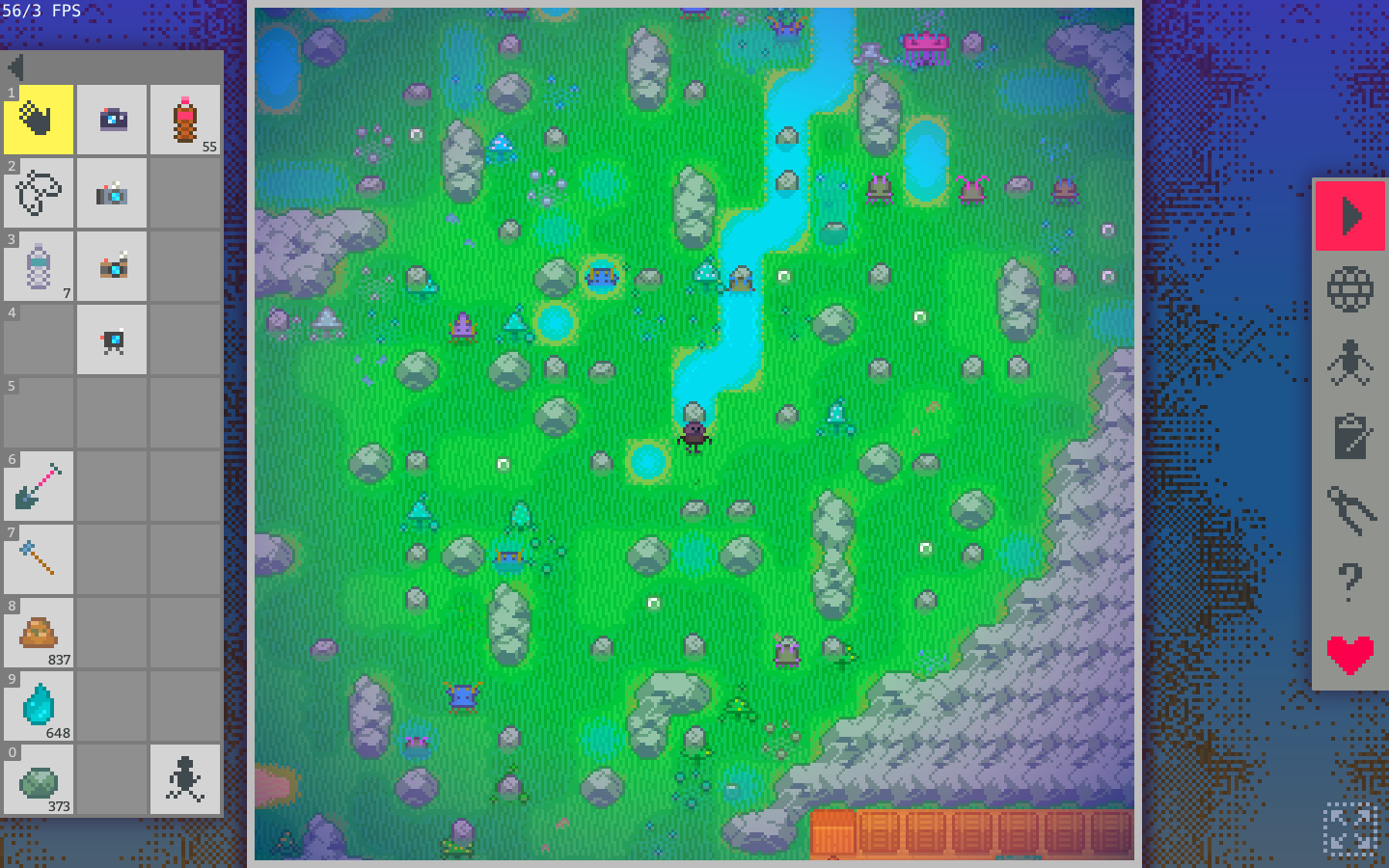
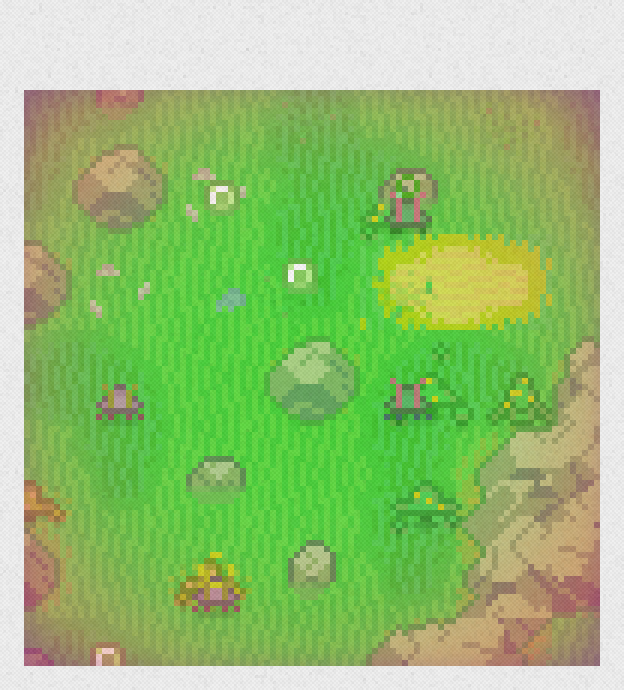
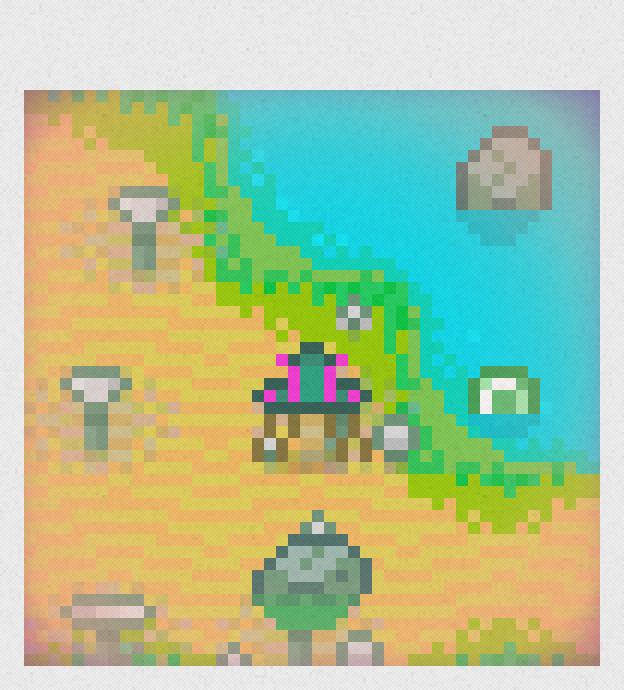
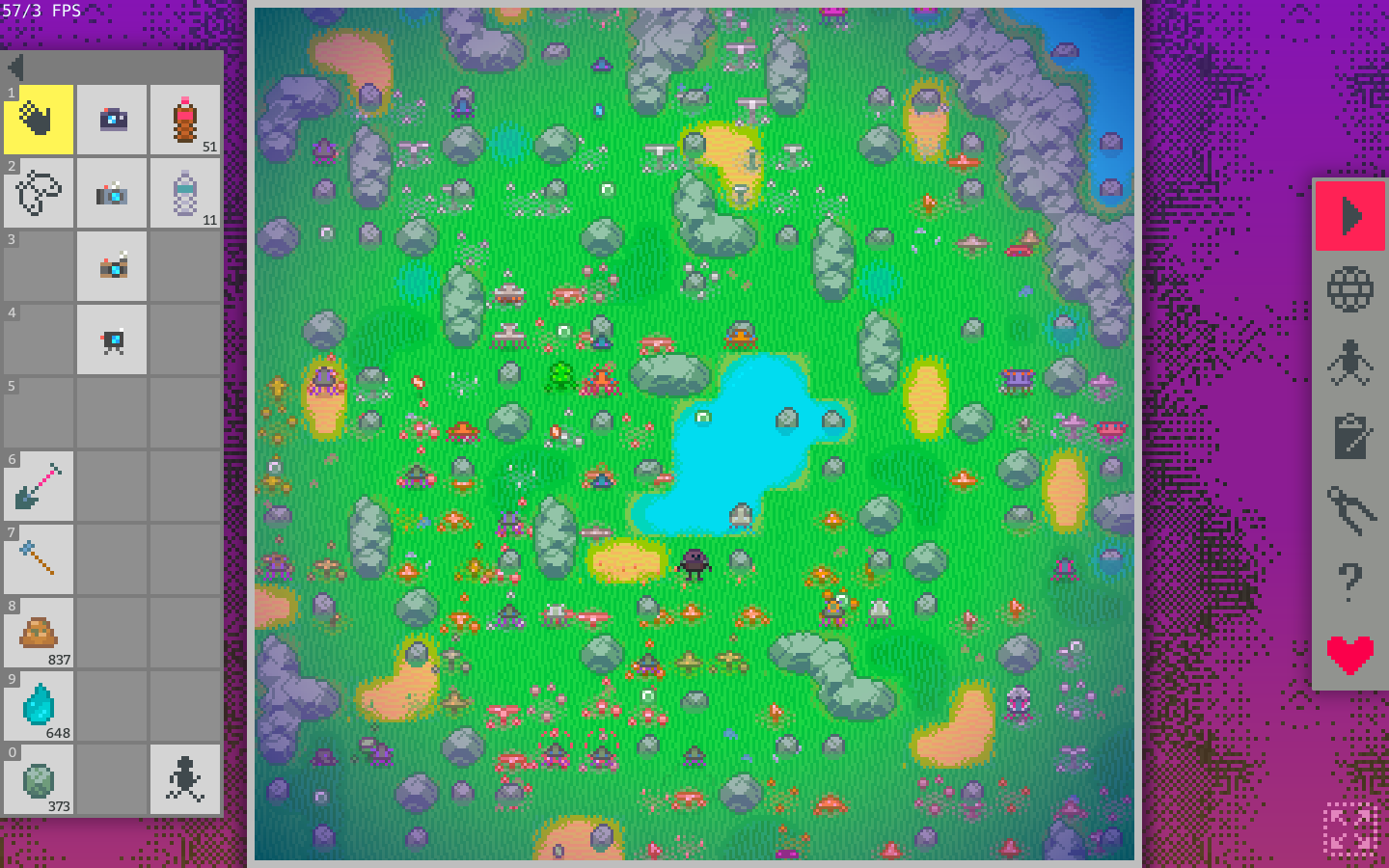
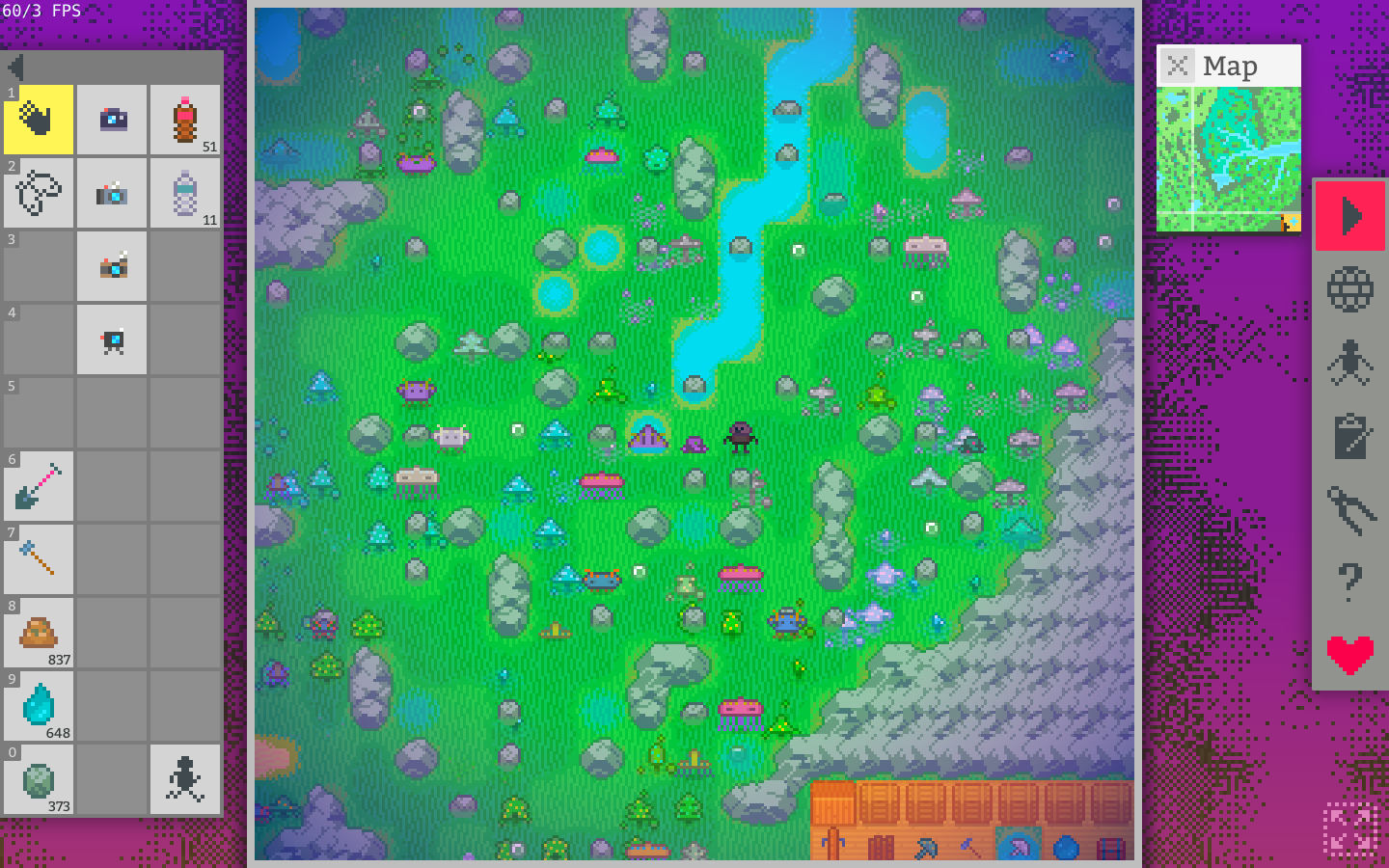
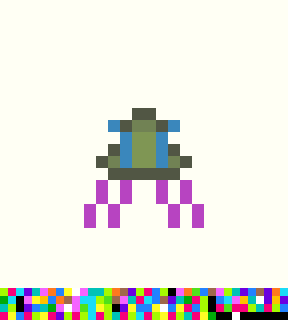
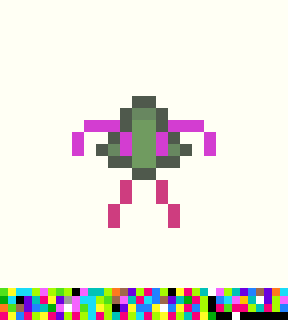
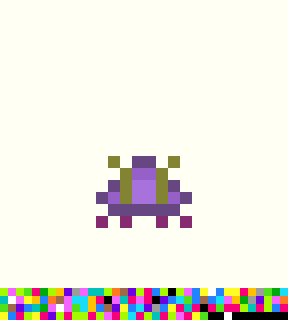
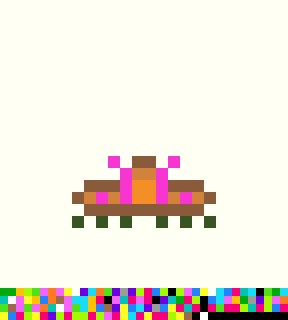
This is a project I worked on in 2022 instead of doing my IB EE. I’d played Vilmonic for about 5 years, but never took the time to really watch the evolution play out in realtime— this project gave me a reason to do so. I wanted to focus on the narrative/storytelling aspect, structuring it like evolution documentaries and videos by the likes of Moth Light Media— while still giving a good picture of the genuine evolution and population dynamics at play.
The writing has aged, but I still find the piece quite enjoyable to read. I really was blown away at how much depth and drama can come out of a simulation like this if you just take the time to look closely.
By Gabriel Broussard Korr,
c. 2022
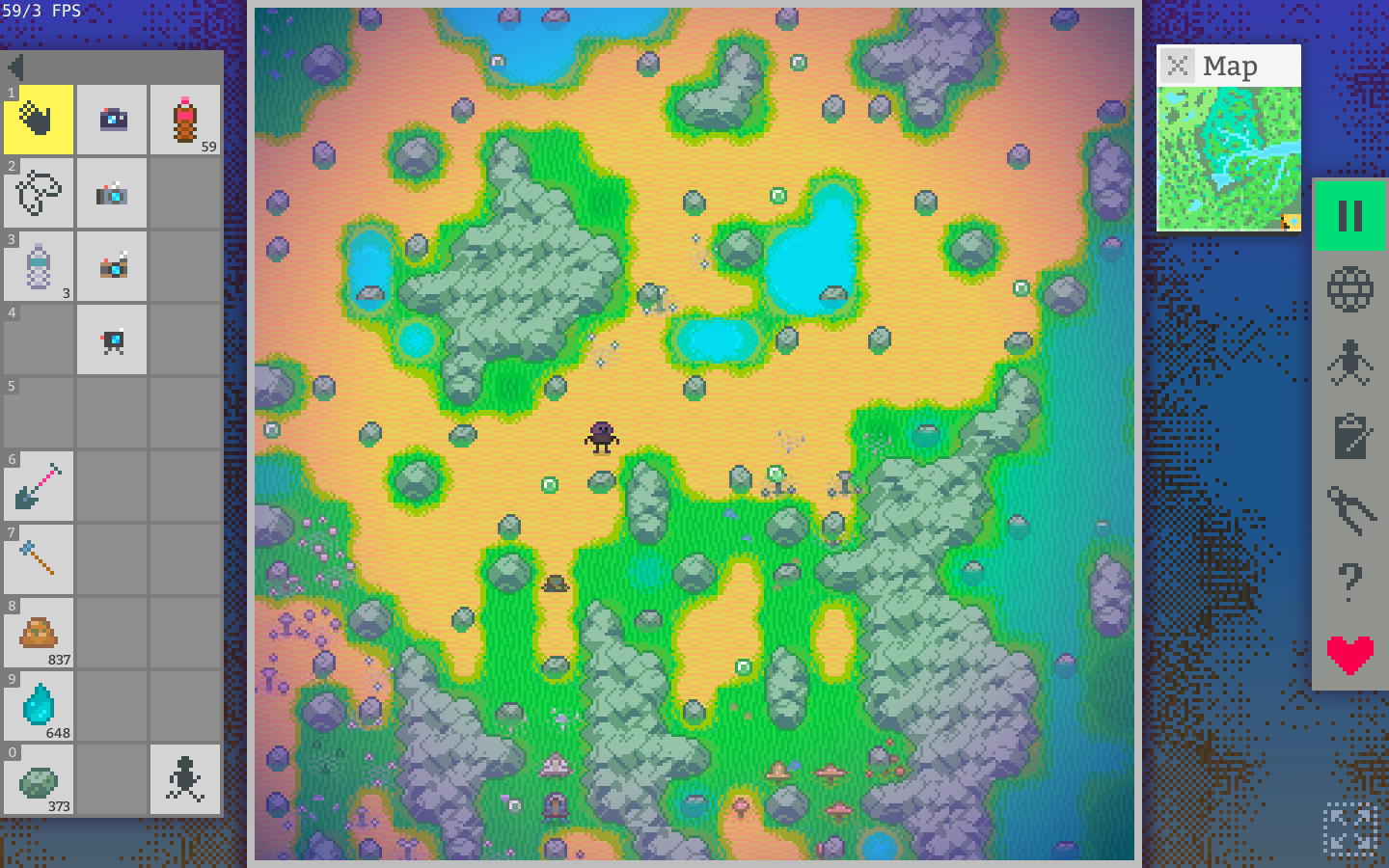
Vilmonic is a ”whimsical” game and evolution simulator created by Bludgeonsoft over the mid-2010s. The game focuses on the player, who is a human-like creature sent by the “vilmonicouncil” to repopulate a desolate, apocalyptic world with life. The player is supposed to facilitate the spread of plant-like fungols (‘fungs’ for short) and animal-like animatroids (‘anims’ for short) while avoiding the aggressive zombatroids, the corrupted remains of those that previously inhabited the world. There are two main themes in the game: cleaning and returning life to a wasteland (picking up trash, removing rubble, and letting fungs and anims repopulate), and observation (figuring out the systems that determine how fungs and anims work and behave). The latter is where I believe the true depth in the game comes from, as every system is predictable and understandable, and it’s very fun to gradually learn and understand.
Like with most games, though, I like to play it a little differently from what’s intended. Years ago, I created a completely empty 50x50 map with all the zombatroids trapped. I really like looking at how animatroids evolve in different environments, so I usually terraform a copy of this world and then watch how anims evolve in it. In this documentary, I’ve terraformed a world and documented exactly this process. Before I narrate what happened in the world, I’ll first explain the mechanics of Vilmonic.
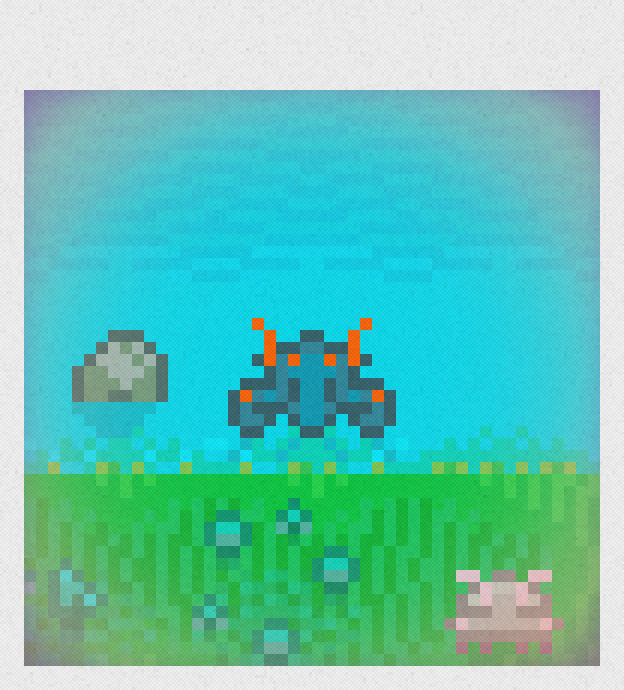
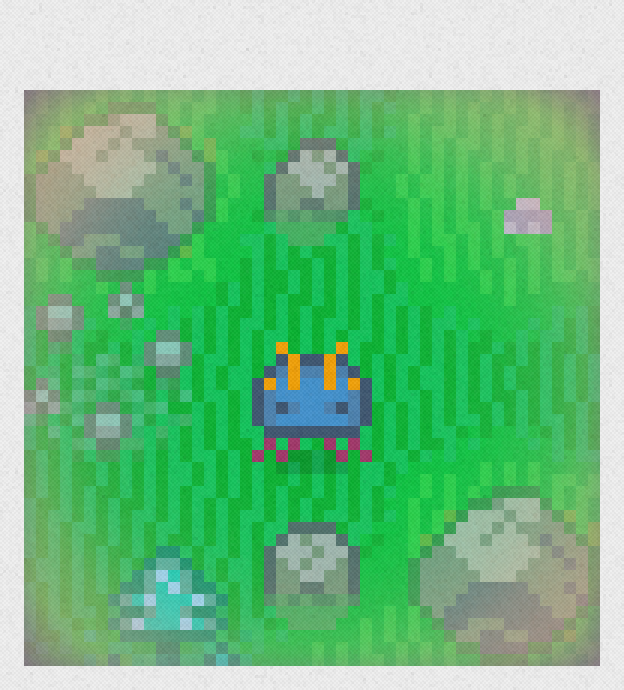
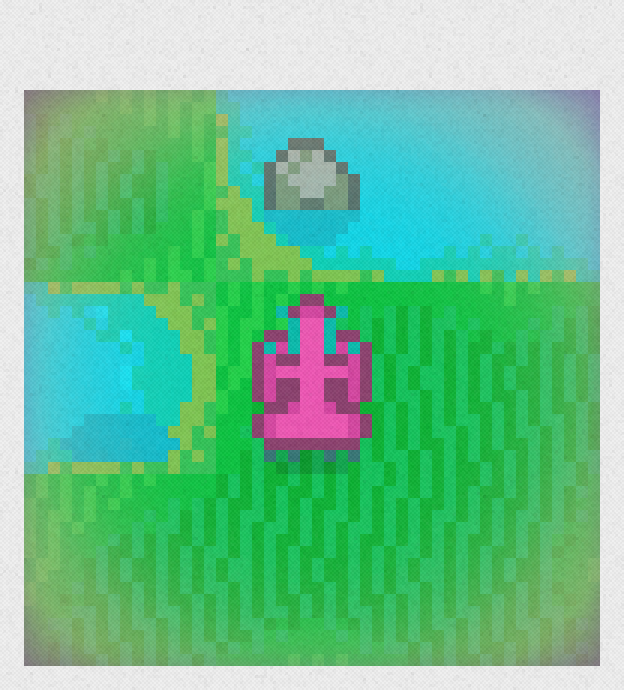
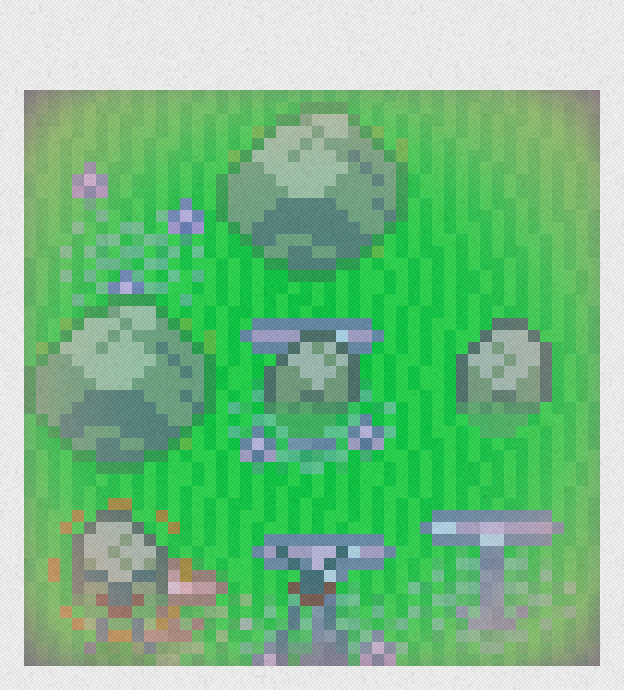
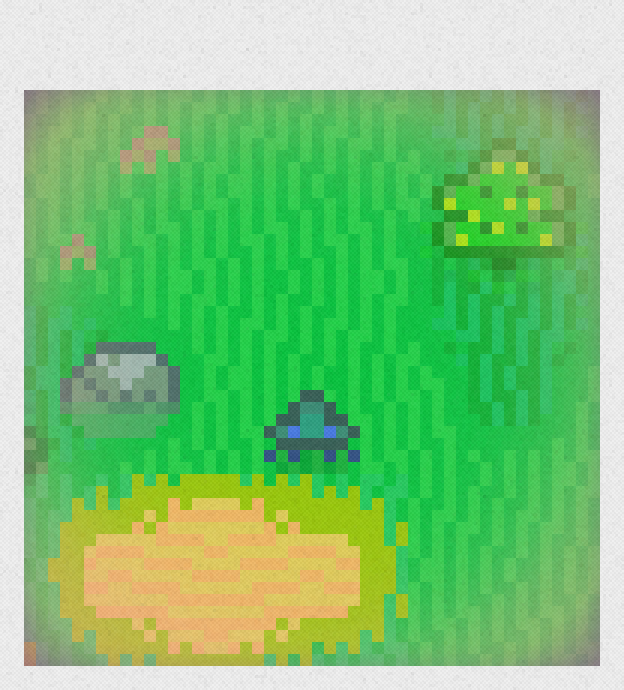
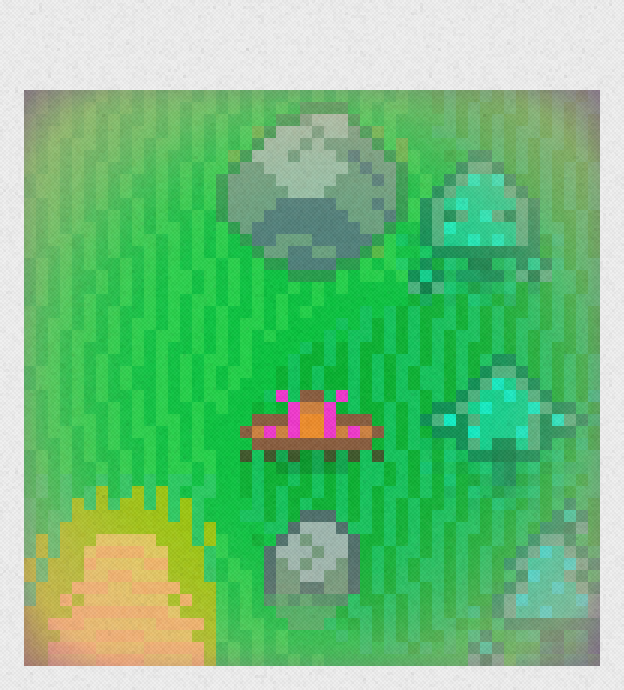
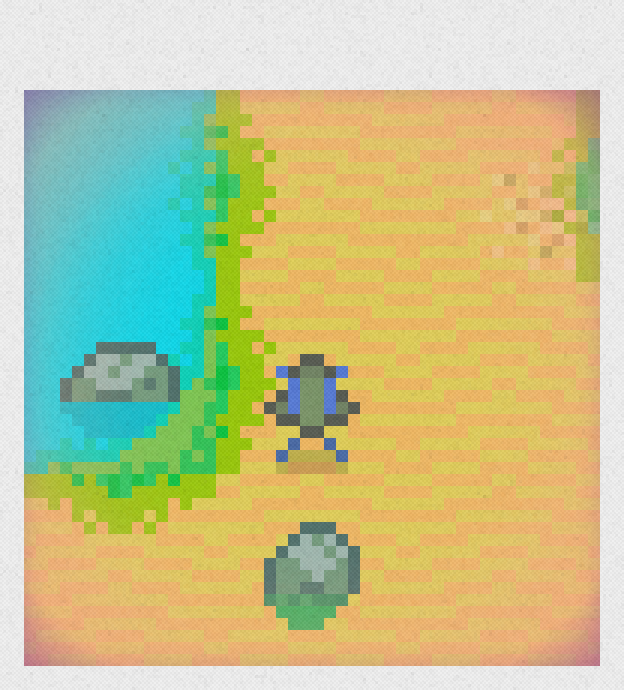
Vilmonic is tile-based and discrete, so everything is confined to a grid. Only one plant and one anim can occupy a tile at any given time, and anims can move orthogonally. Terrain is composed of various distinct tiles. The main ground tiles differ in “wetness”, which affects fungs’ and anims’ abilities to live on them. The four ground tiles are: “tundra” or “desert”, which is very dry; “dry”, which is sort of the basic tile; “wet”, which is wetter than dry; and “marsh”, which is much wetter and can be drunk from. Then, there’s two other relevant tiles: water, which is (obviously) very wet and on which fungs cannot grow, and rocks, which can’t be occupied by anims or fungs, purely blocking movement.
Desert Dry Wet Marsh Water Rock
Vilmonic has two key organisms that make up its environments: Fungols and Animatroids.
Fungols, or fungs for short, are the autotrophs of the system— stationary, plant-like organisms that grow and reproduce. They have certain traits that affect how well they’ll grow in a given environment, but I’m not going to focus on that in the documentary. For now, what’s important is that fungs will generally evolve to be able to live in an arbitrary environment after a bit, allowing them to eventually spread throughout a map.
The second organism, Animatroids, contain the real depth of the game. They have fifteen genes controlled by a number of pixels called their DNA that can, like in the real world, mutate occasionally when a new specimen is born. Unlike the real world, the rate of mutation in Vilmonic is quite high; even halving it like I have with mods still results in most offspring having some sort of mutation (albeit usually neutral), which makes genetic drift particularly relevant along with the small populations sizes in my worlds of only 50x50 tiles. Six of the fifteen genes are used for the anim’s physiology, while the other nine are used for its brain, which I’ll explain later. It’s not important to know these six specifically for the documentary, but they do control features that are important.
Three of these control the bending of the anims’ three bones, which determine its body shape in a very simple way. All anims fit within 16x16 pixels, and have bilateral symmetry; thus, the bones are mirrored on both sides. The bones can overlap. An anim’s body is procedurally built around the bones: “flesh” is placed on pixels occupied by bones, while “skin” is placed on adjacent pixels. The amount of flesh on an anim determines how much stress it can take before dying (consider the vitality of an elephant that’s hungry or wounded versus a mouse), and the ratio of skin to flesh determines how fast the anim loses water. This last bit is probably the most relevant piece of the anim’s physiology, since it makes or breaks its ability to survive in an environment. Smaller anims that don’t lose water fast will drown in wetter environments, while wrinkly anims with lots of skin will quickly die of thirst in dry ones if they can’t find water to drink from.
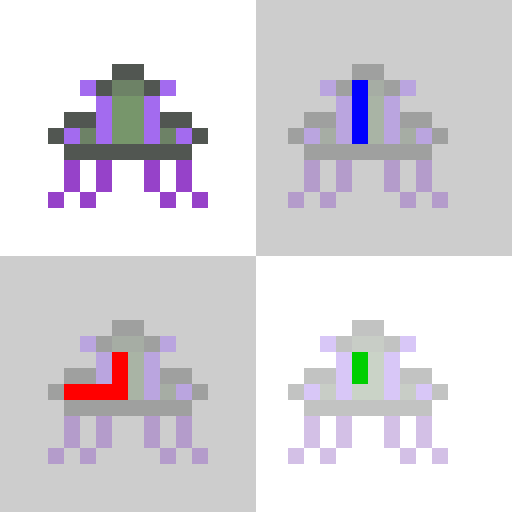
Tecoi Dehaibus’s three bones, illustrated by the binocular card’s overlapping-bones view and a manually traced representation of the bones.
The other three control other aspects of the anim: one controls the legs of the anim’s legs, which has an effect I’ve never found relevant (letting it move faster from tile to tile; problem is, anims already pause every time they move to a new tile, so this ability barely helps). Another controls the length of the anim’s antennae, which determines how far it can sense stimuli— its “sensory perception radius”. This usually ranges from two to five tiles, and the difference is very noticeable. This has various relevant ecological effects which will be noted, and it increases the amount of food the anim needs to live (discouraging it in environments where it isn’t needed). The last gene is another important one: it controls the anim’s metabolism. Anims only think/perform actions in certain intervals, determined by their metabolism. All anims die after a set number (currently unknown) of these updates, so anims with lower metabolism can live significantly longer. I once used artificial selection to achieve an anim that lived a whole hour, but most anims live less than ten minutes. Metabolism is especially important because it can let the anim go longer without food; it only gets hungrier or gains/loses water on an update. An anim with higher metabolism will have to eat constantly, while one with lower metabolism can eat significantly less frequently.
The anim lifecycle mimics that of animals in real life. Anims have four key stats: hunger, thirst/overhydration, stress, and fertility. Hunger gradually decreases over time, and can be refilled if an anim eats the fung on the same tile as it. Thirst will either increase or decrease depending on the tile the anim’s on and its flesh/skin ratio; usually it gradually decreases, an anims will have to take a drink in a marsh or water tile to refill it. When the hunger or thirst bars are empty, or the anim has gained too much water (through having a low flesh/skin ratio and standing on a wet tile; drinking will never overfill the bar), its stress will go up; if the stress bar fills completely, the anim will die. The stress bar drains when neither the hunger nor the thirst bar are empty. The fertility bar also fills under these conditions, and drains when the stress bar is not empty. If the fertility bar fills completely, it will get emptied, the stress bar will increase by half, and the anim will lay an egg (which will hatch into a copy of the parent, but whose DNA might be slightly mutated; all anims reproduce asexually). There’s also a fifth stat, development, but all it does is track the anim’s lifespan (and can’t be affected by other things). When it fills completely, the anim dies.
The real special thing about anims, though, is their brain. The brains determine what actions the anims take, and can make the difference between an anim that can’t survive in a perfect environment and one that can tough it out even in a very difficult one. (When thirsty, hungry, or stressed) An anim senses three stimuli from tiles within its sensory radius, and then interprets that through its brain to decide which direction to move. If the anim lands or is on a tile with a fung, egg, or corpse and is hungry, it will eat the fung or egg (the fung takes precedence, but eggs still get eaten often, which can actually be an issue for some populations). Same with drinking if the anim is thirsty. If an anim wants to move in a direction, but the tile in that direction is occupied by another anim, it will attack that anim, increasing its stress. If the attack kills the anim, it will then move into the tile occupied by the dead anim, and thus will eat it if hungry. This is what allows carnivores to work.
The anim’s brain synthesizes two sets of factors in a simple, understandable way. It checks each cardinal direction and assigns a value to it that could be positive or negative, and then moves in the direction with the highest value (or chooses randomly between the highest in the event of a tie). For each direction, it combines the three stimuli with the anim’s stats. The three stimuli are scent, which is produced by fungs (a tile with a fung on it that’s in an anim’s sensory radius will be perceived as scent by the anim); water, from water tiles; and motion, from other anims and eggs. Each of the nine combinations of stimuli and stats is assigned a value based on the anim’s genes (the nine I mentioned), and this value is used for the value given to each direction.
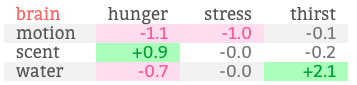
The progenitor’s brain as seen on the binocular card.
This chart, available for every anim, shows these relations. If, for example, this anim is hungry, not stressed, and not thirsty, then it will avoid motion and water and be attracted to fungs. If it then becomes thirsty, it will be very attracted to water, likely overpowering its other stimuli.
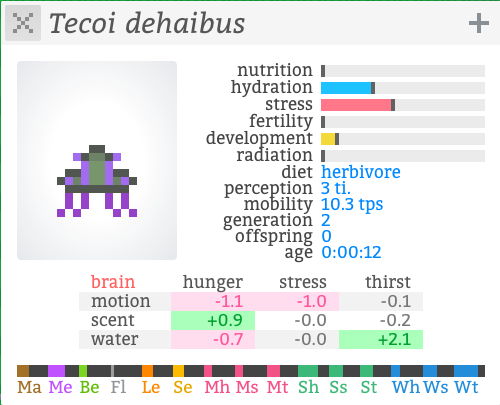
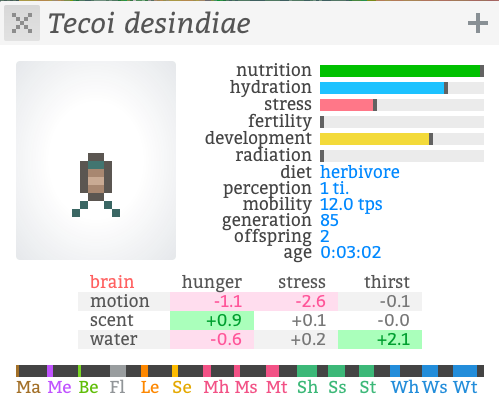
The binocular card for the progenitor.
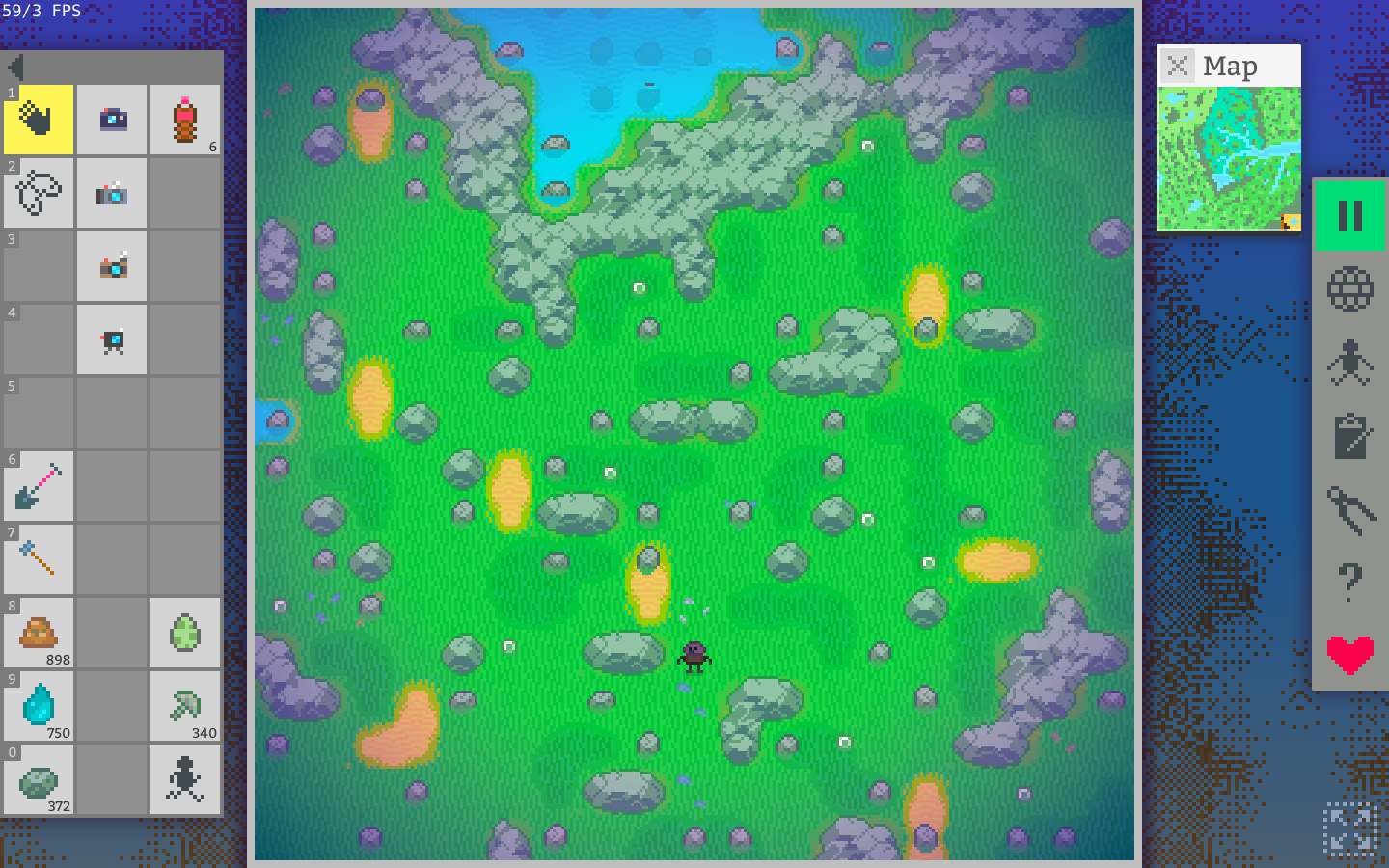
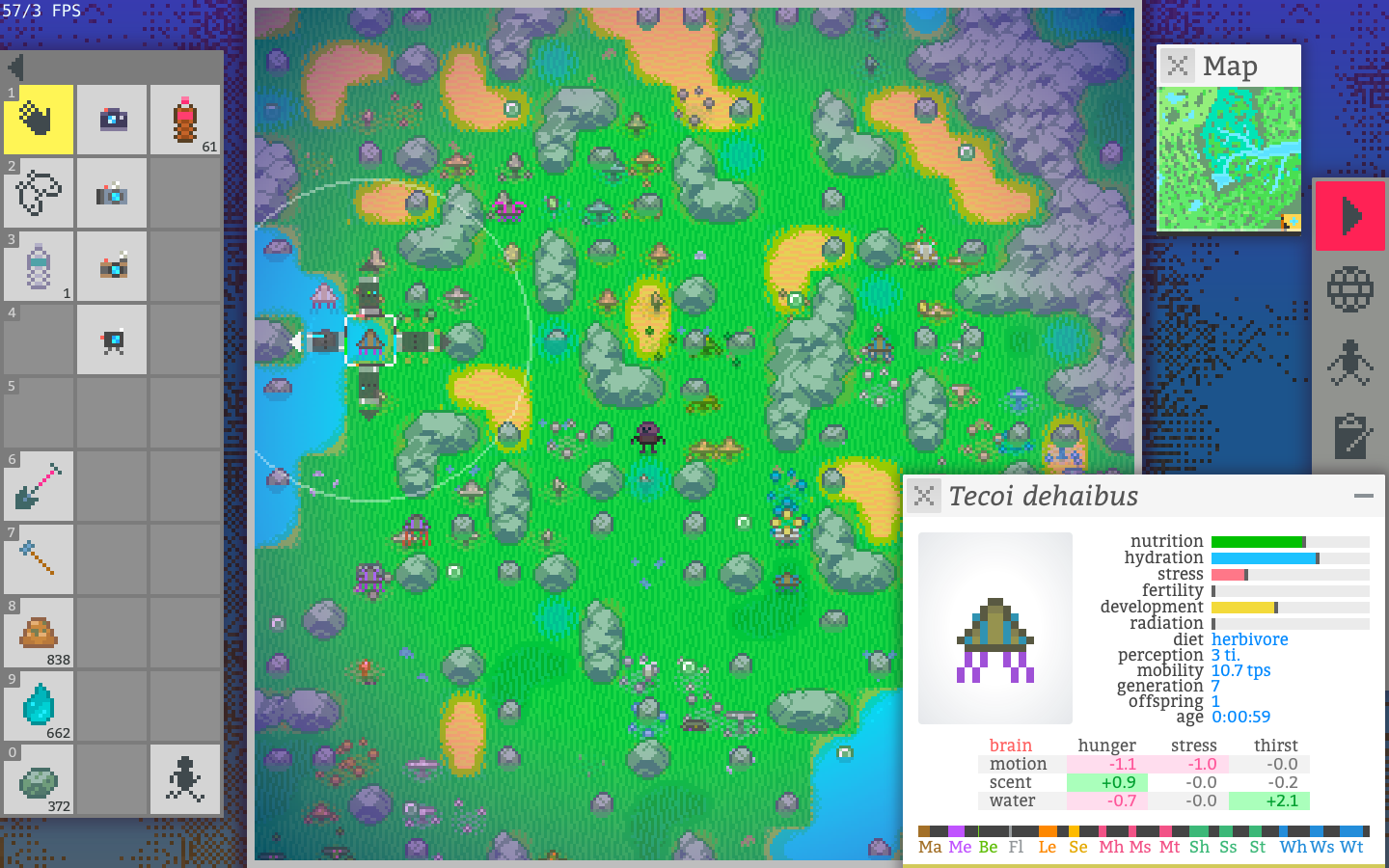
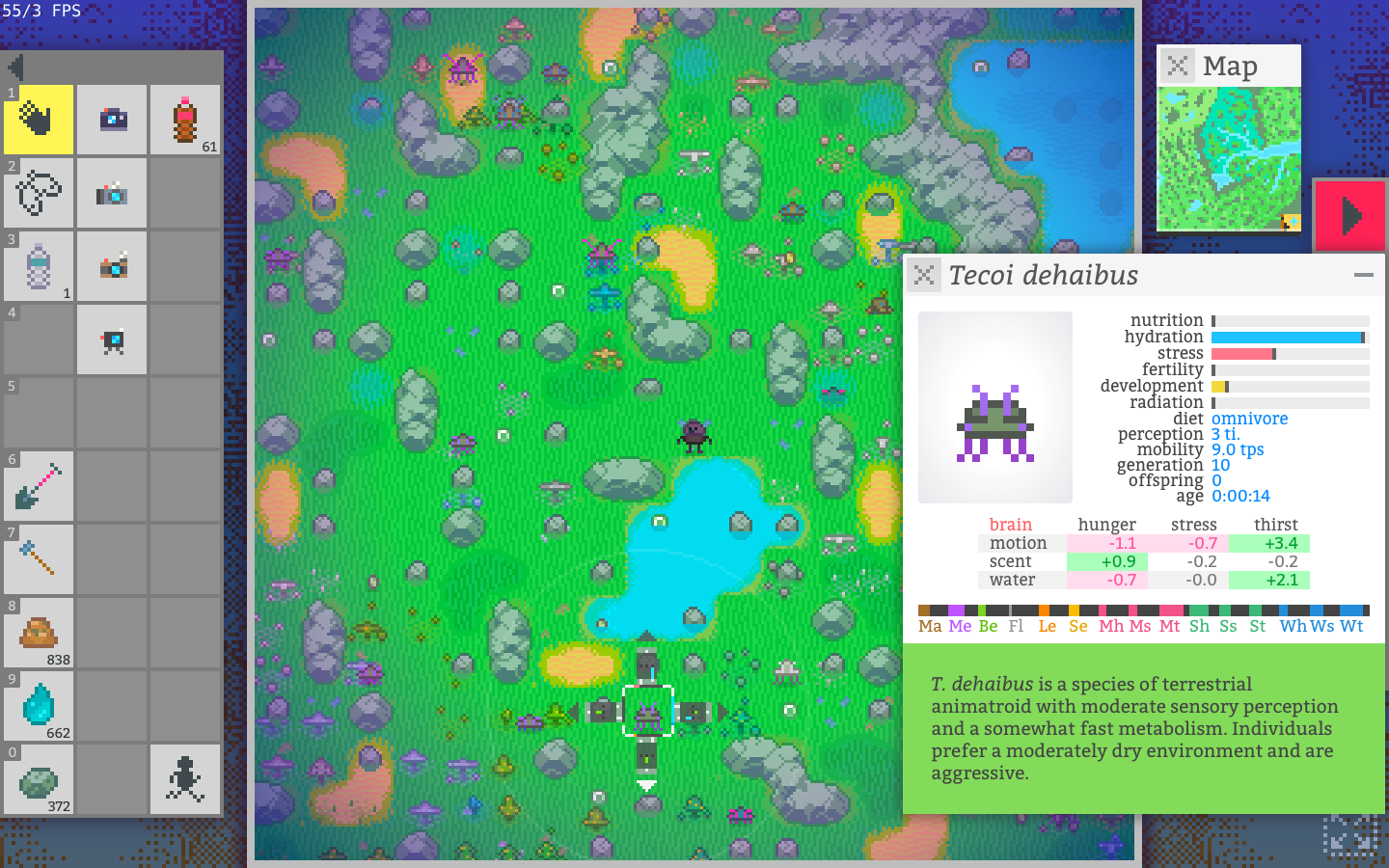
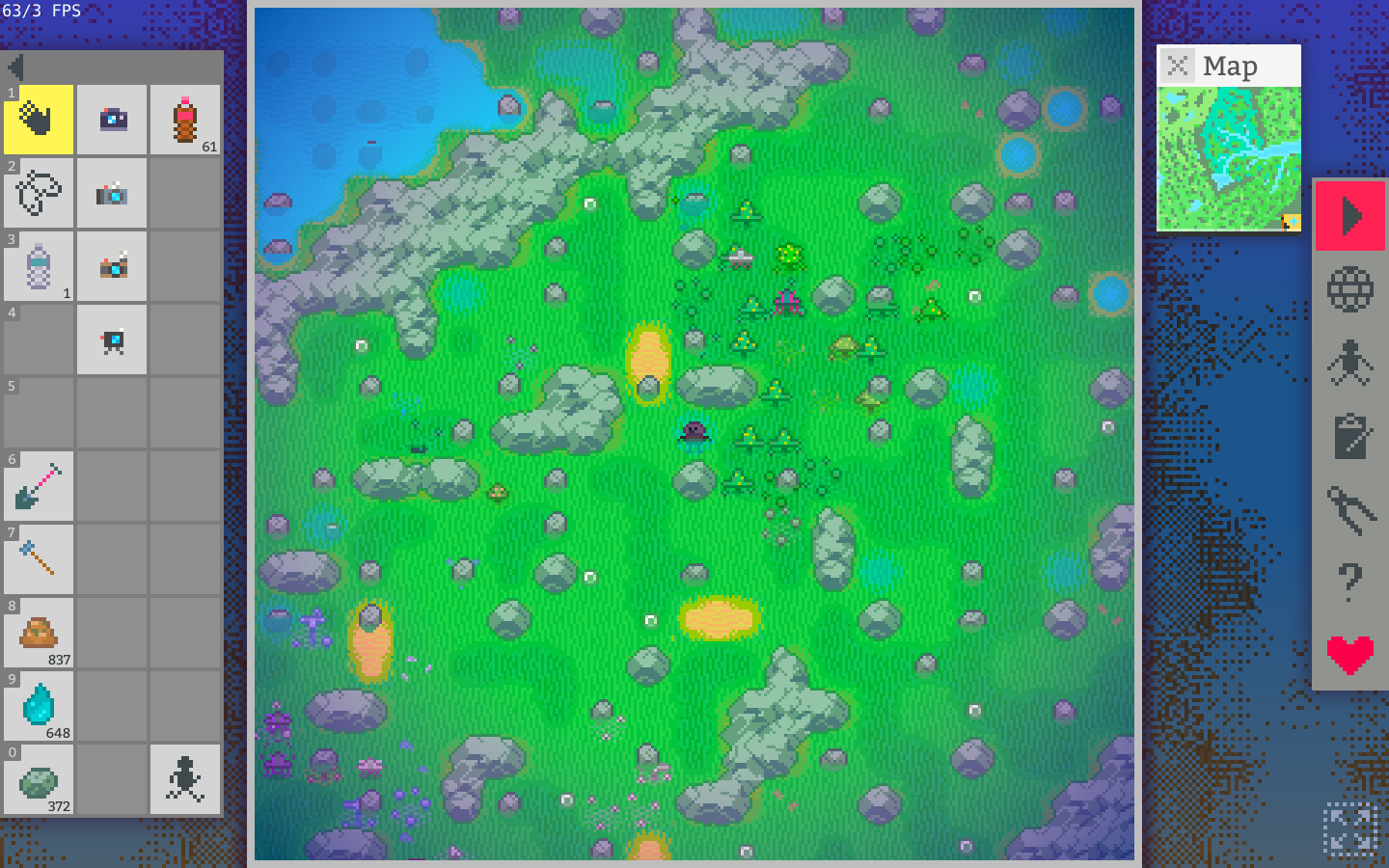
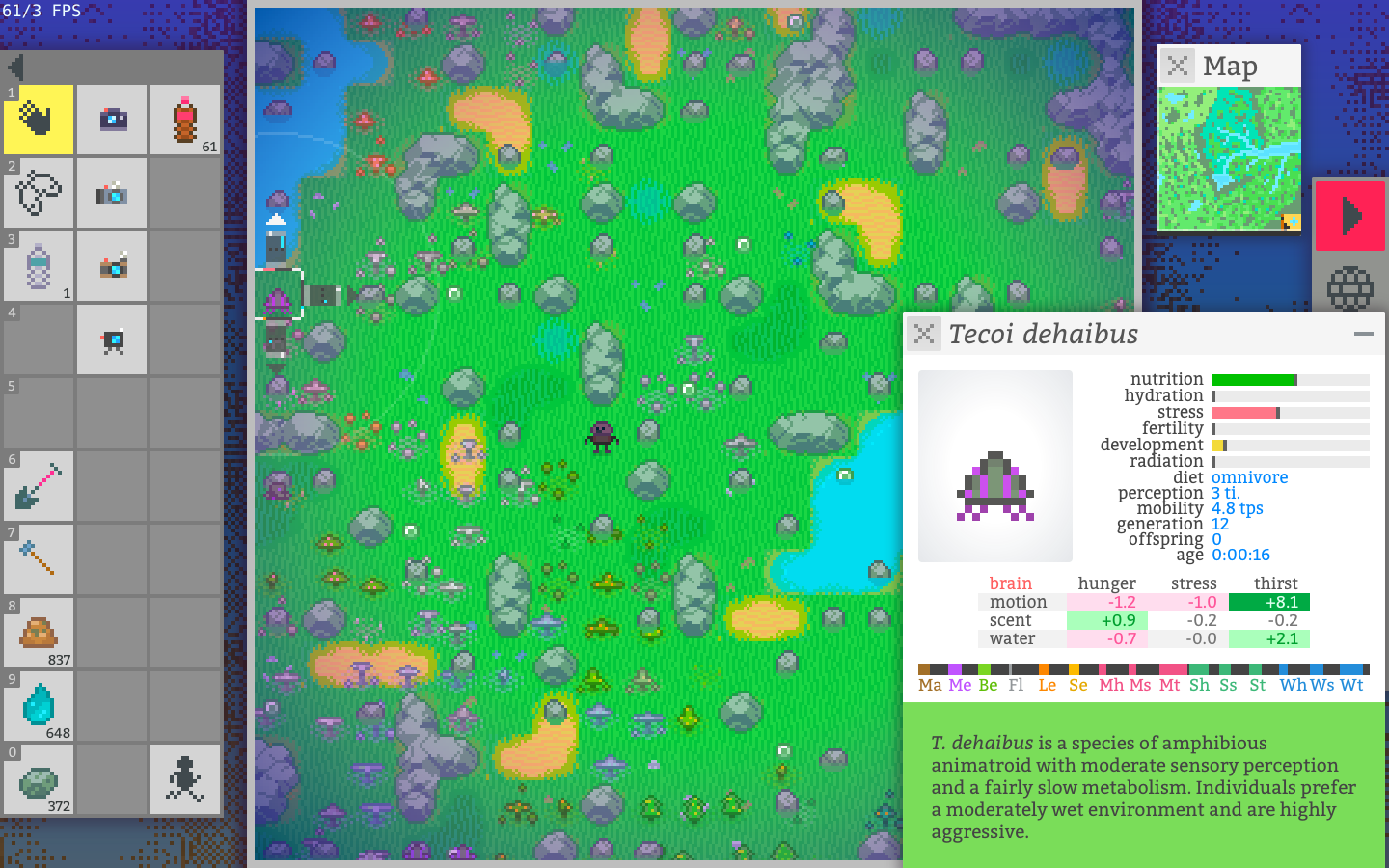
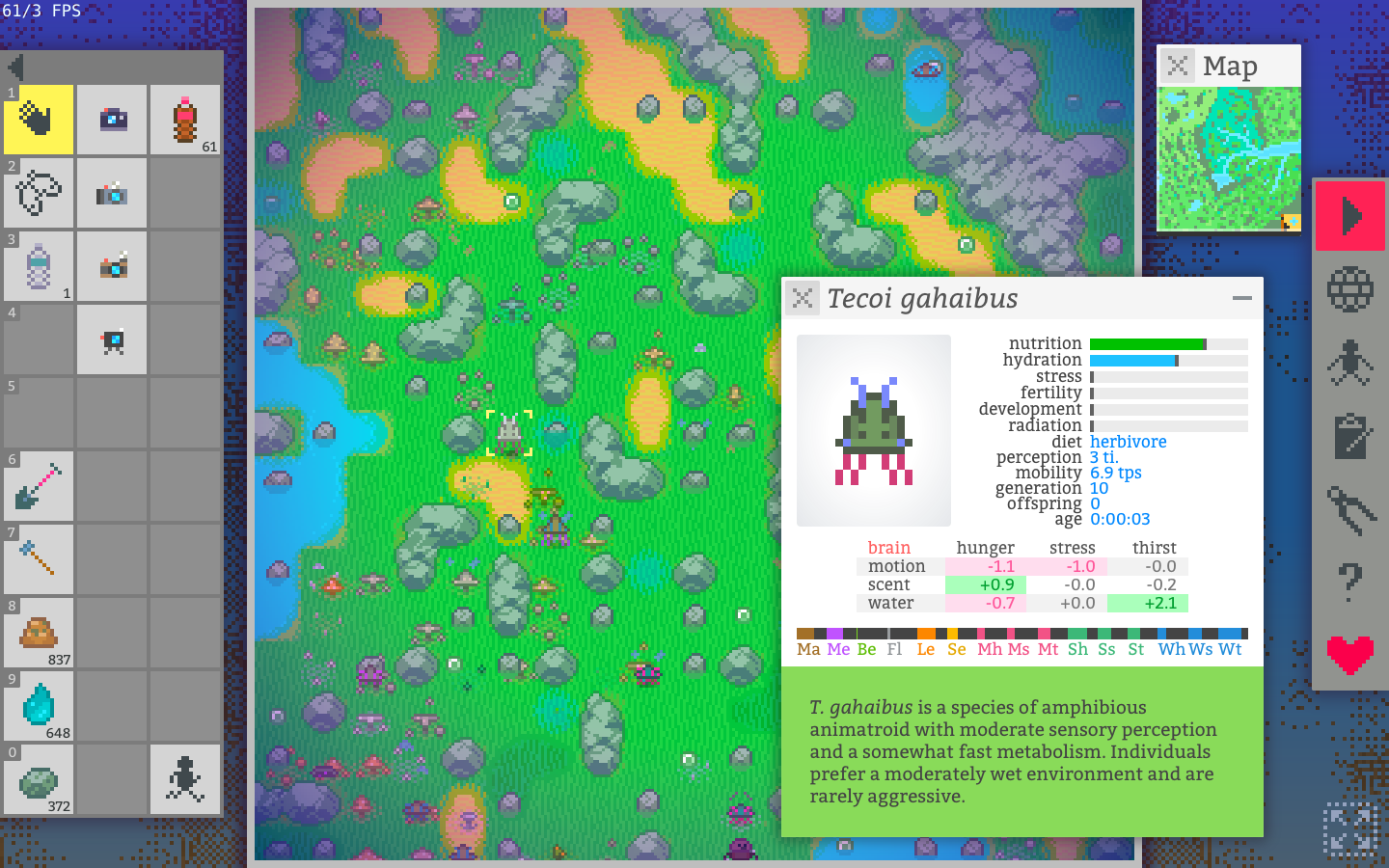
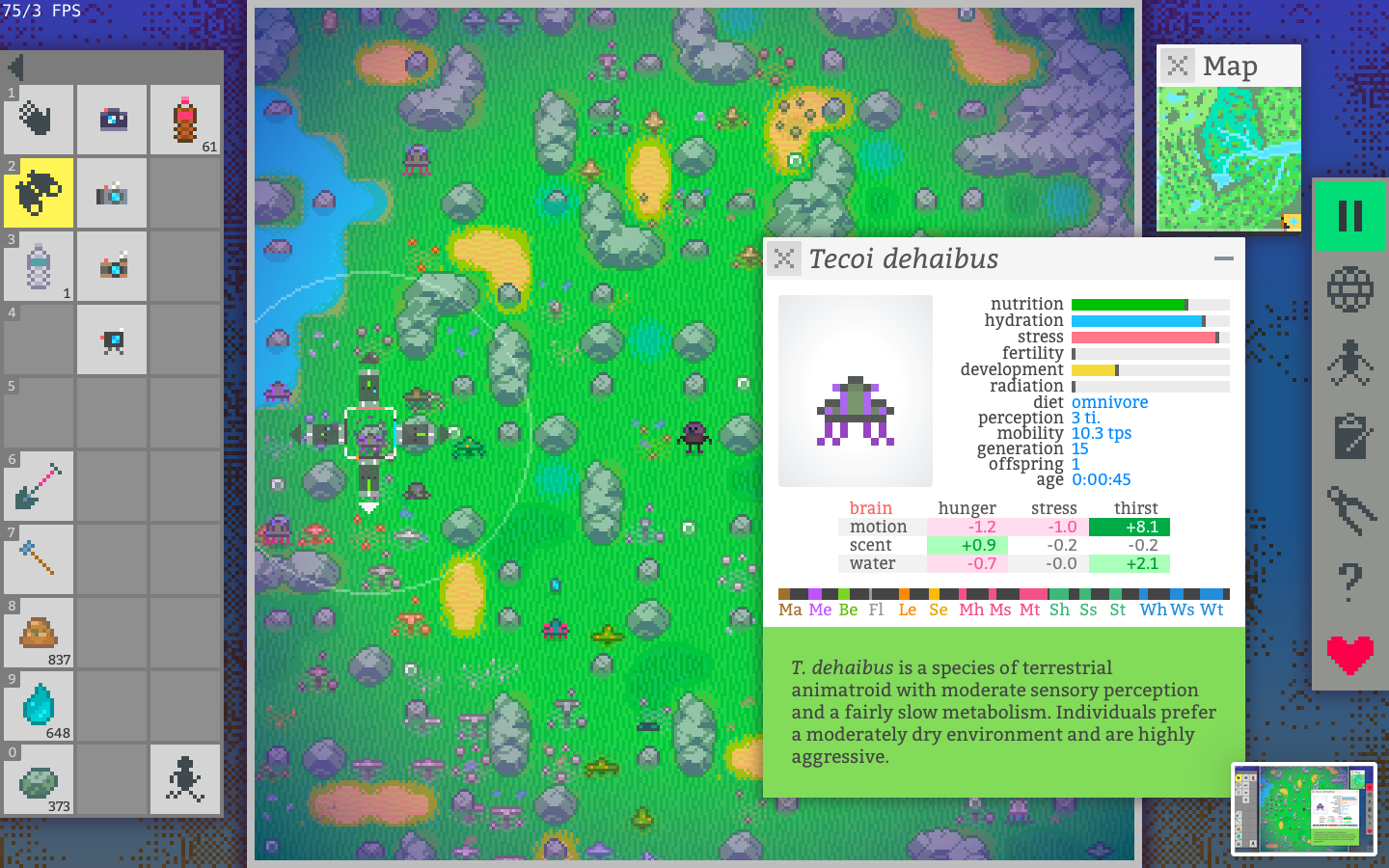
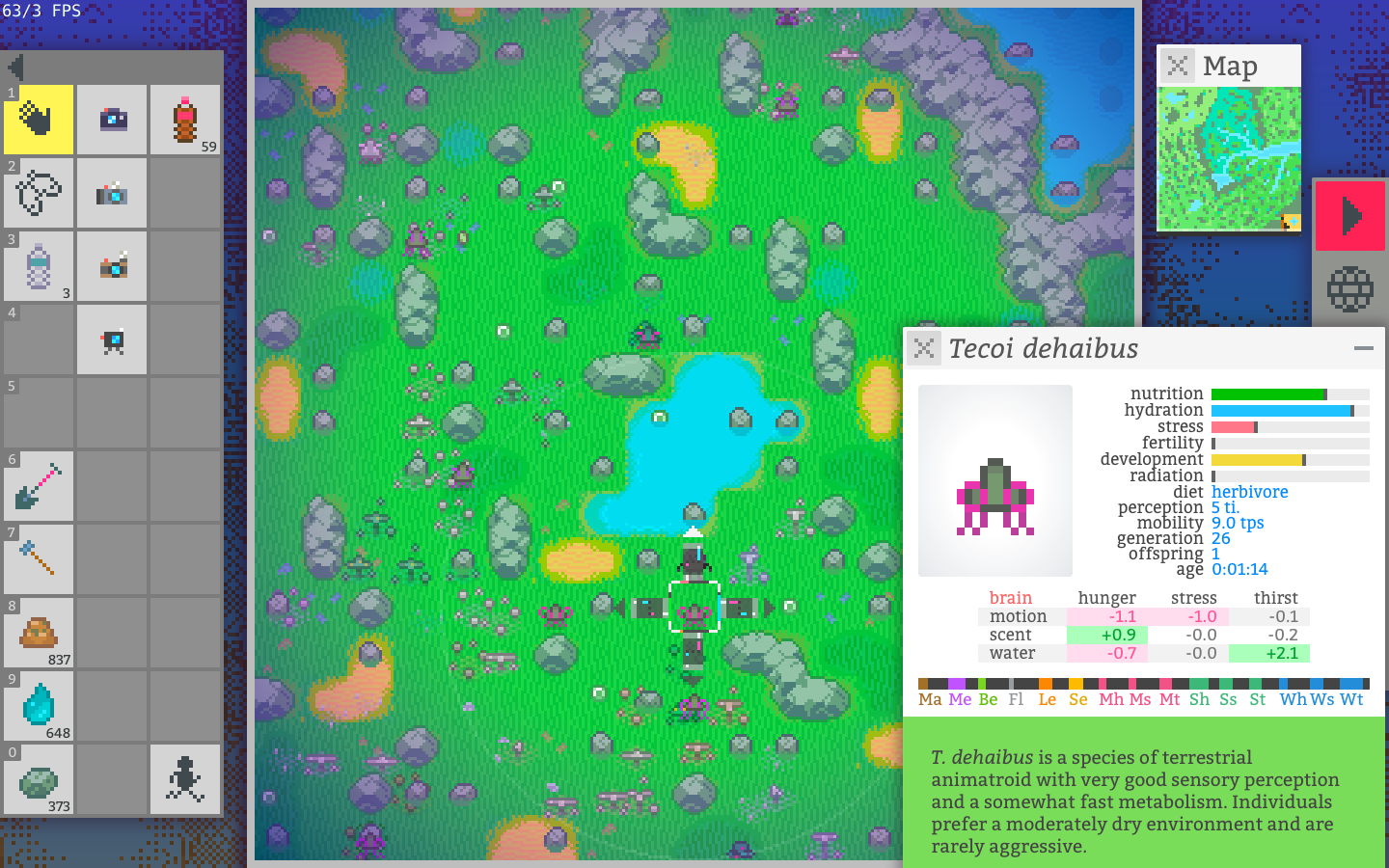
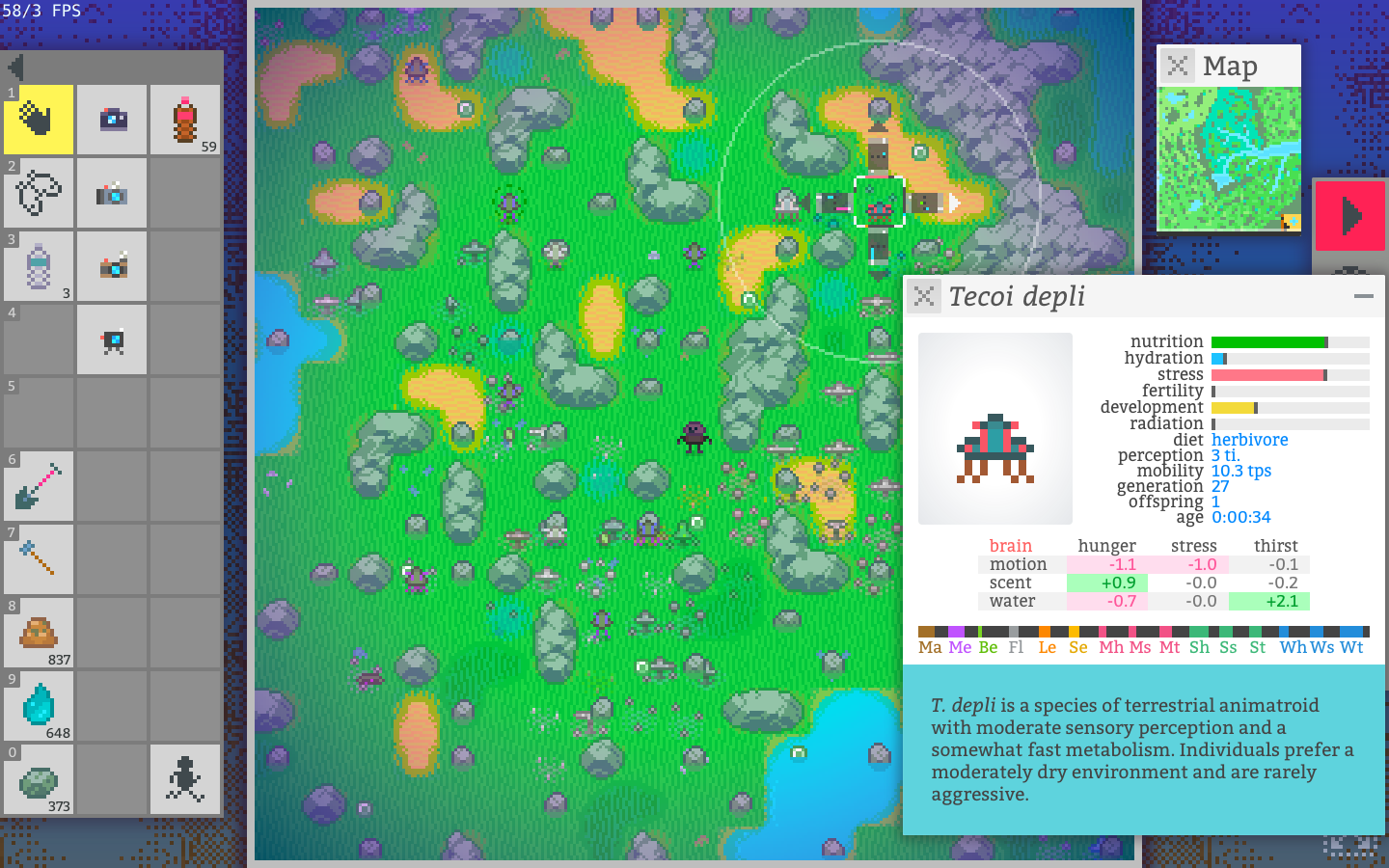
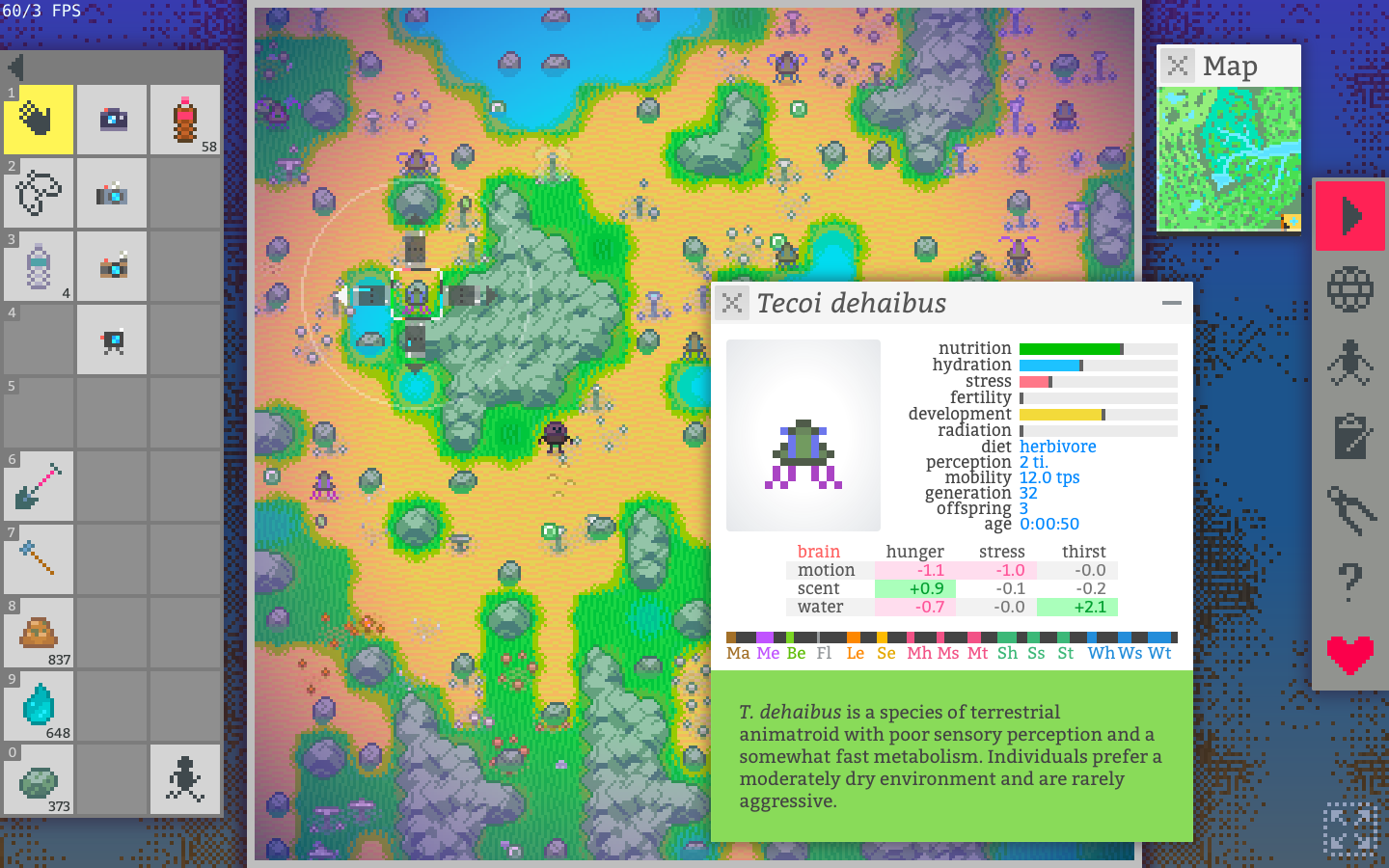
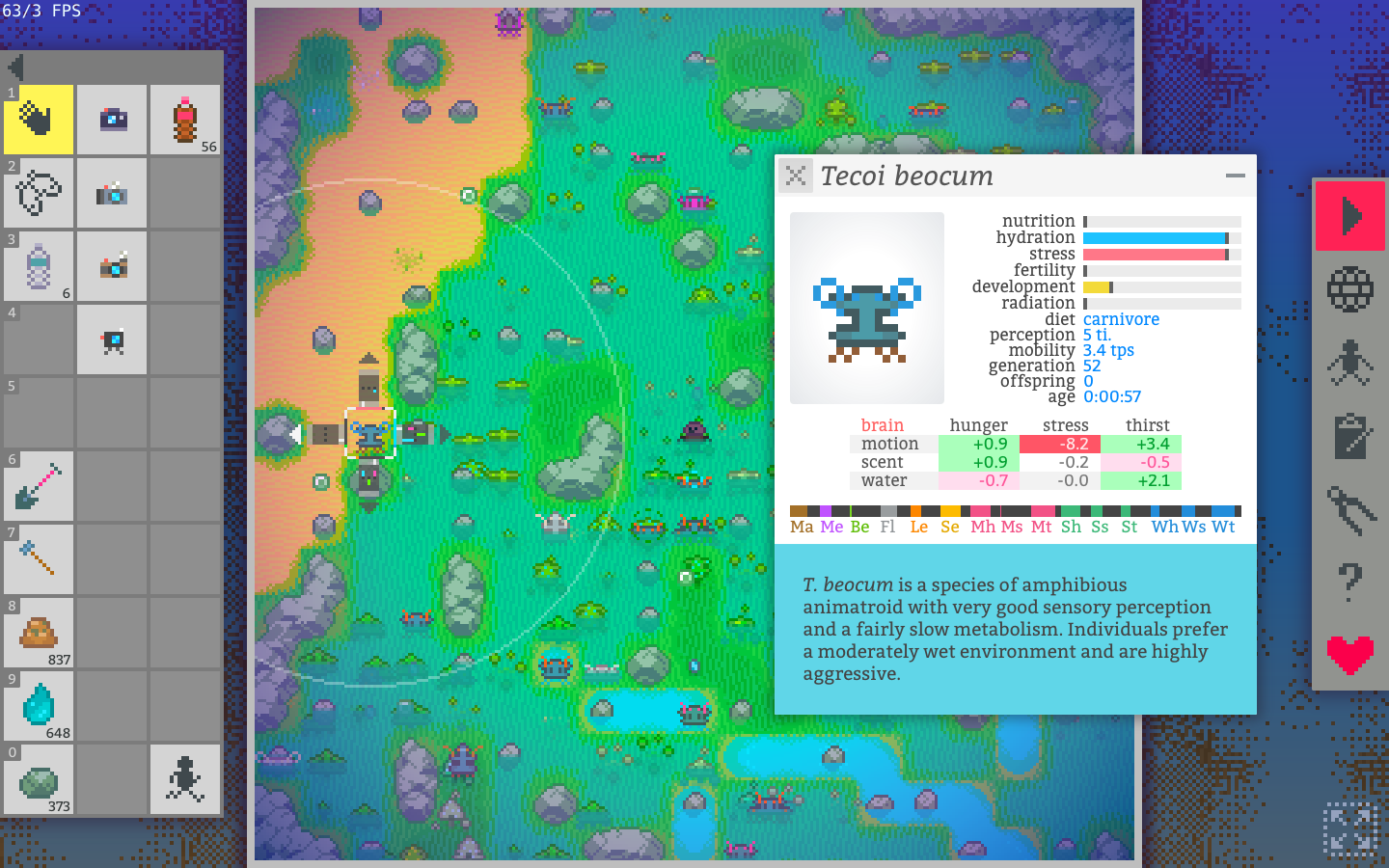
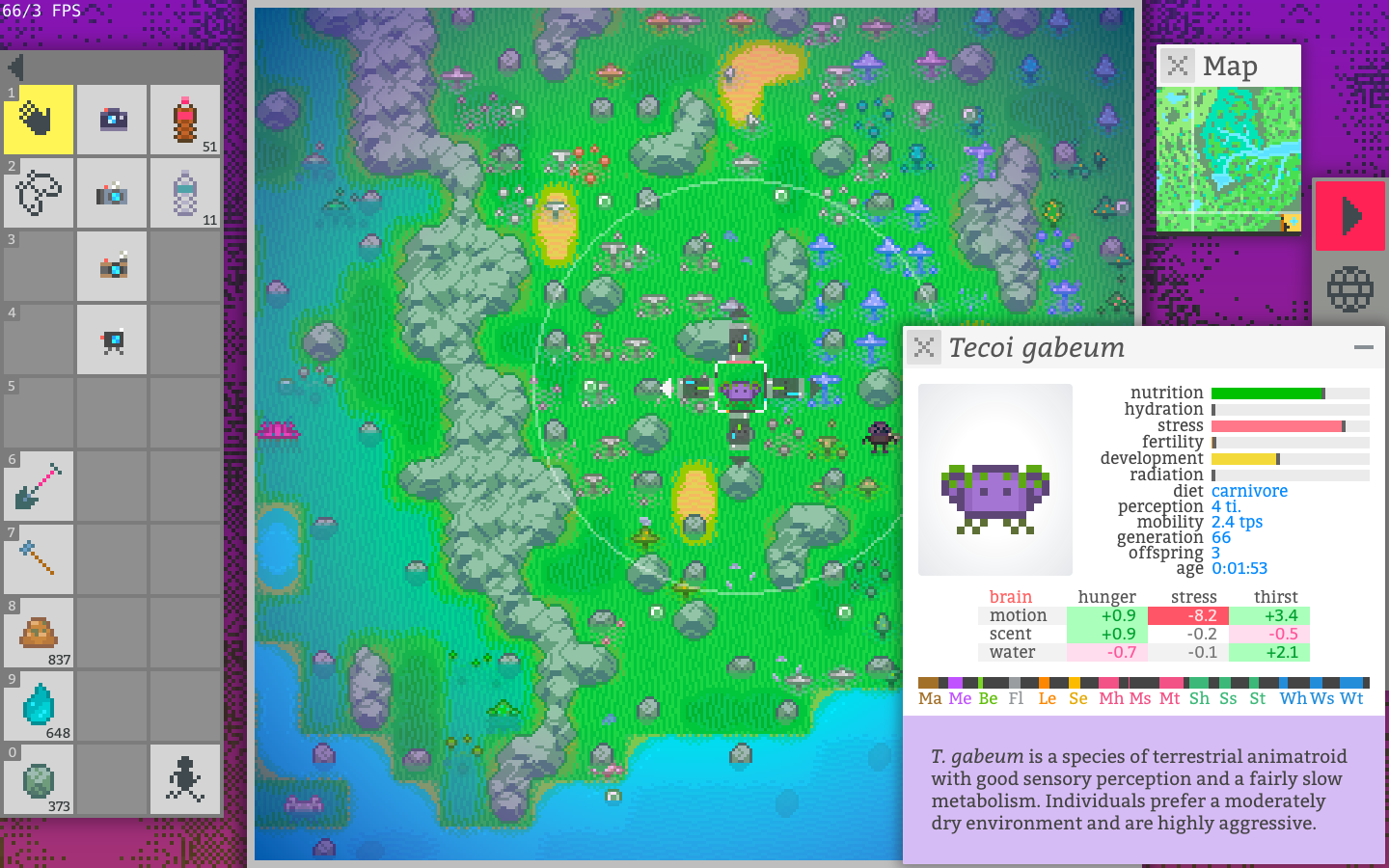
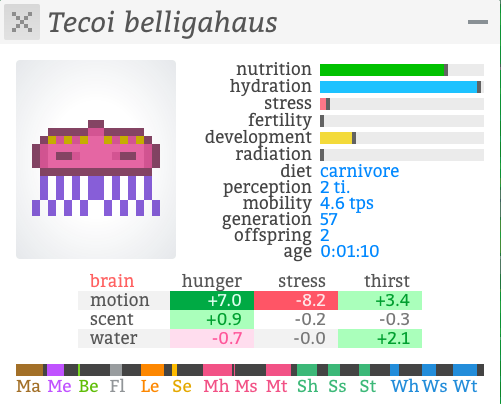
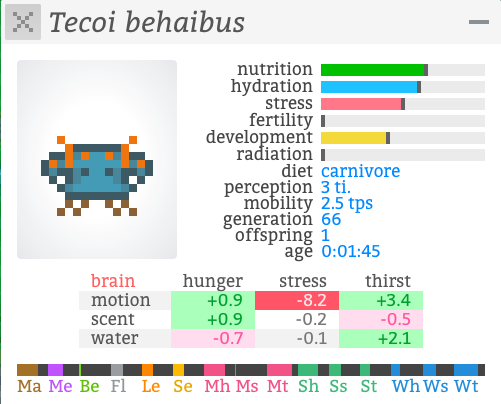
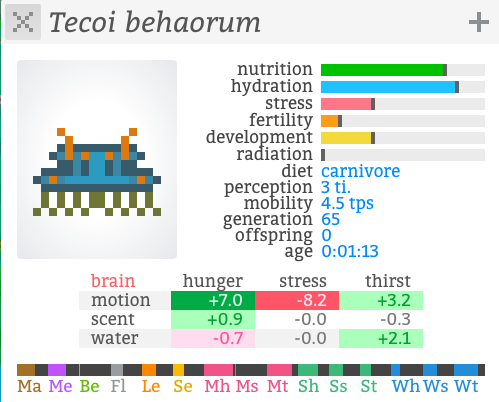
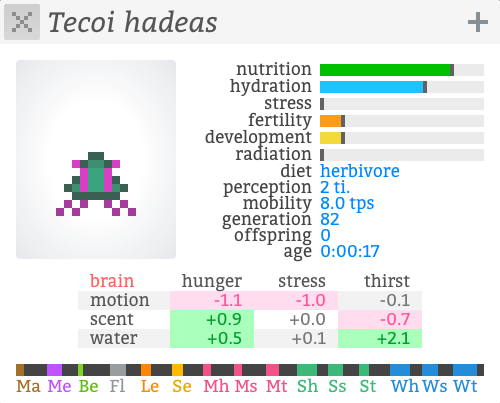
Arguably the most important item in the game is the Binoculars, which give you detailed information on any live anim you click on. Here you can see the aforementioned stats: nutrition (hunger), hydration (thirst), stress, fertility, and development (radiation is irrelevant on this map). “Diet” is a completely arbitrary distinction between herbivores, omnivores, and carnivores based on an anim’s attractions/repulsions to motion and scent, despite the fact that all anims will eat fungs, eggs, or corpses under the right conditions. Perception is the anim’s sensory perception. You might see this anim’s mobility and go “Wow! 10 tiles per second is really fast!”, but as I said earlier, this is almost entirely irrelevant due to anims only moving a single tile per metabolism tick. Generation is a nice way to see the relative age of a lineage, though other lineage-tracking tools are unfortunately lacking. Offspring is mildly interesting, counting the number of eggs this anim has laid in its lifetime. Age is very helpful, and can be used with the development bar to estimate the lifespan of an anim (for example, this anim looks like it very roughly lives to 1:30). Then, you can see the anim’s brain, and a slightly oddly-formatted readout of its genes (as adjacent bars). Hovering over a gene tells you its name— they are, from left to right, Masso (bone-related 1), Metabo (metabolism), Bendo (bone-related 2), Flexo (bone-related 3), Leggo (leg length), Senso (sensory perception), and then the brain genes, which consist of a prefix— Mo- for motion stimuli, Sce- for scent, and Wa- for water— and a suffix— -ho for hunger, -stro for stress, -tho for thirst. For example, Watho controls the attraction to water when thirsty (the bottom-right box in the brain), and Scestro controls attraction to scent when stressed (center box).
Vilmonic automatically considers an anim a new species if its DNA is different enough from the species of its parent. Vilmonic generates species names based on the most extreme genes of an anim, i.e. adding a root if the anim has a very high or low masso. This can cause names to get pretty long if the anim has a lot of extreme traits. If the naming system produces a name that is already taken, it adds -xus to the end.
Due to species being based on DNA distance, members of one species can sometimes be quite different and survive better in different environments. Thus, I (rather than the game, as with species) denote and name subspecies based on when I find it useful, especially to differentiate notable populations of the same species.
Genus names don't matter; they’re just aesthetical and can’t change through evolution. Like the taxonomic names, anim colors have no effect and are only for aesthetics.
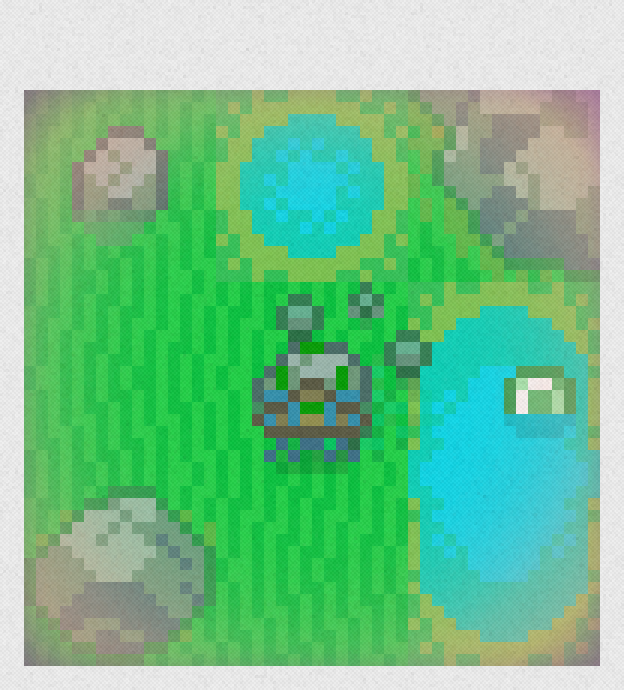
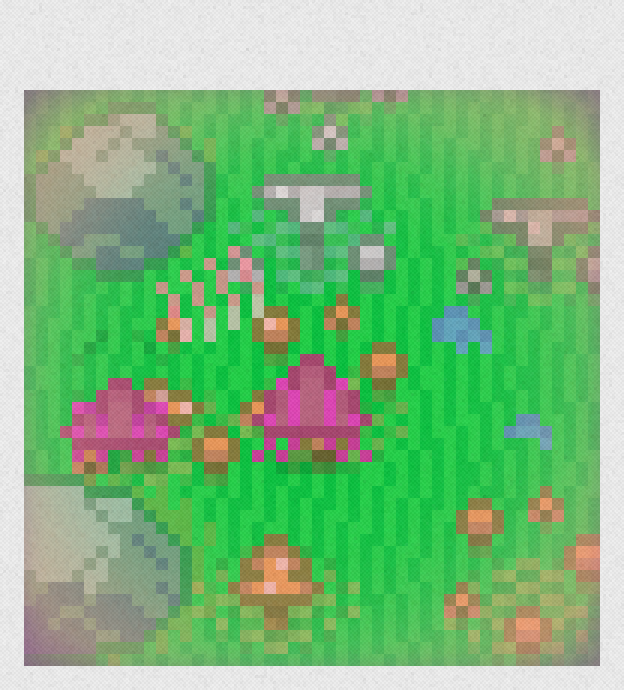
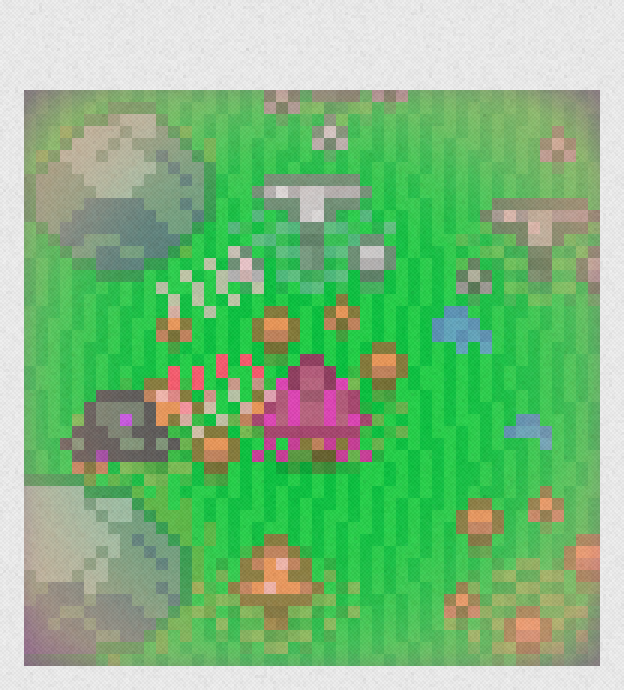
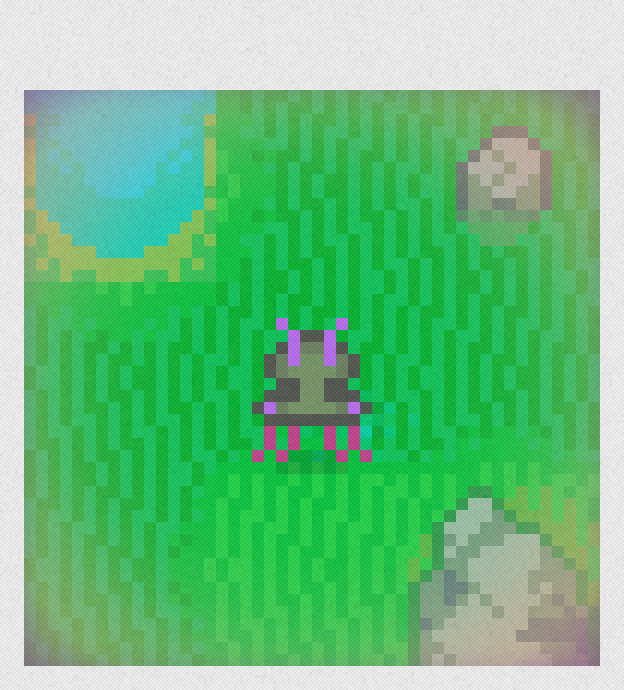
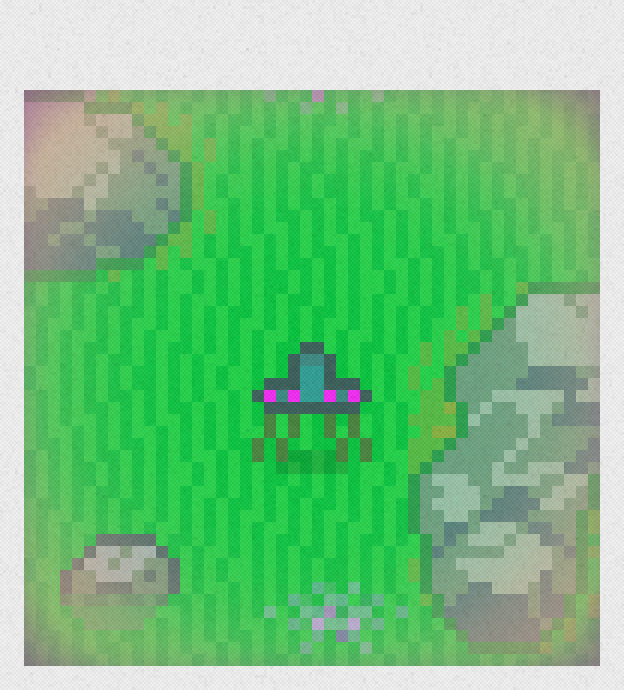
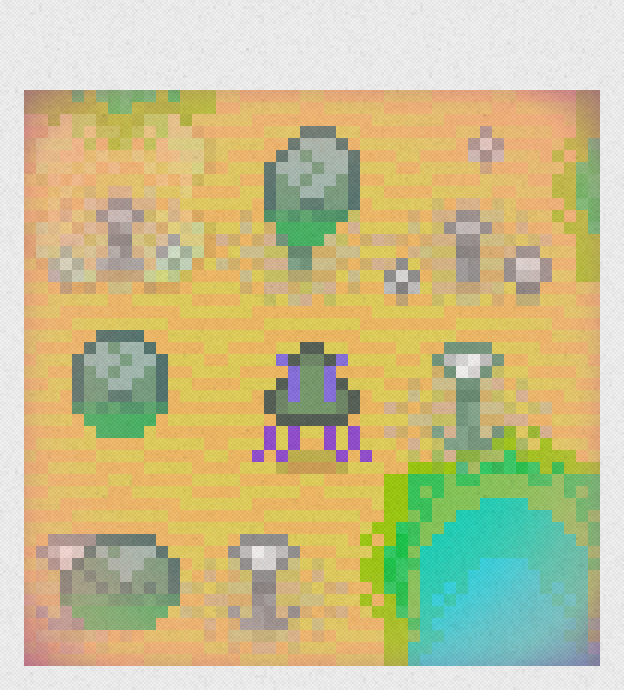
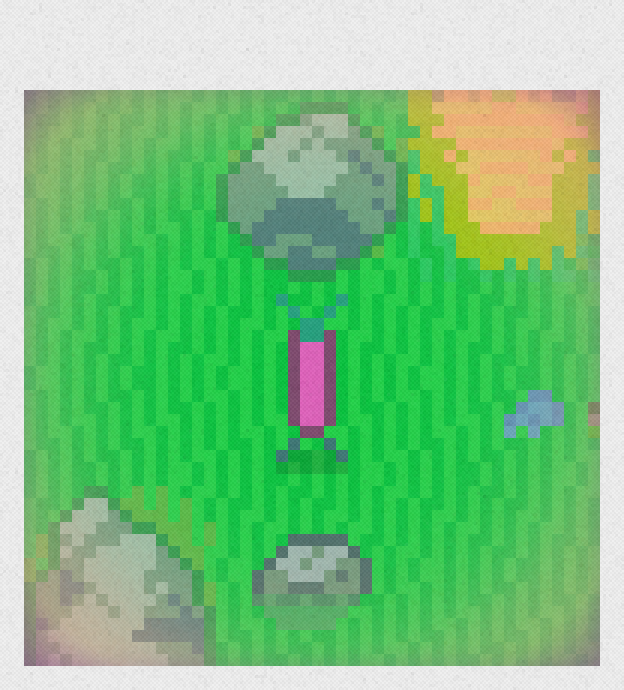
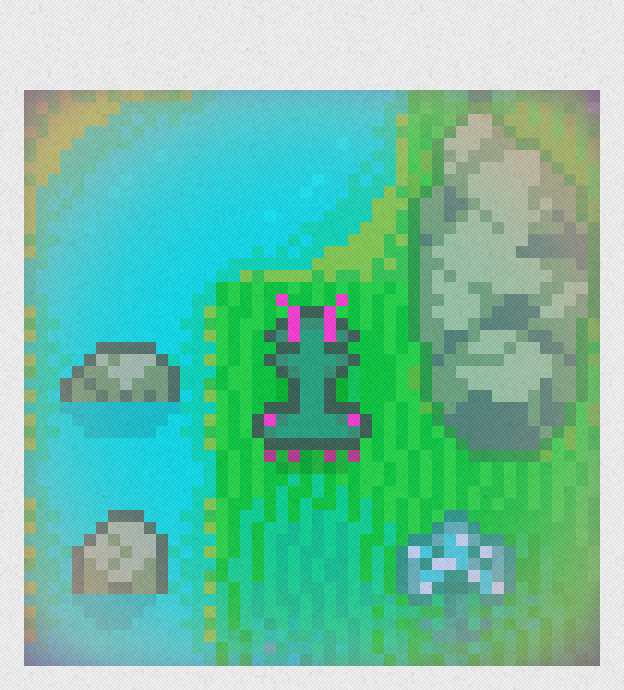
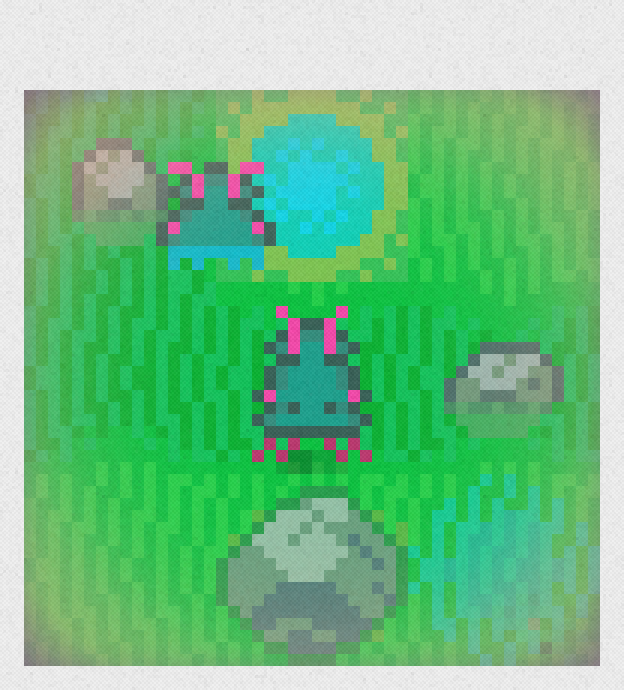
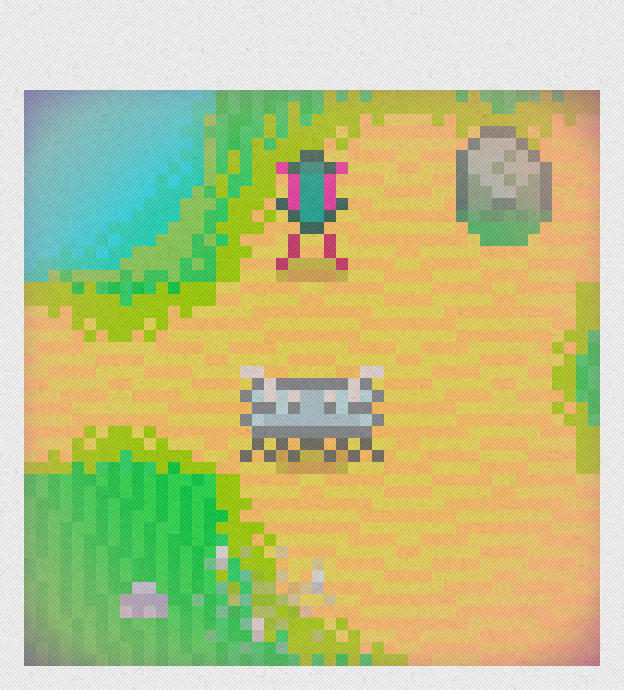
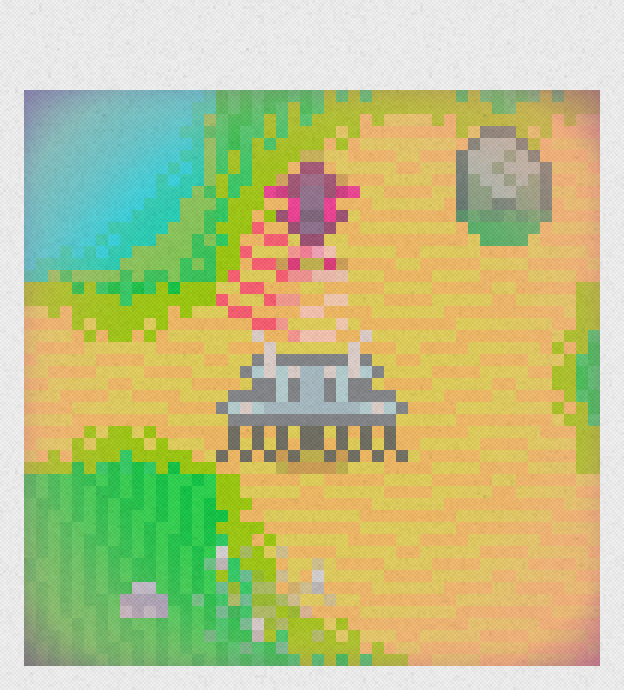
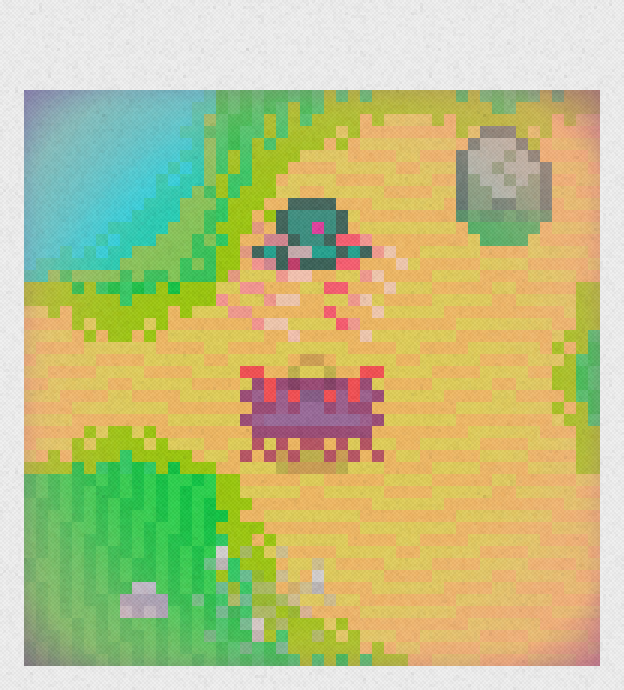
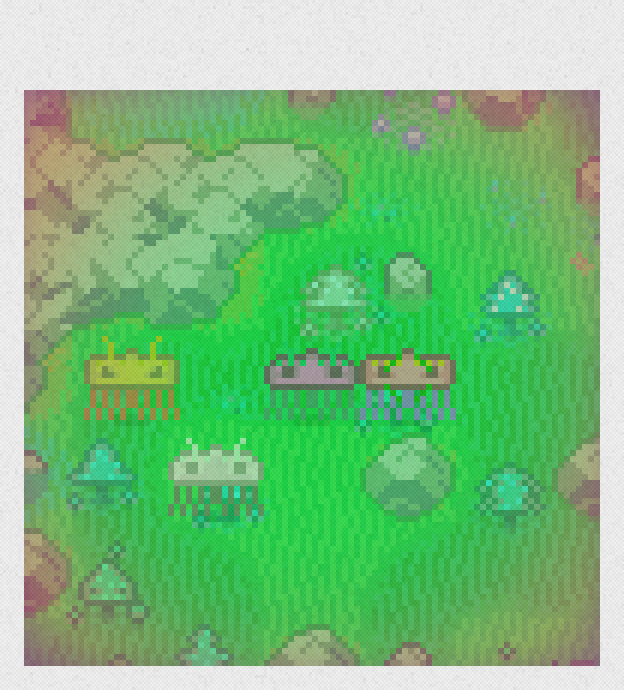
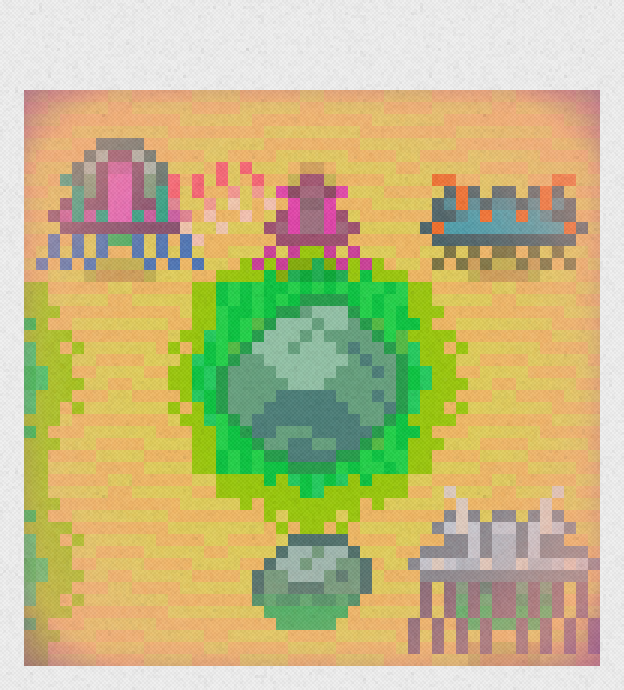
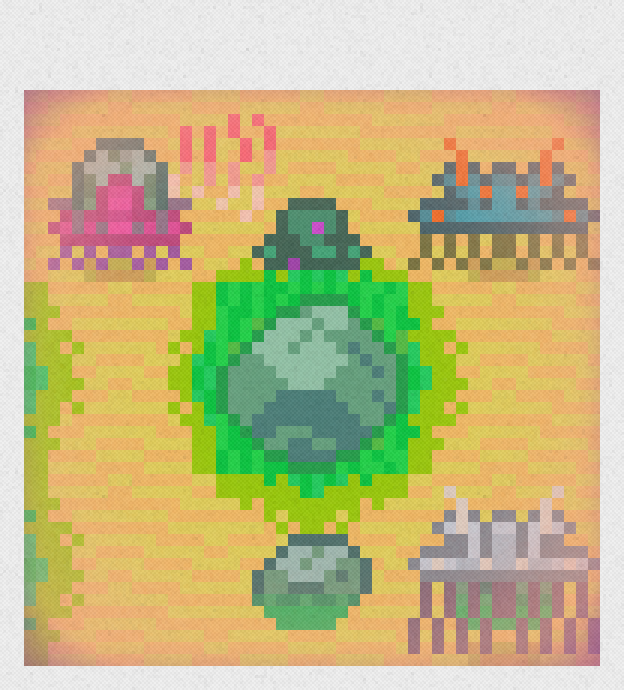
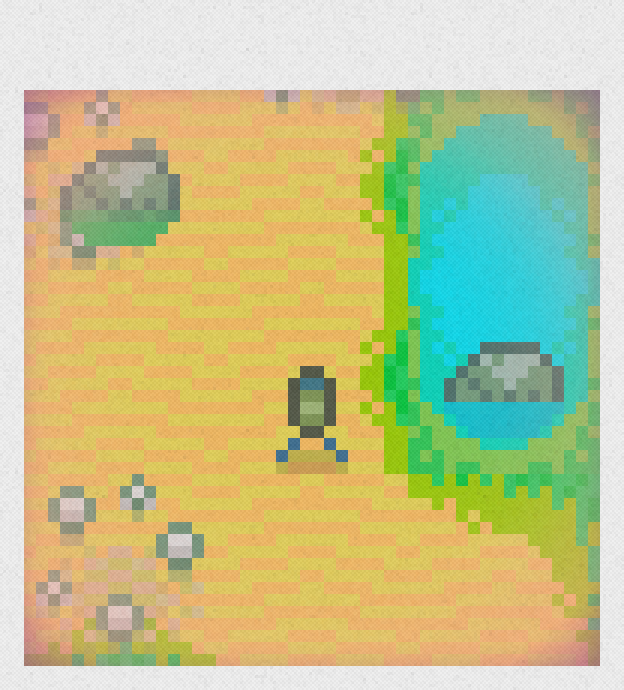
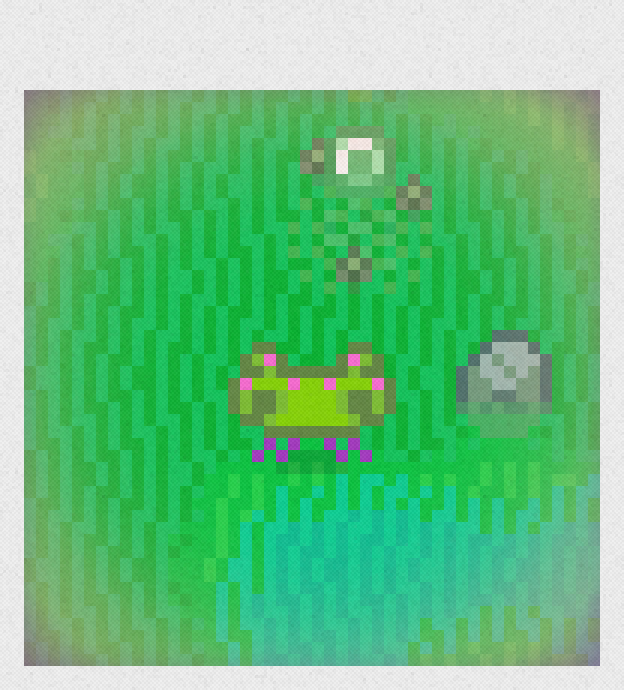
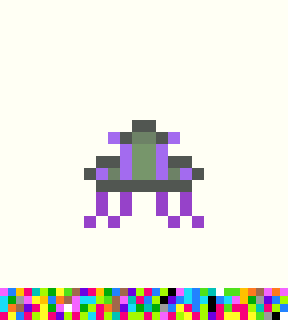
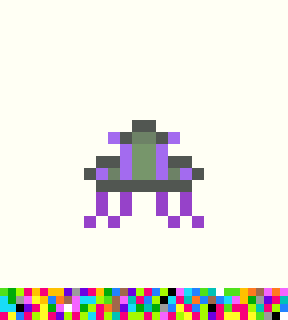
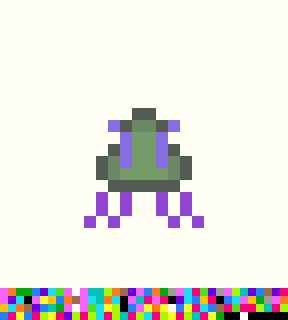
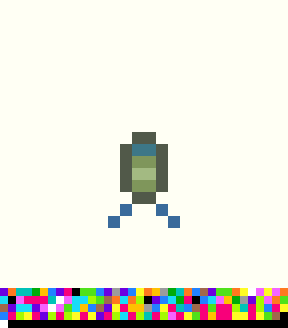
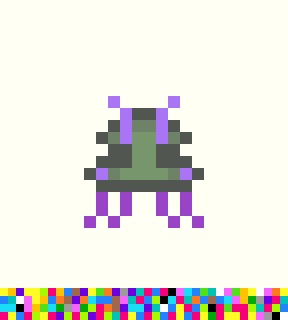
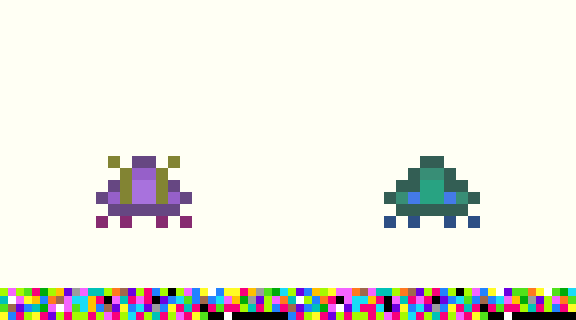
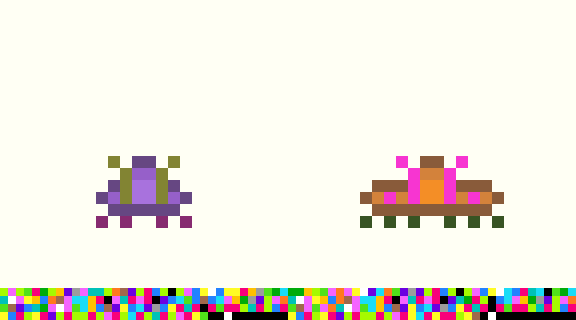
Anims “squish” a little as part of their animation; this is purely aesthetical, but it can make identifying an anim in an image a little tougher. These images show a Dehaibus and its squished form, which it cycles between at a rate based on its metabolism (anims with very high metabolism switch very quickly, and vice versa).
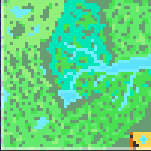
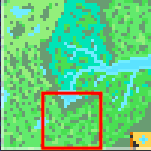
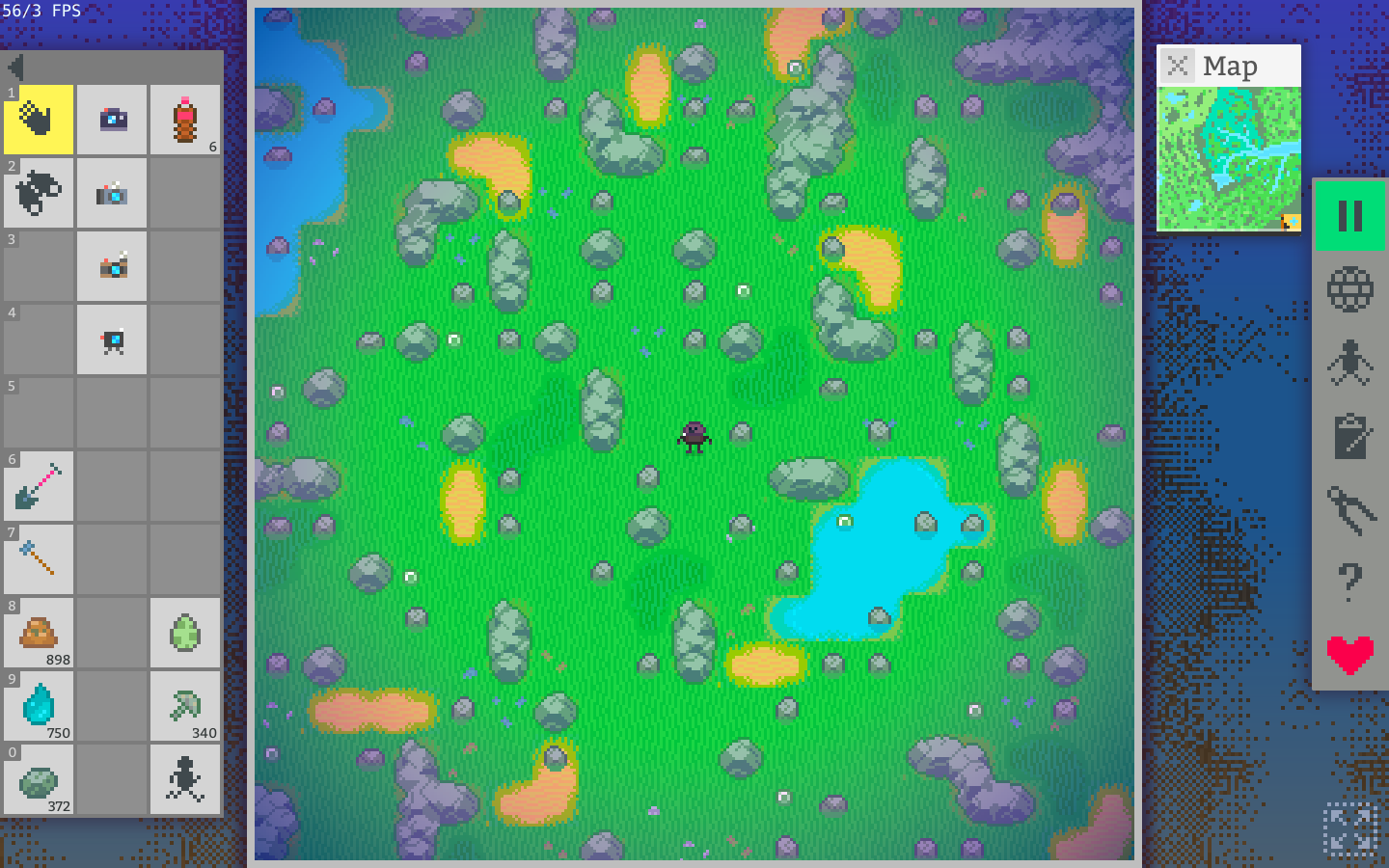
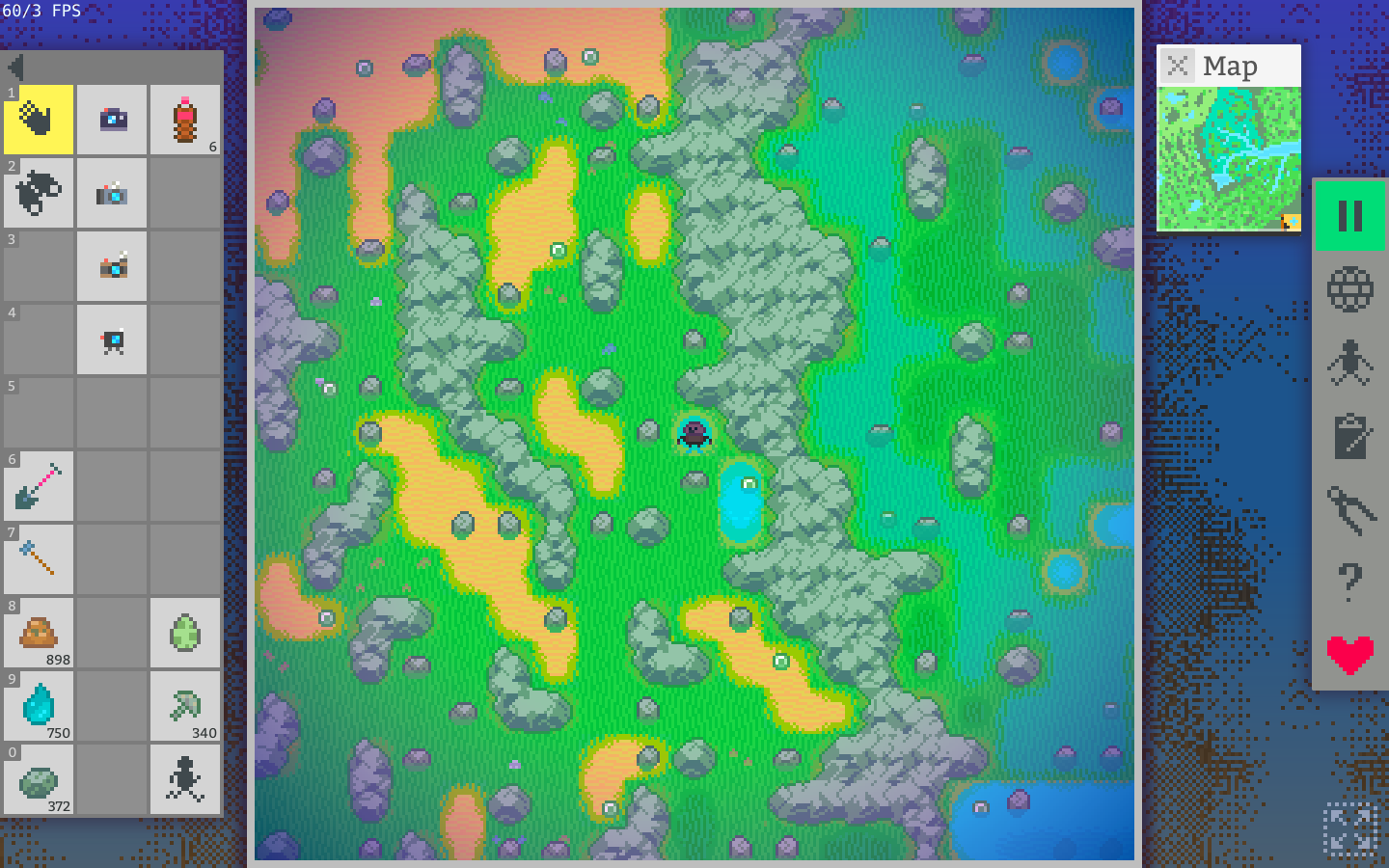
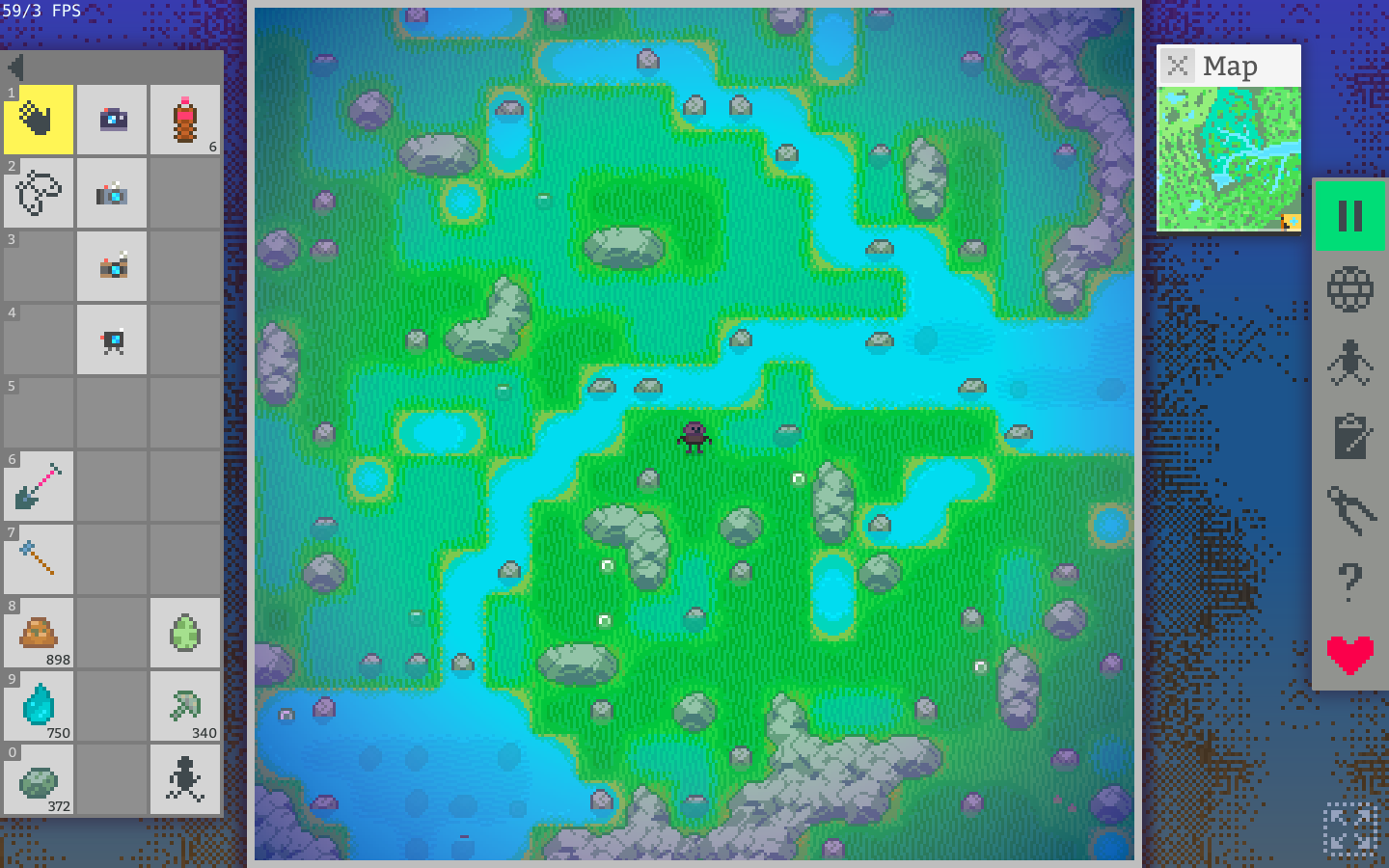
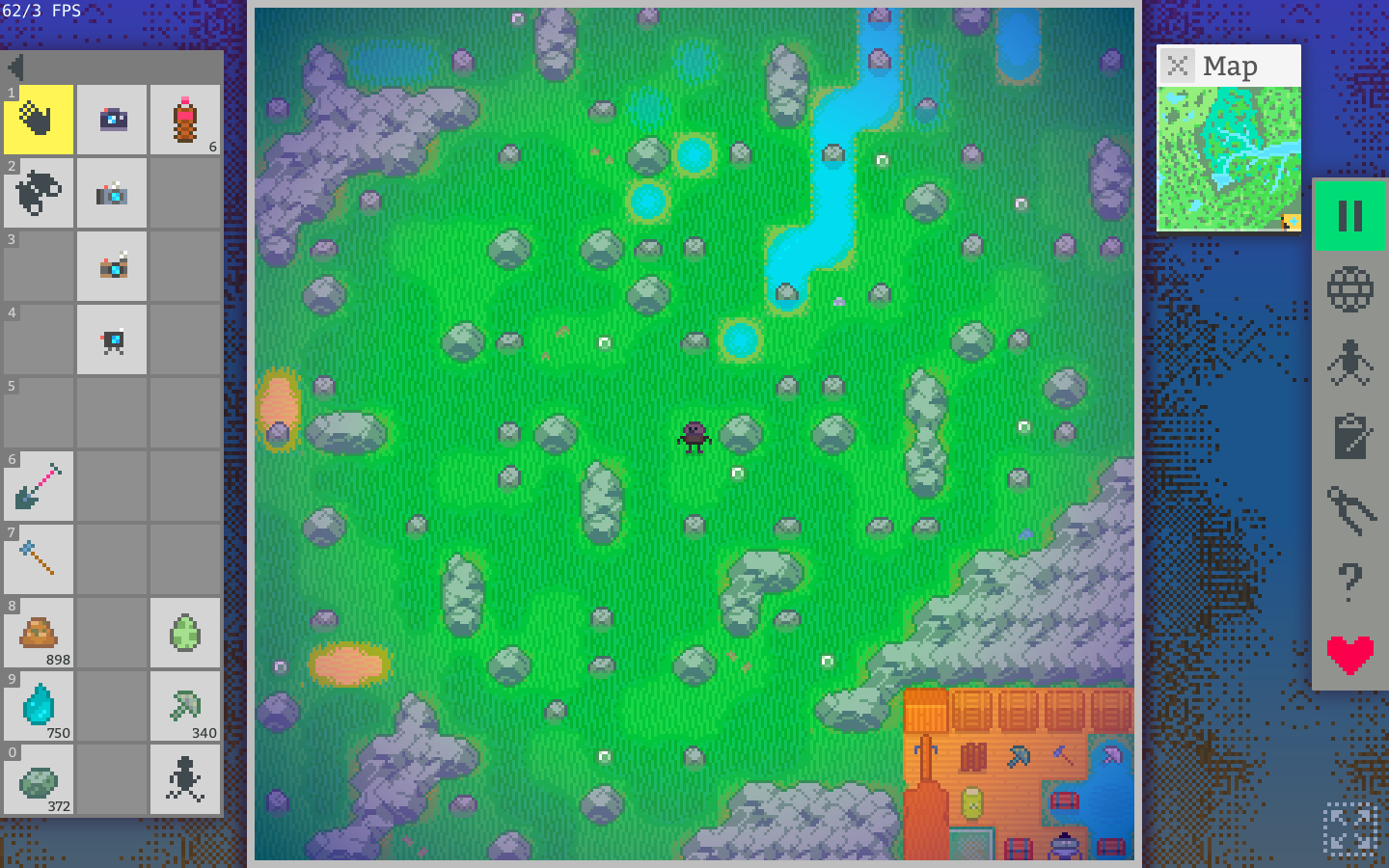
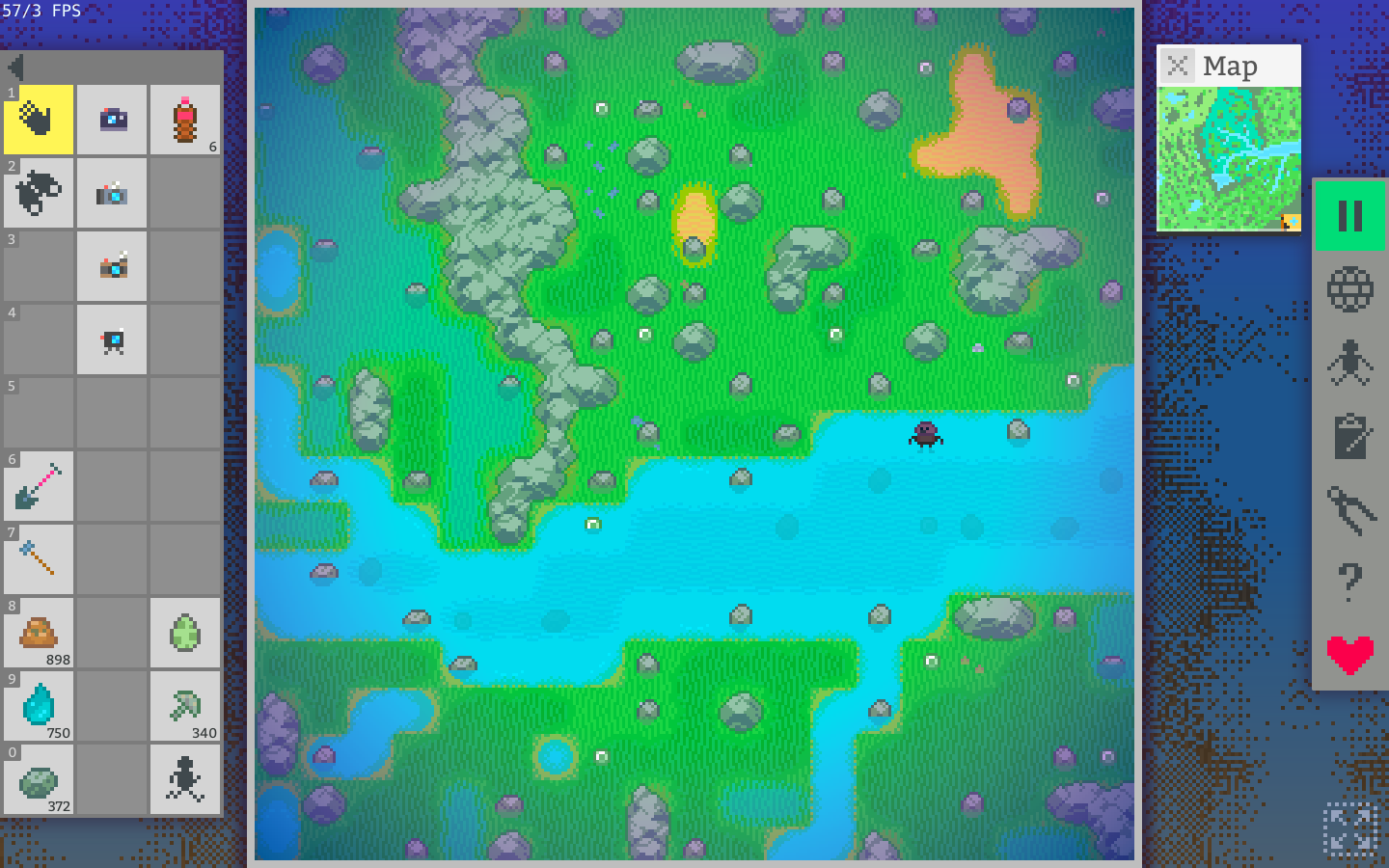
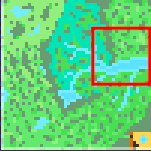
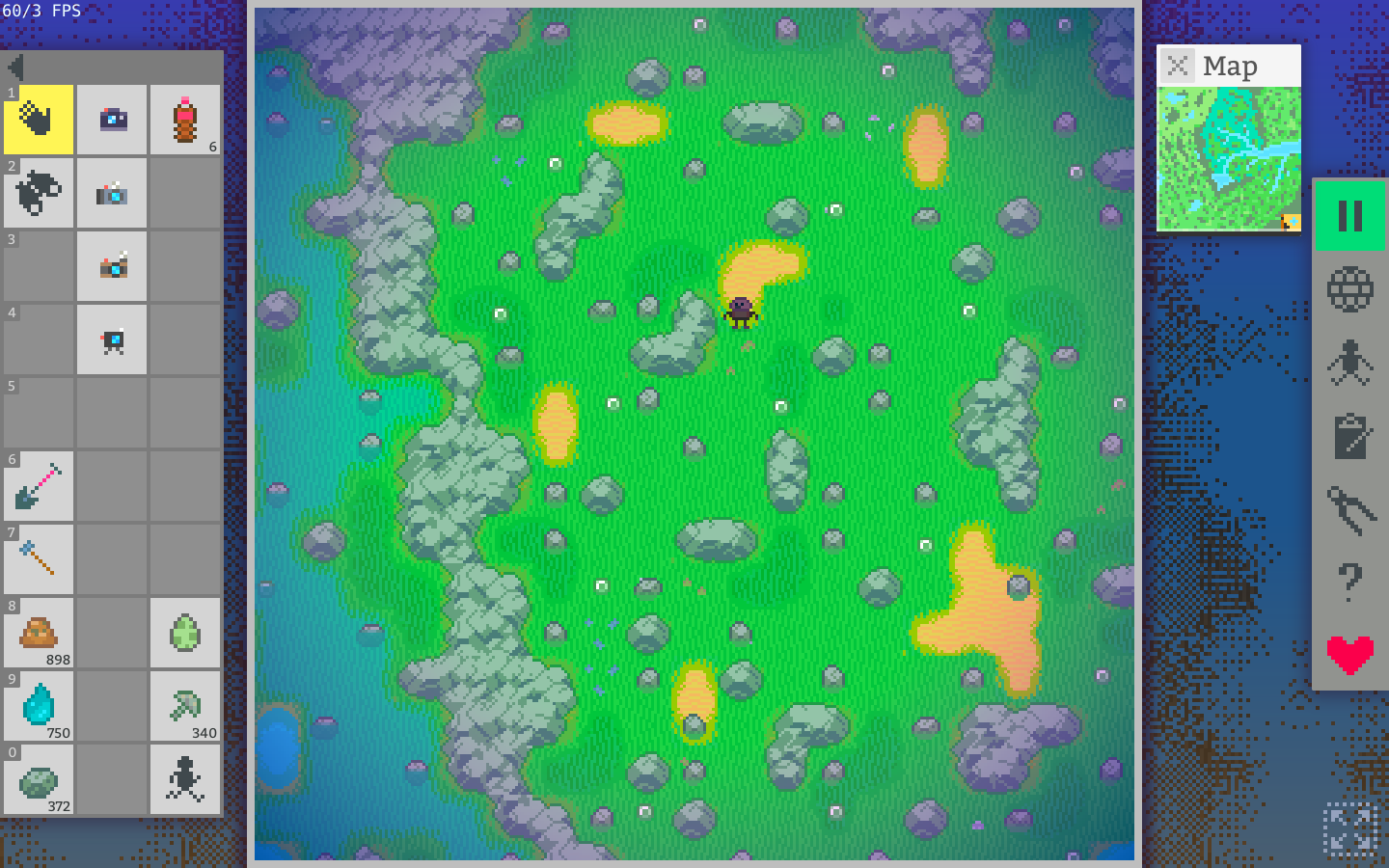
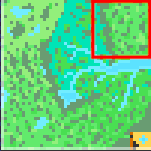
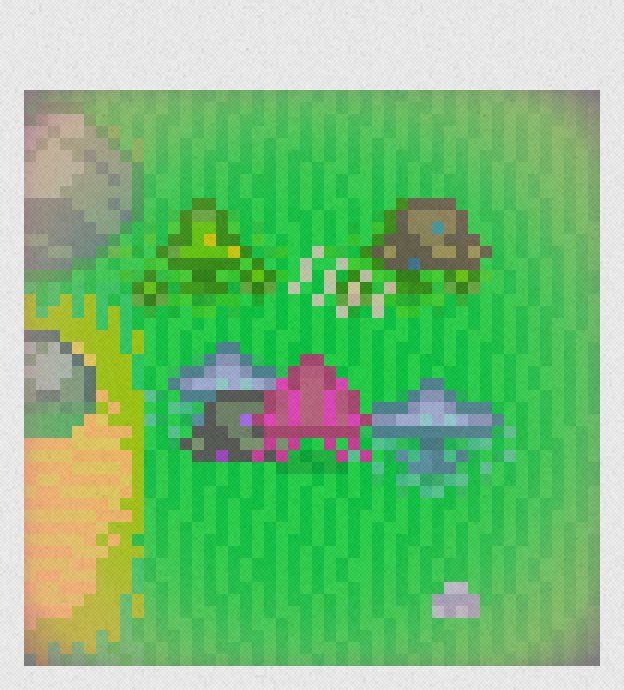
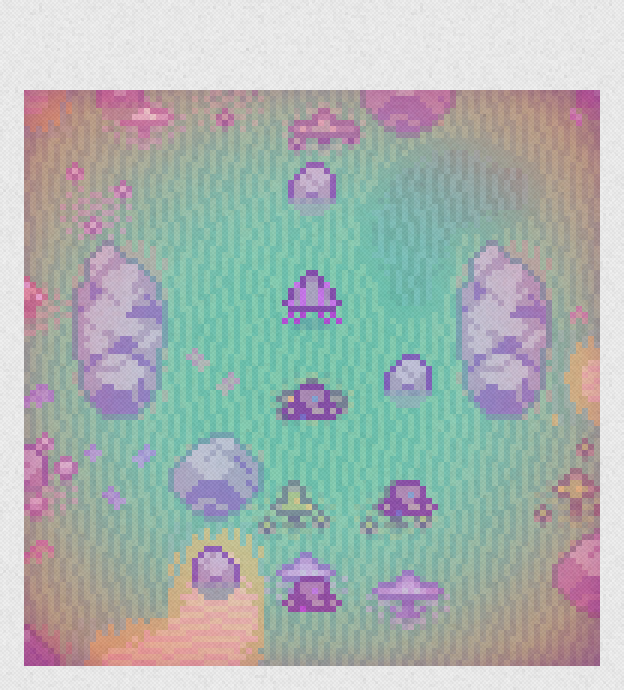
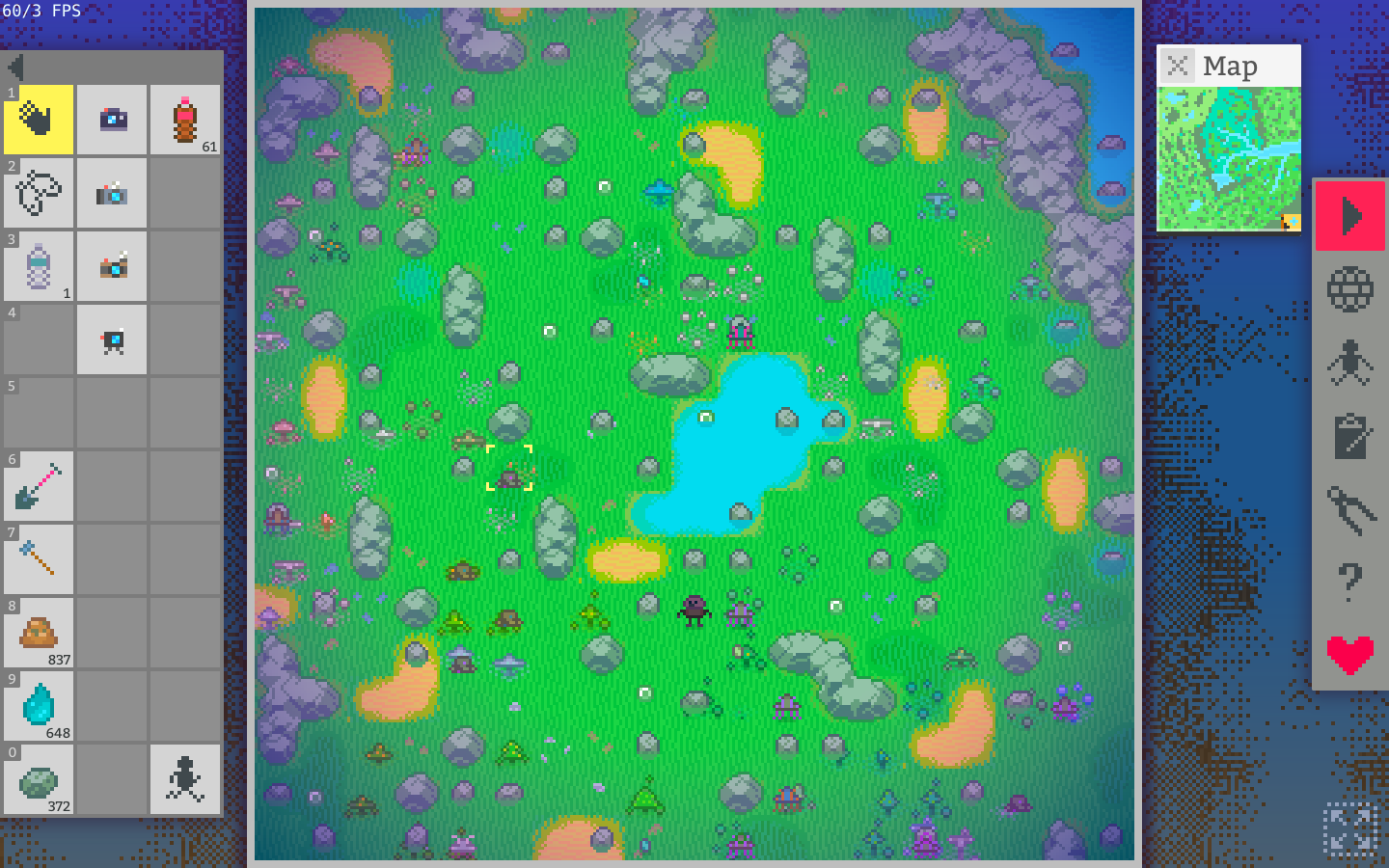
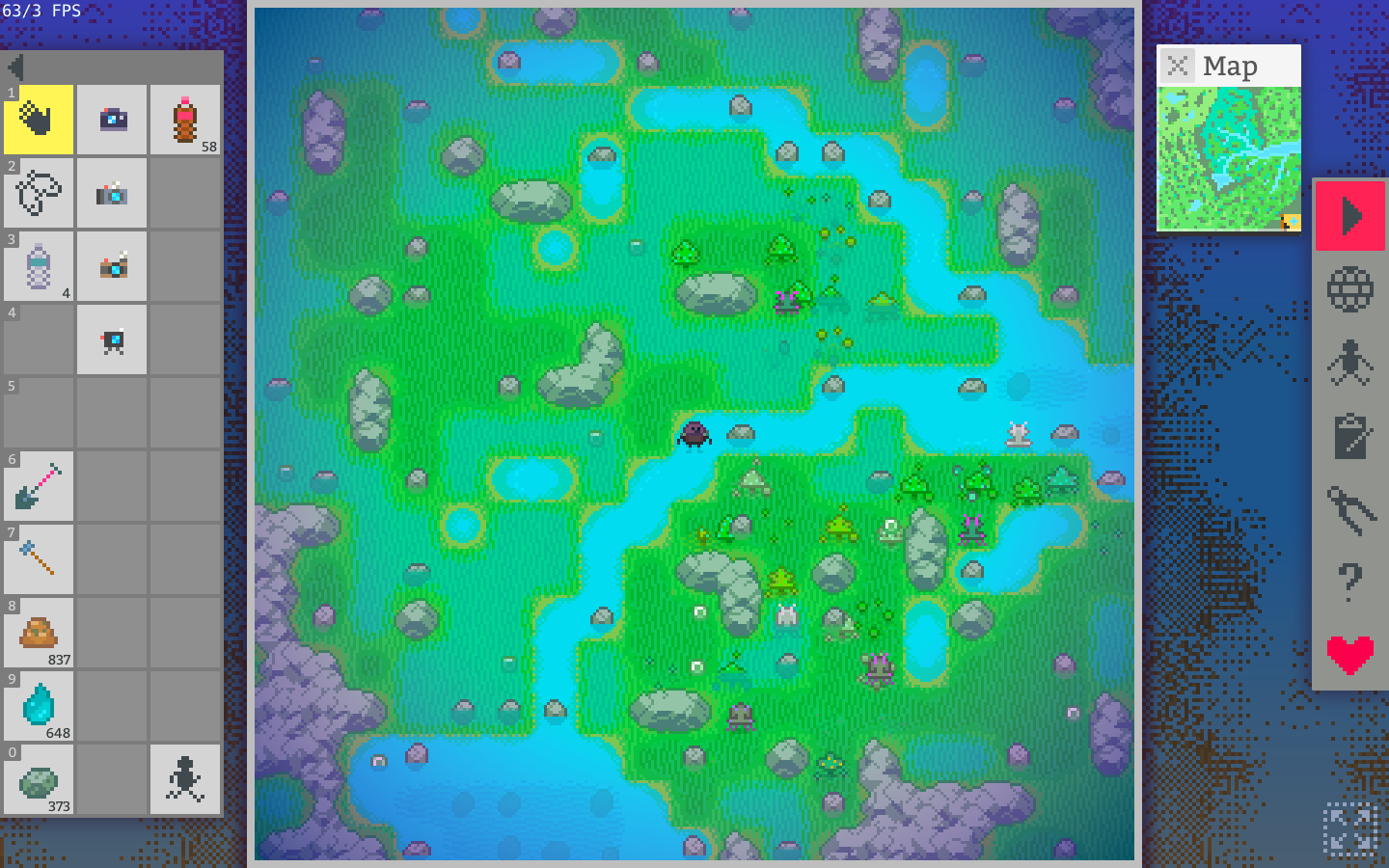
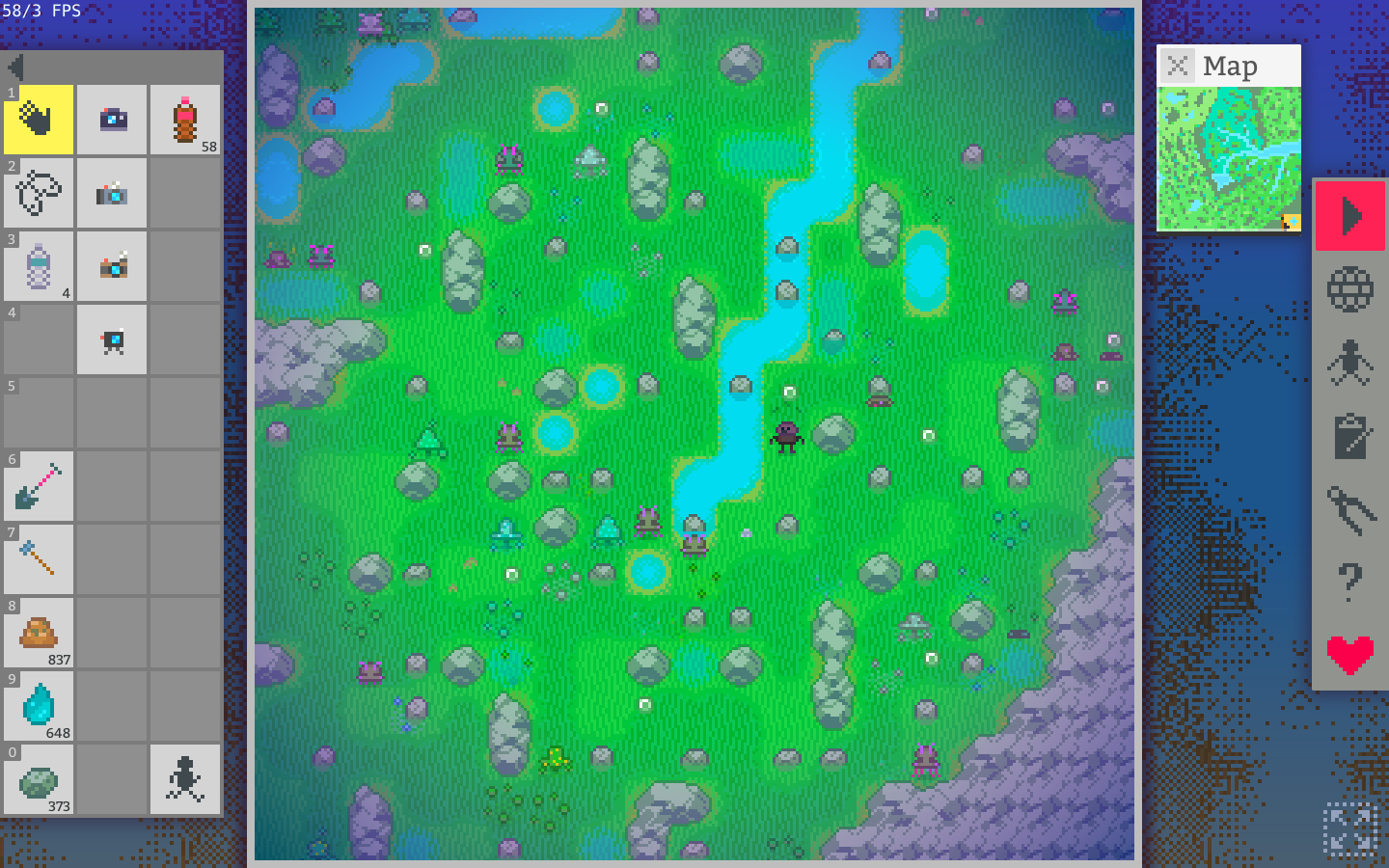
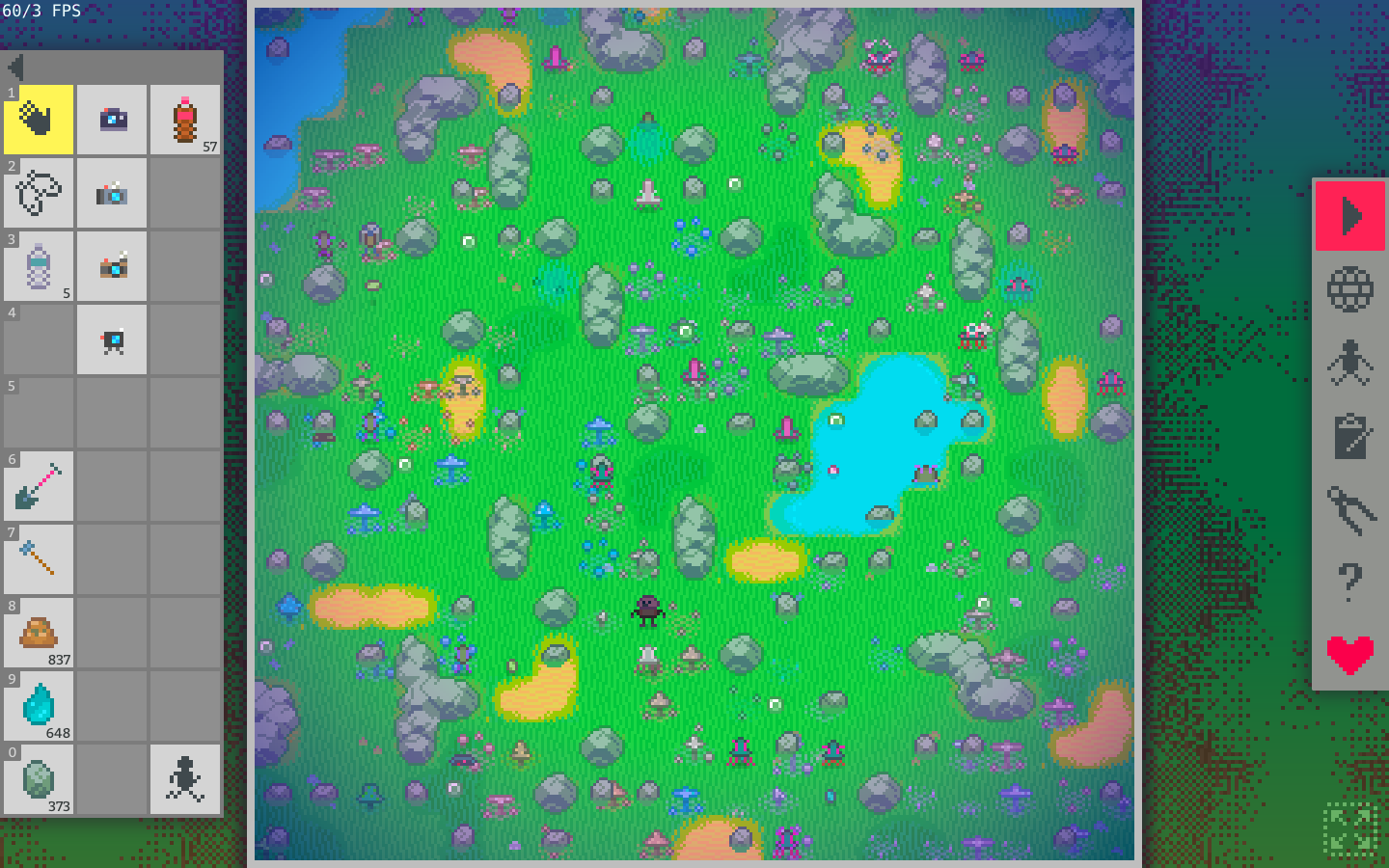
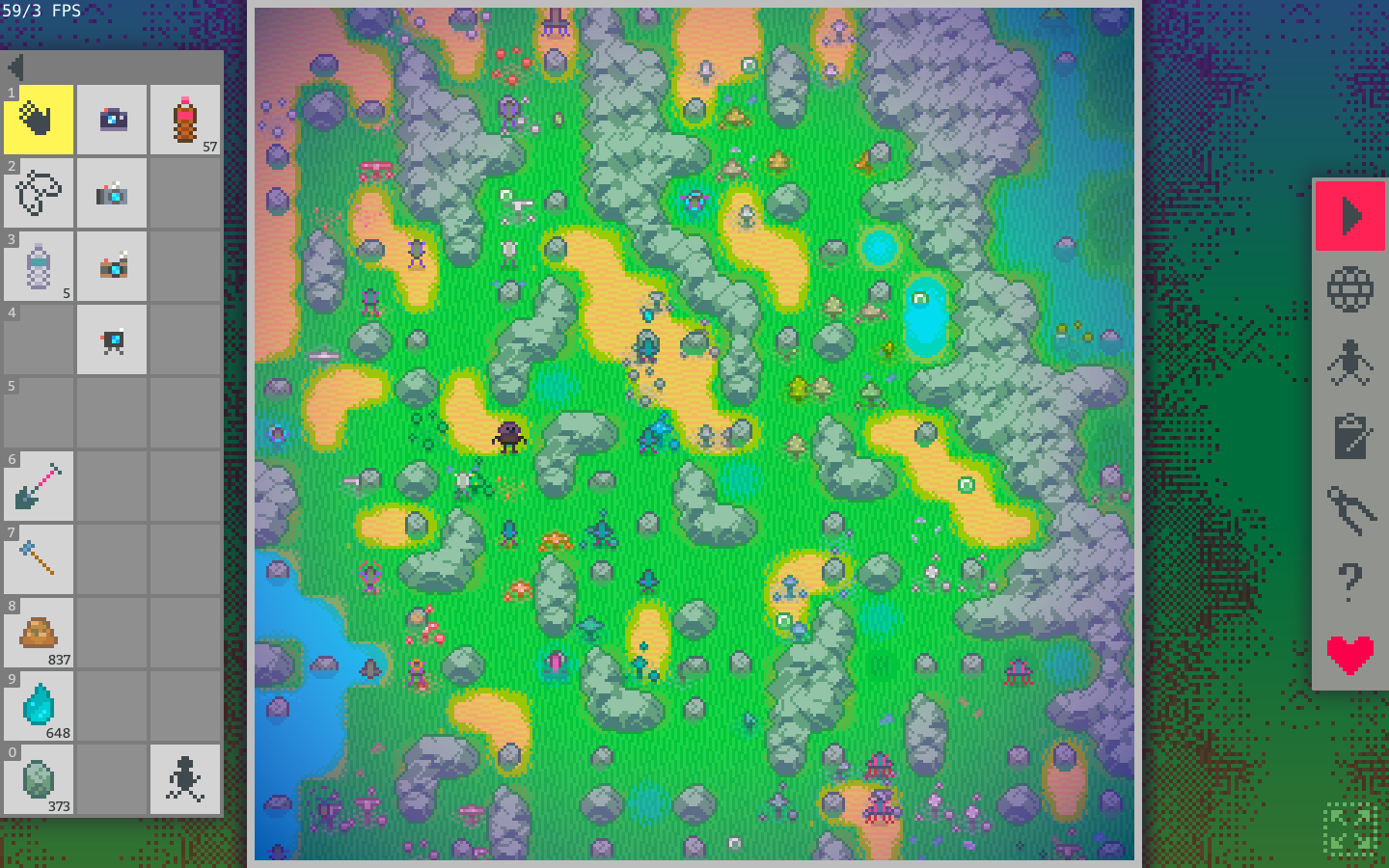
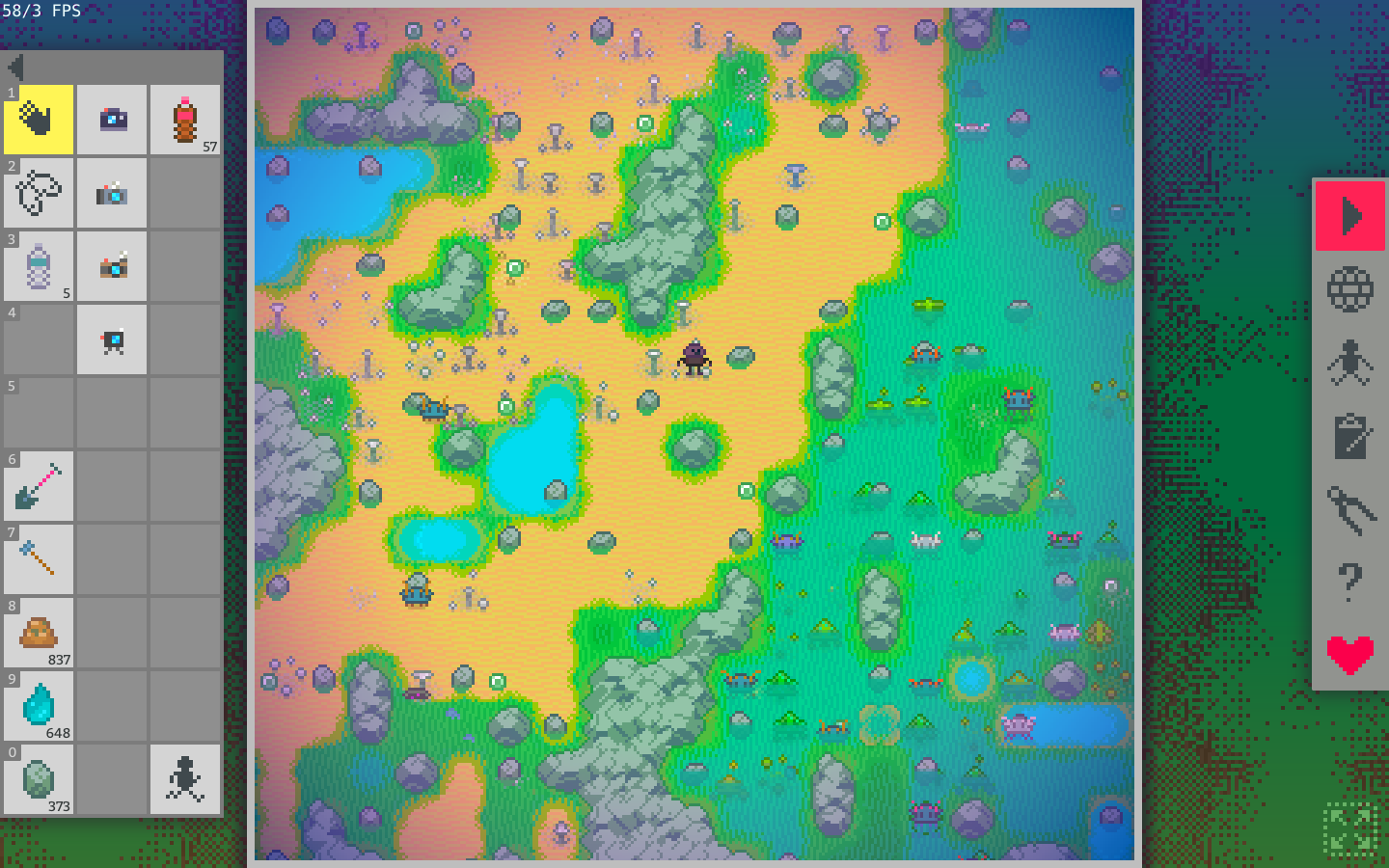
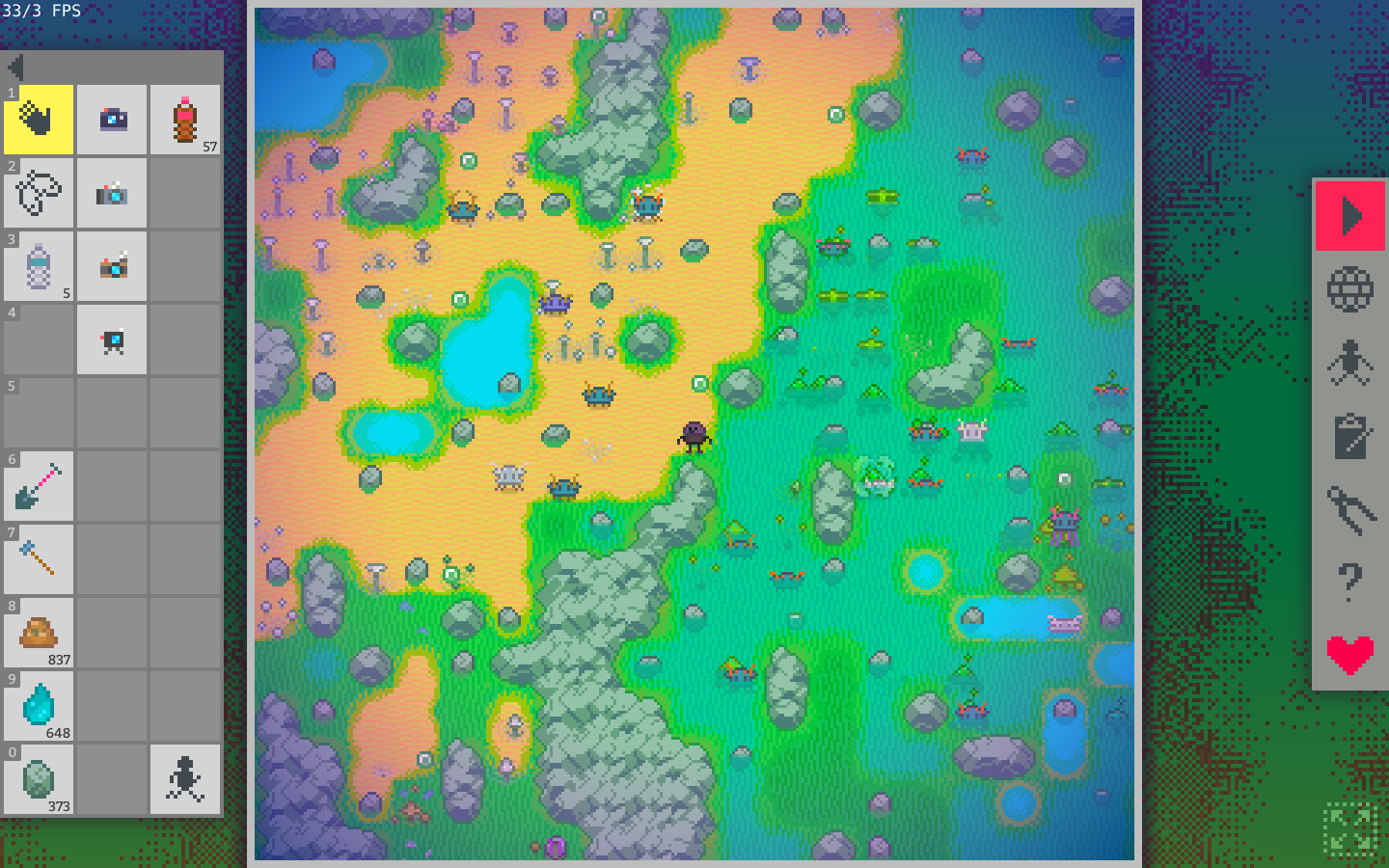
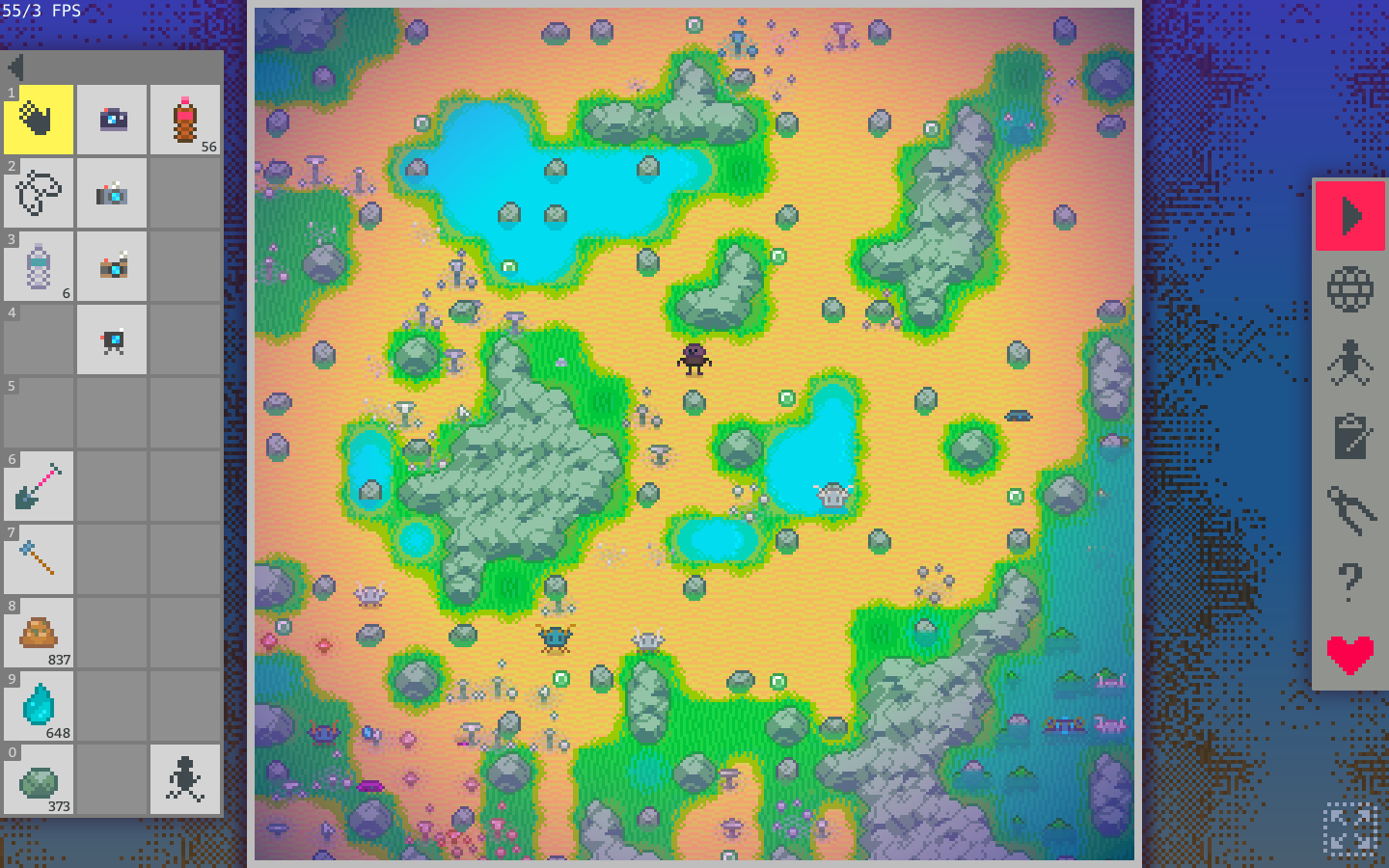
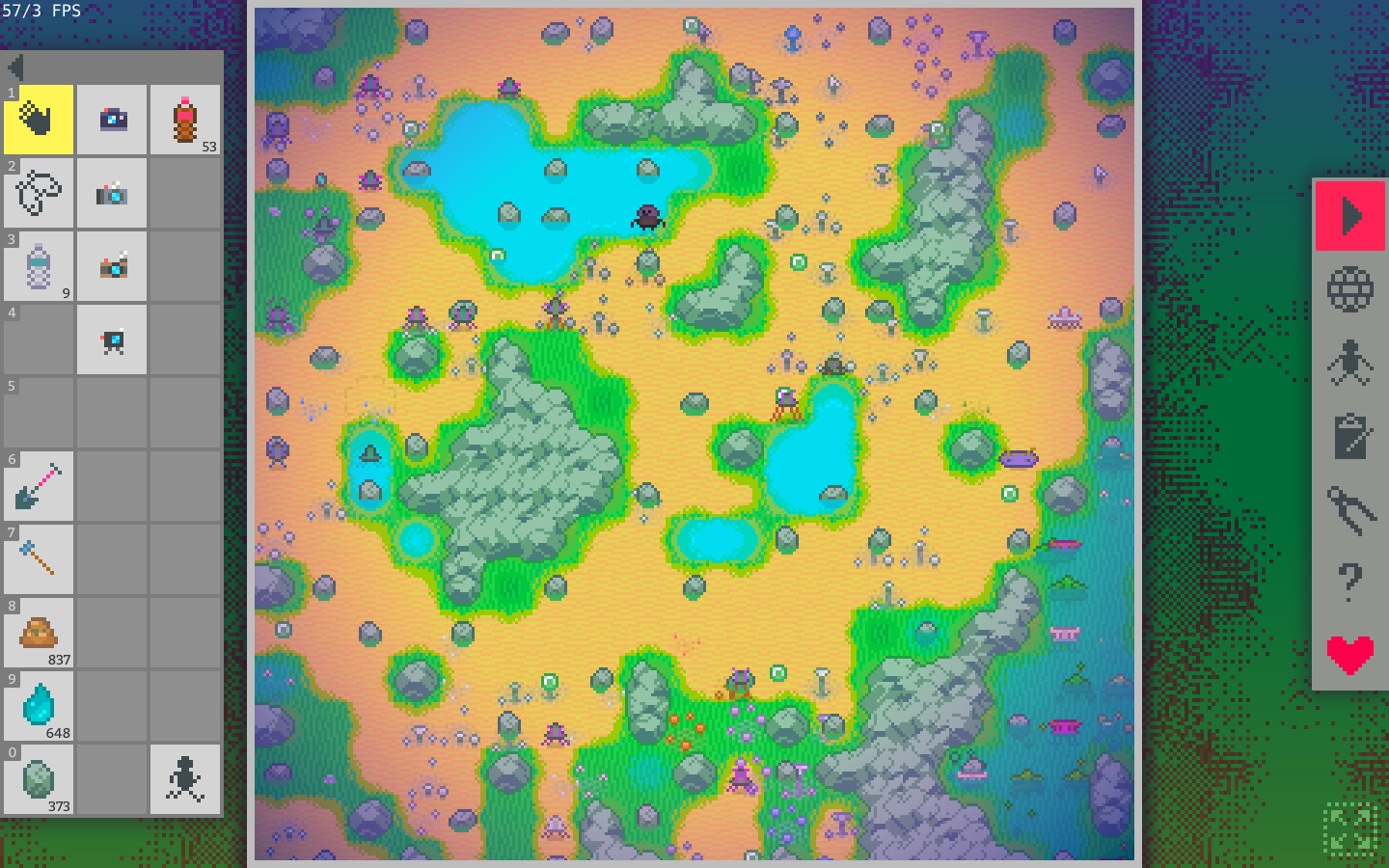
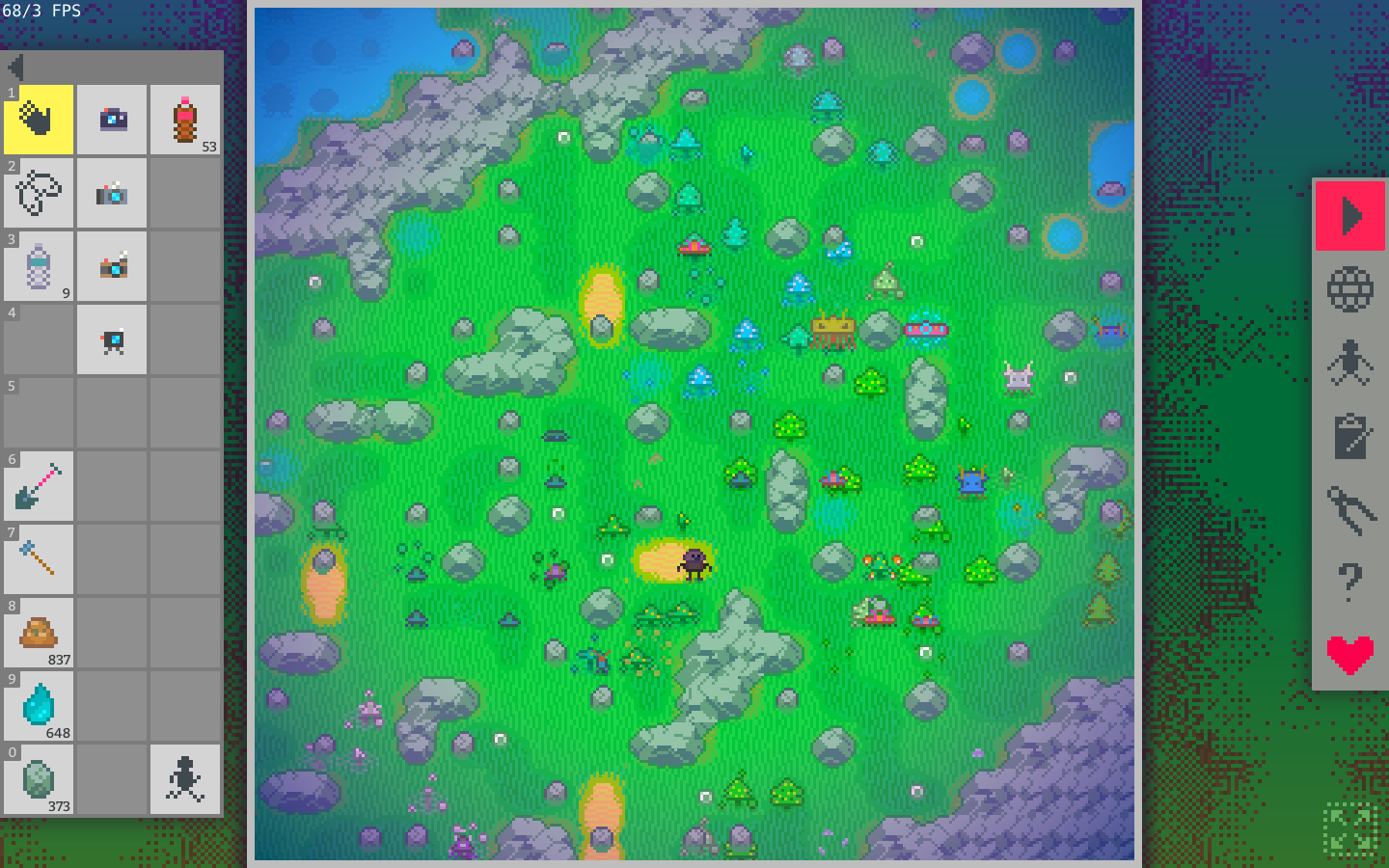
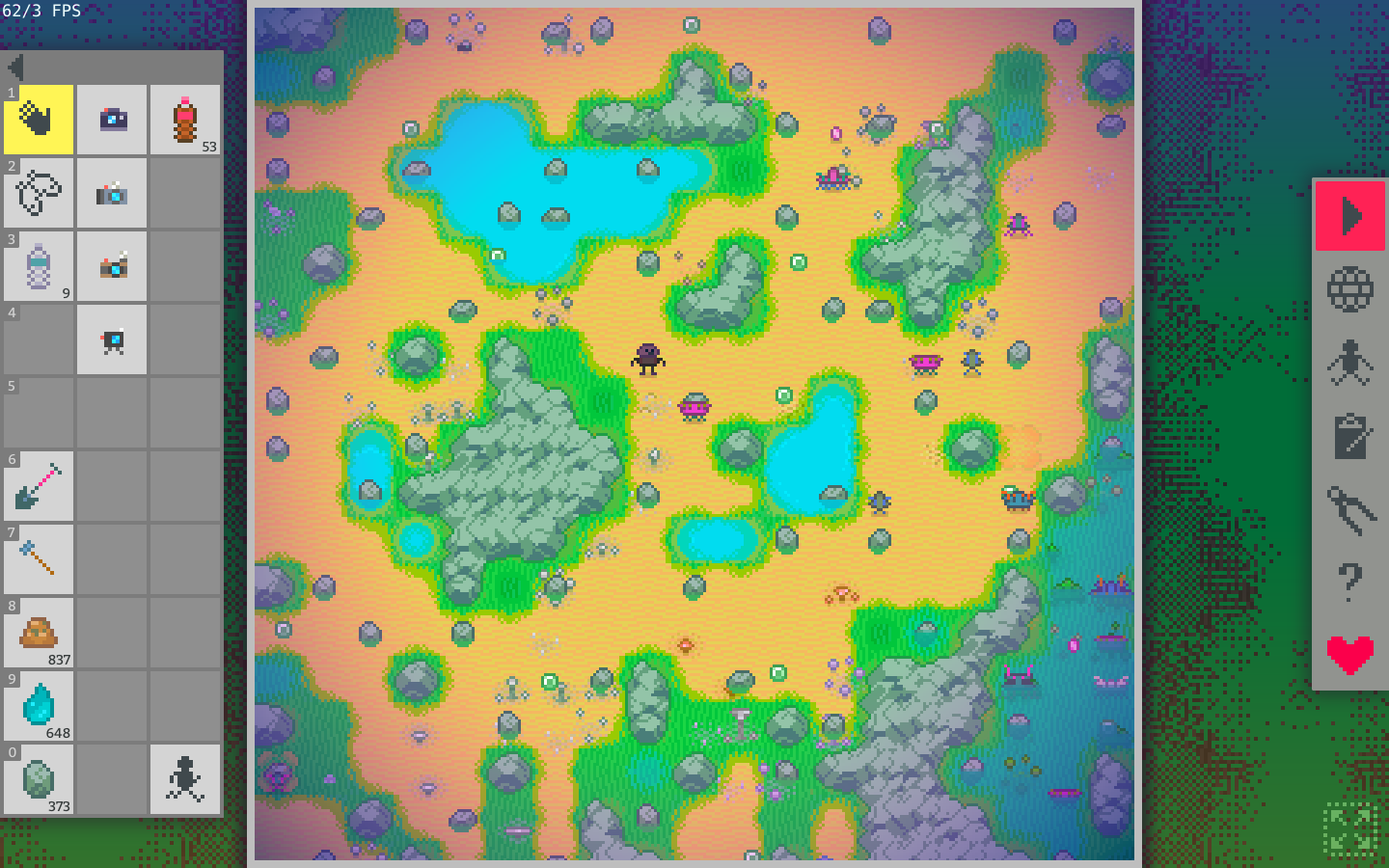
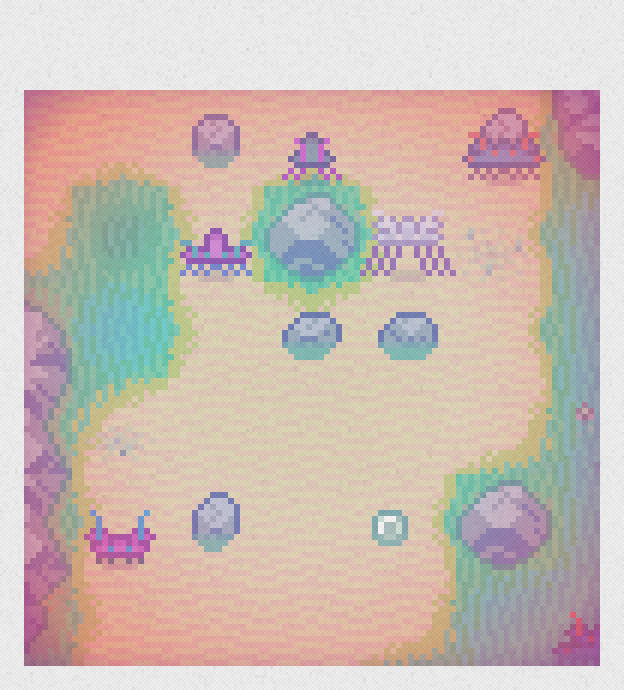
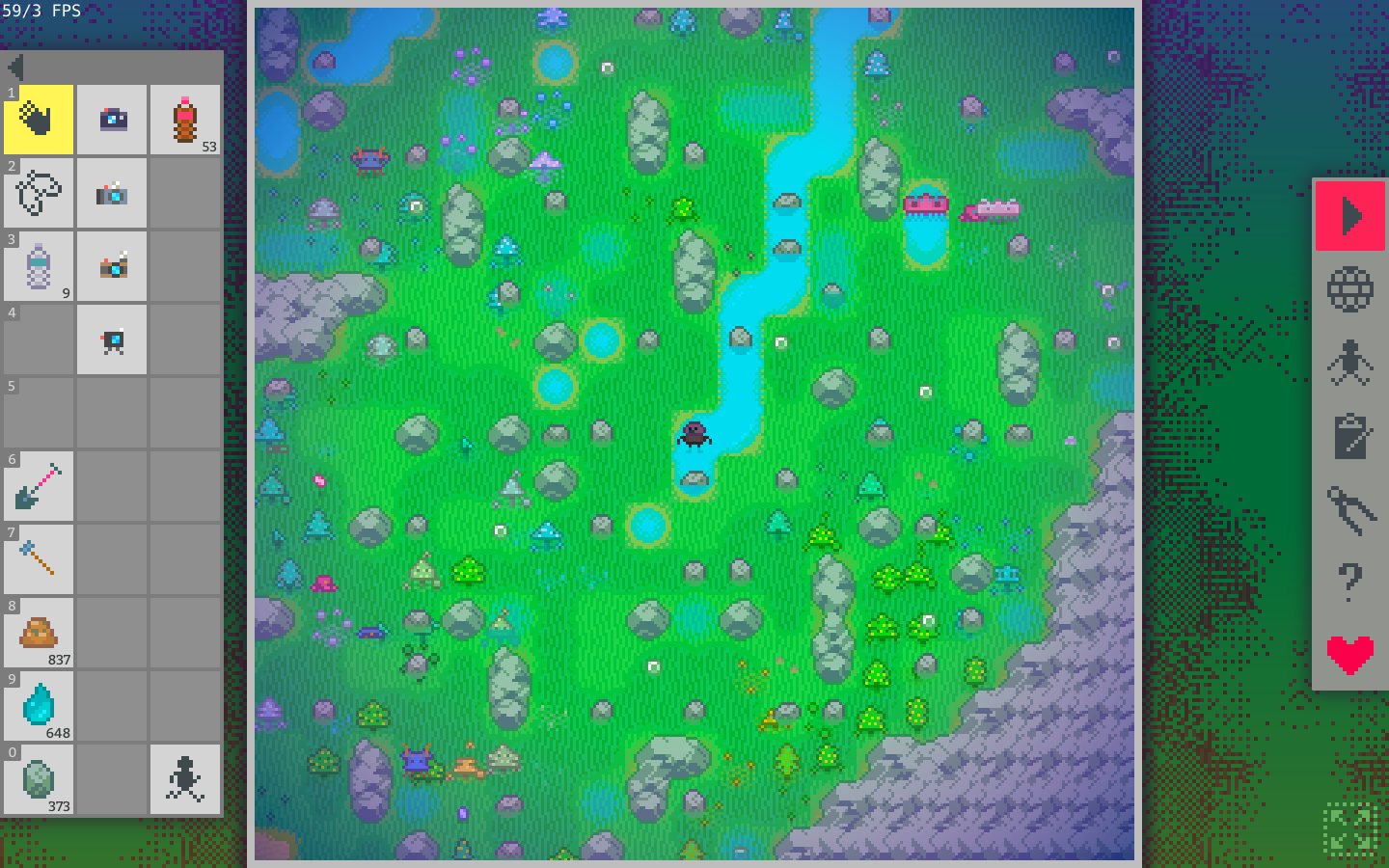
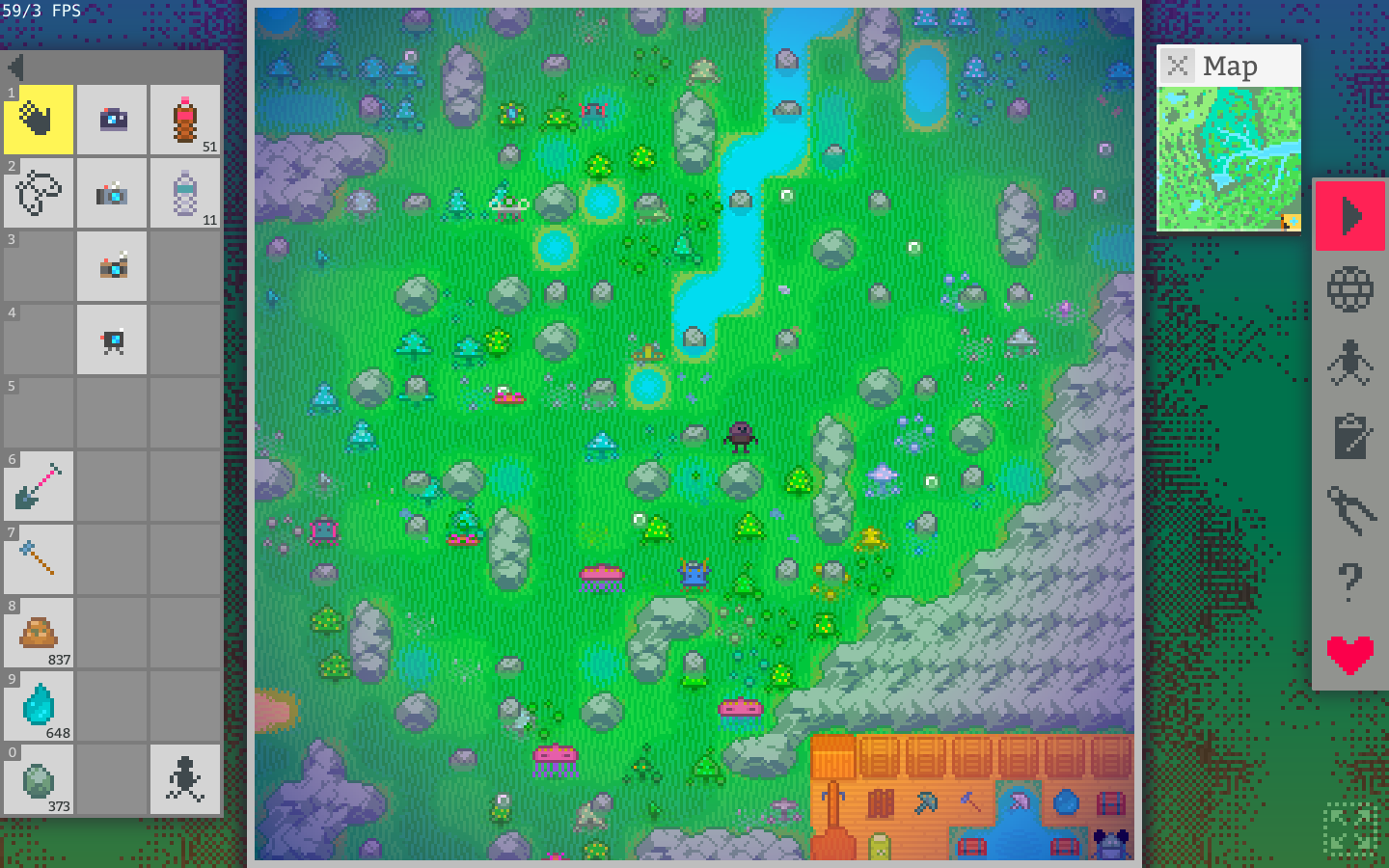
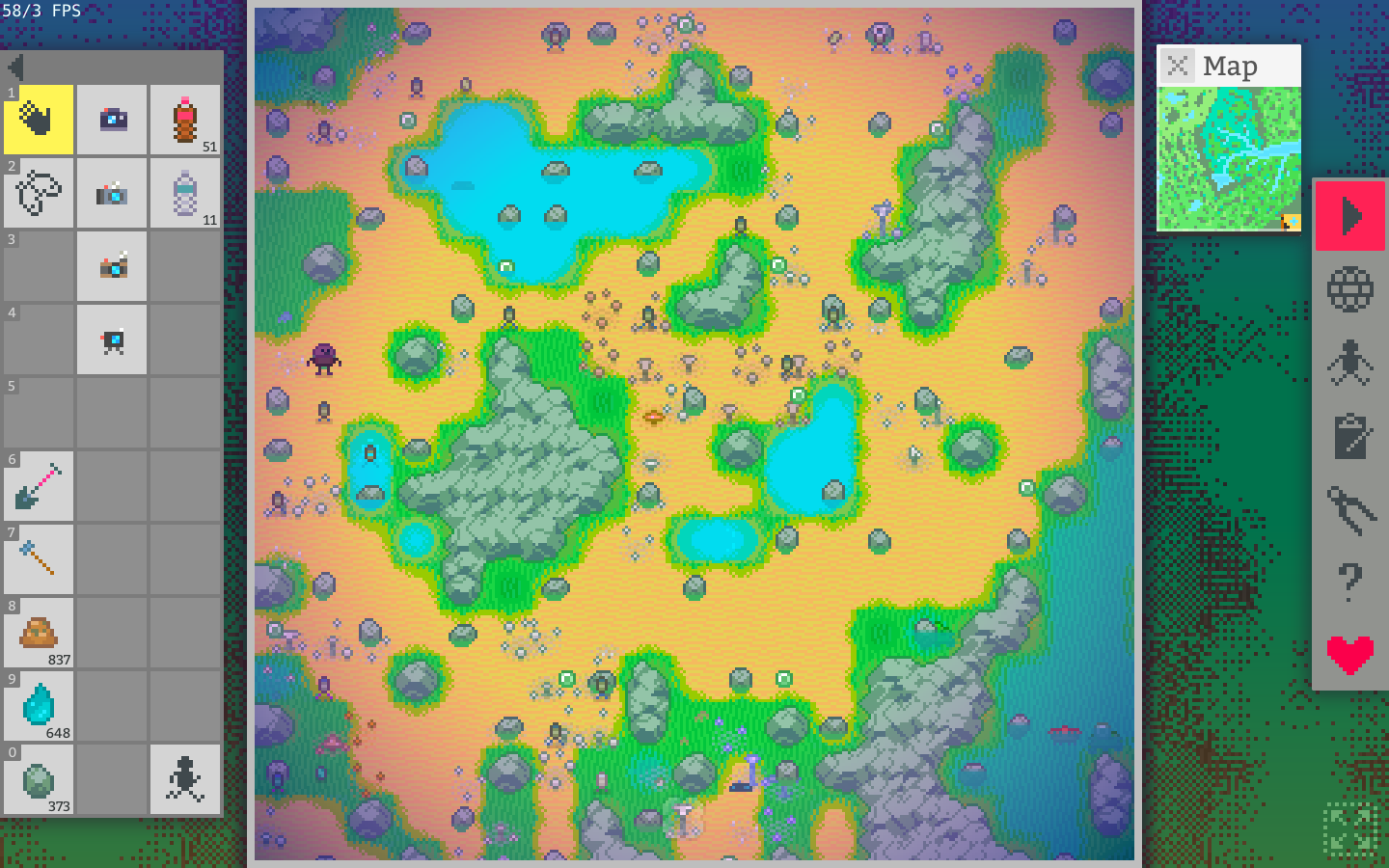
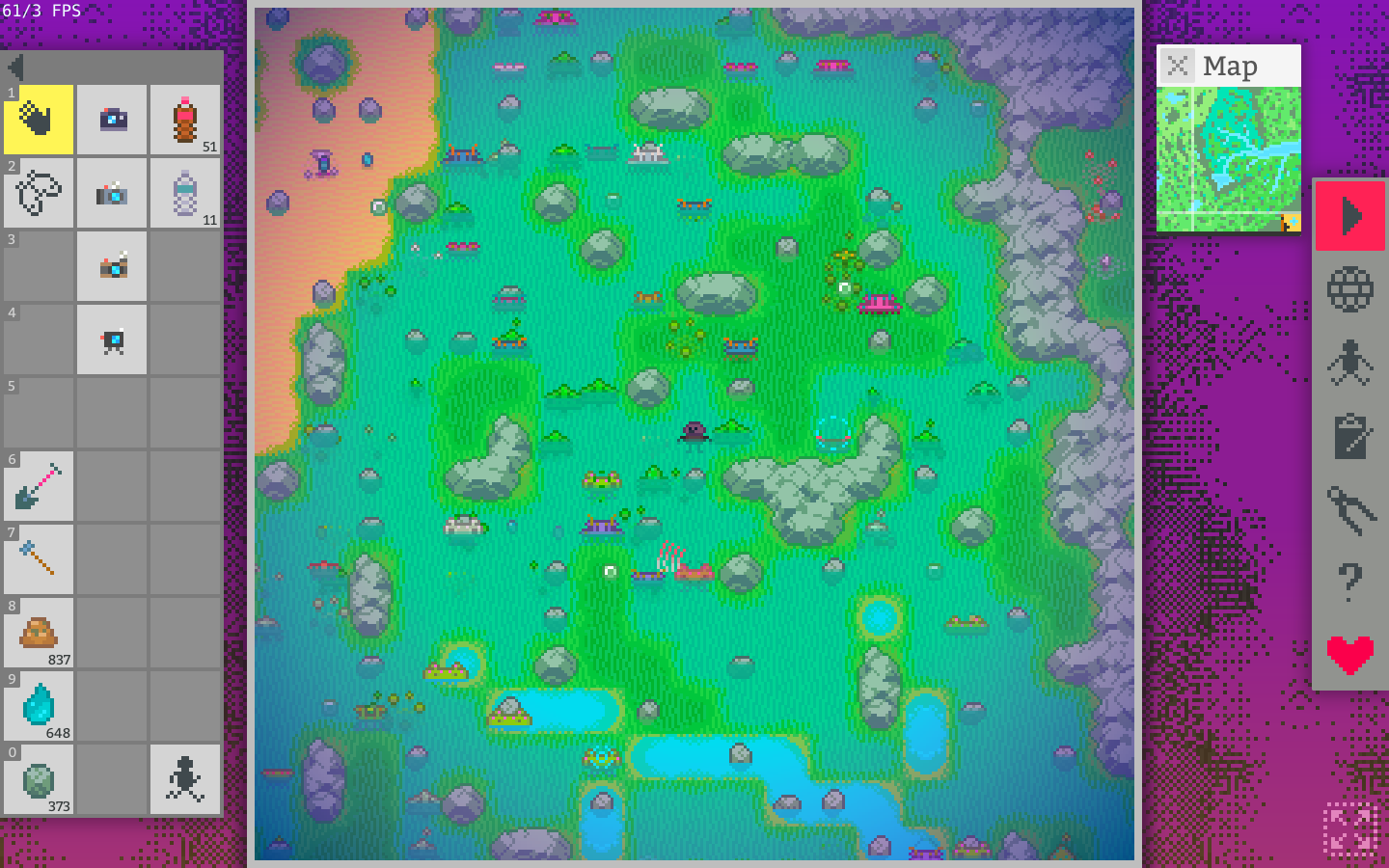
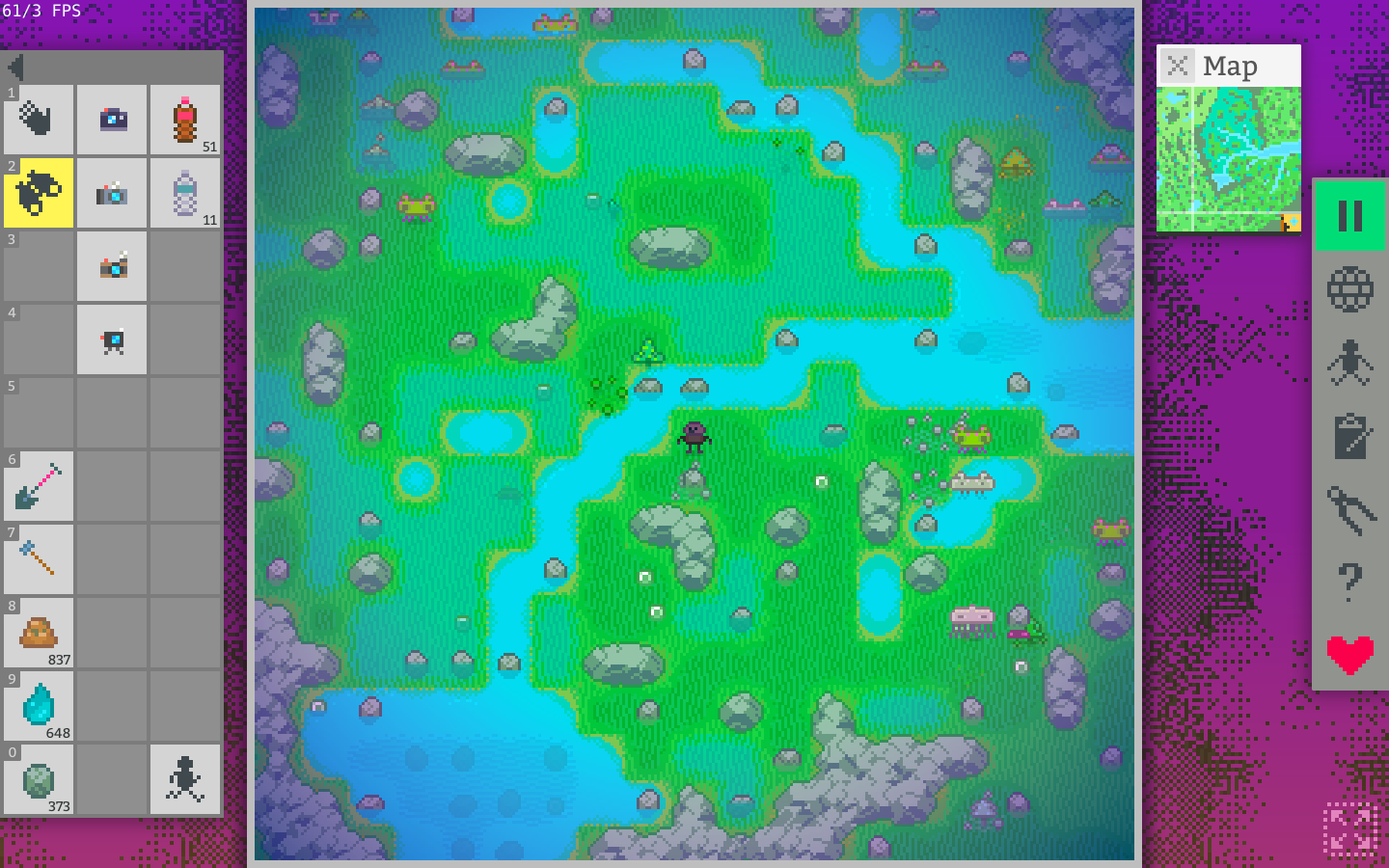
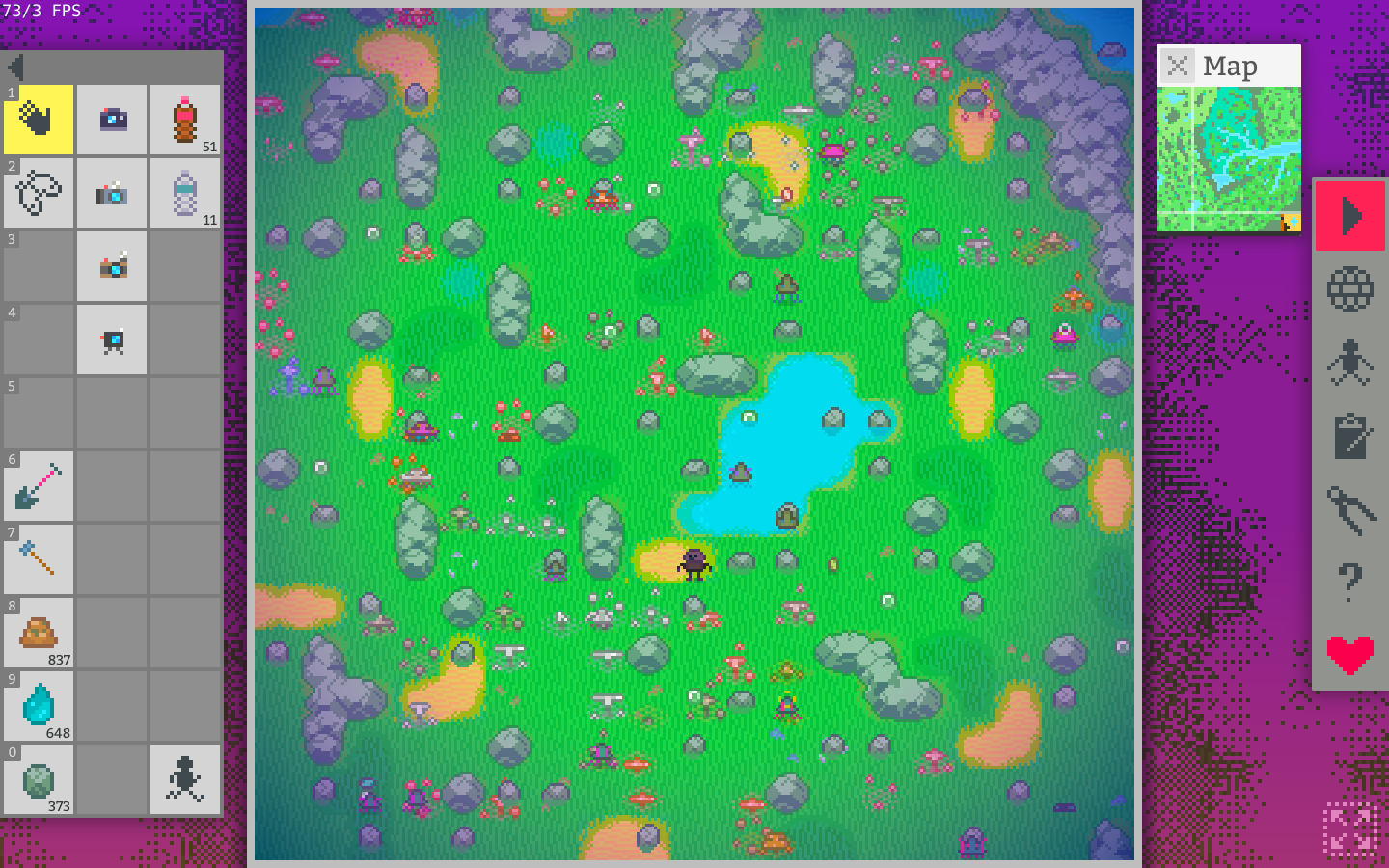
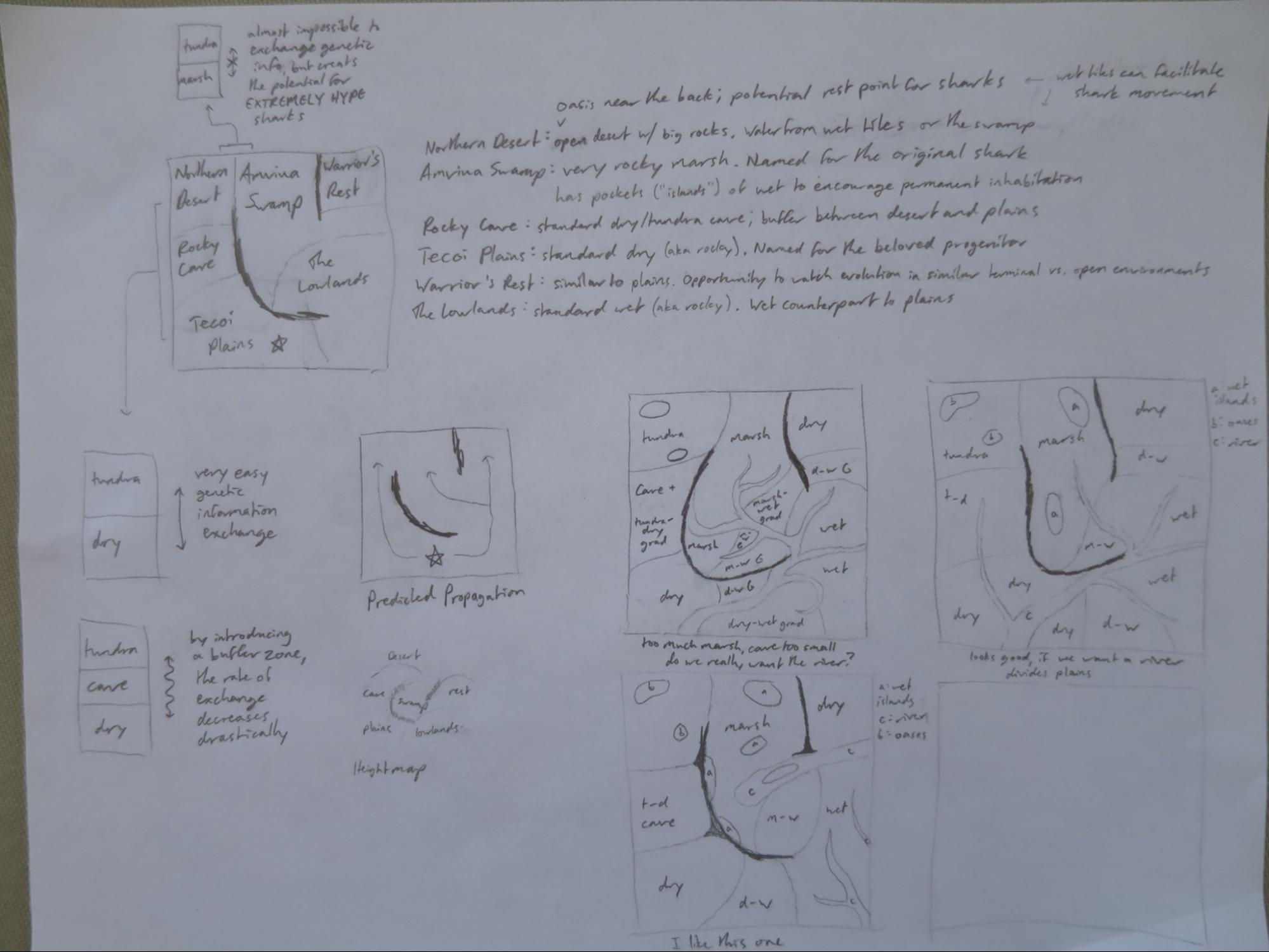
This is the map I terraformed for the purposes of this project. There’s a section on my design process and thoughts at the end, but for now I’ll just show the result. You can use these images to keep track of where on the map the screenshots later are from.
The whole map. Tiles are denoted by their colors, with various shades of green for the different ground tiles. My storage area for terraforming is in the corner, inaccessible by anims.
Eastern Tecoi Plains, close to the border with the Lowlands
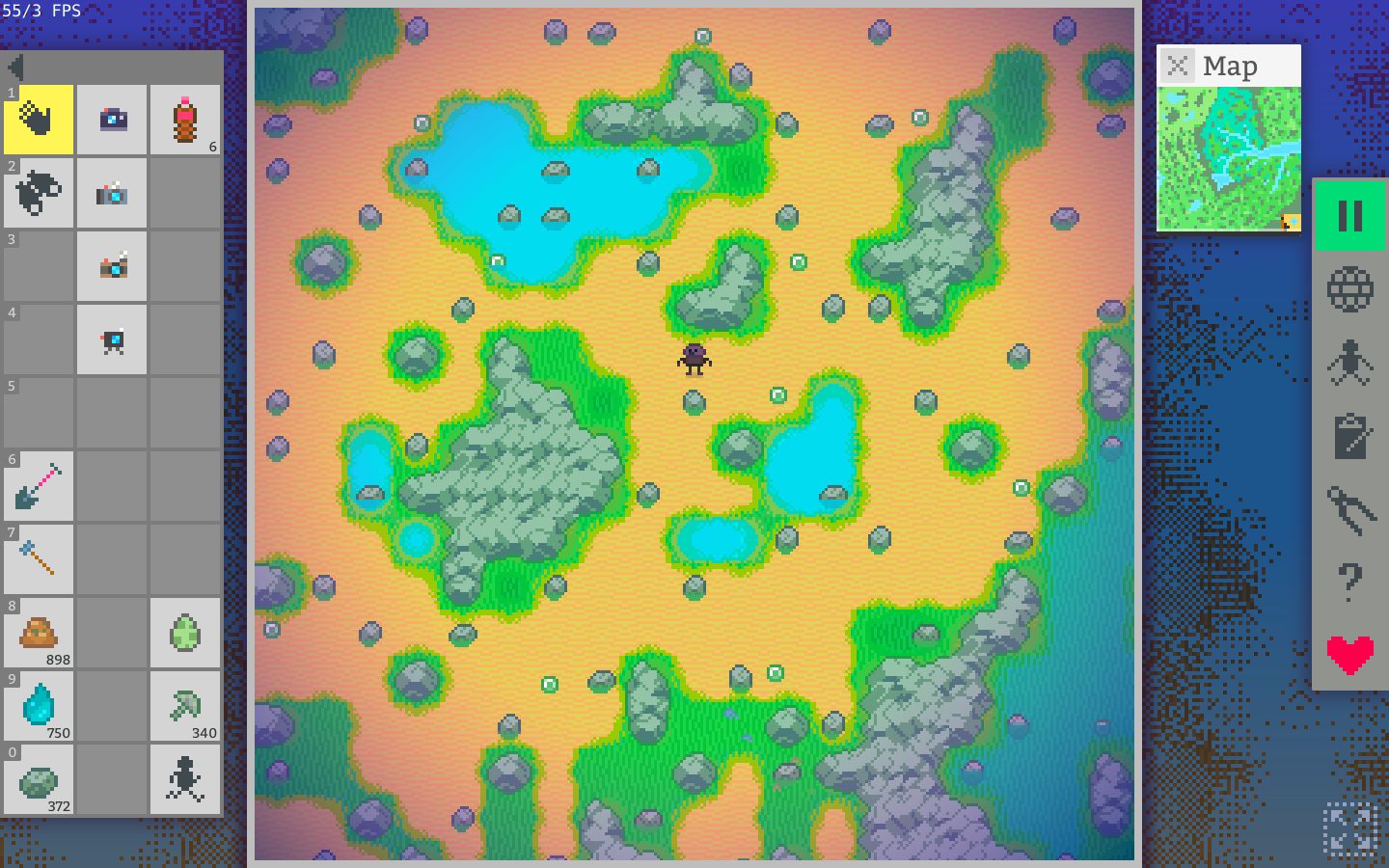
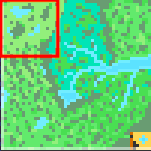
Western Tecoi Plains, right under the mouth of Rocky Cave
Rocky Cave.
Northern Desert
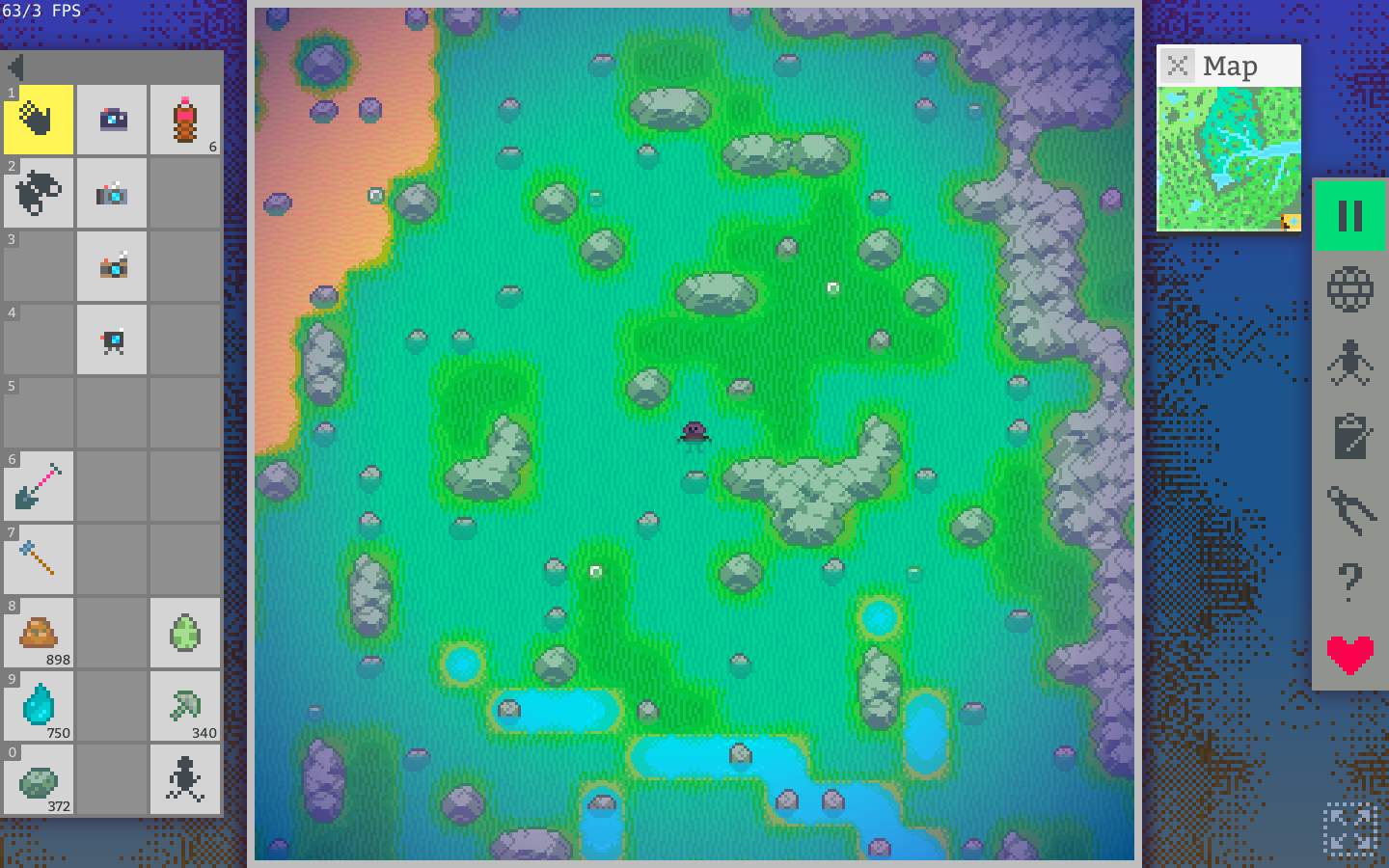
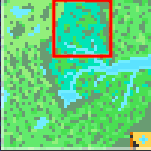
Northern Amviua Swamp
Southern Amviua Swamp
The Lowlands, along with my storage area
The river separating the Lowlands from Warrior’s Rest
Warrior’s Rest
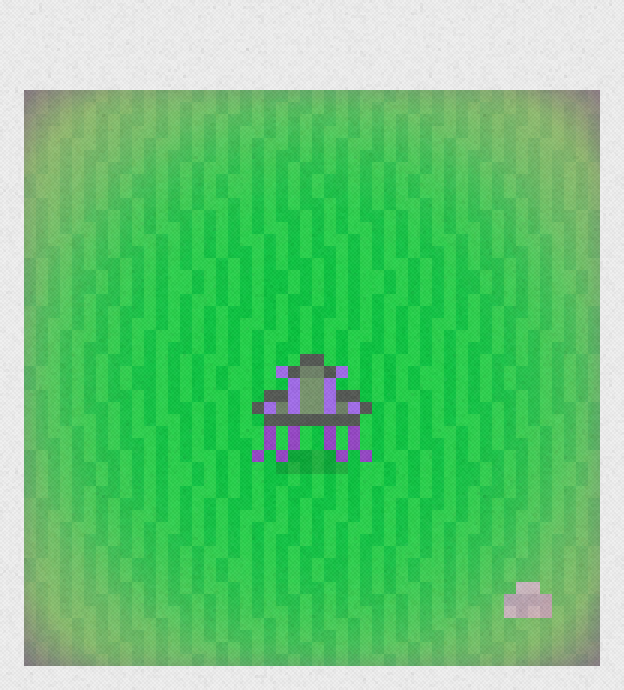
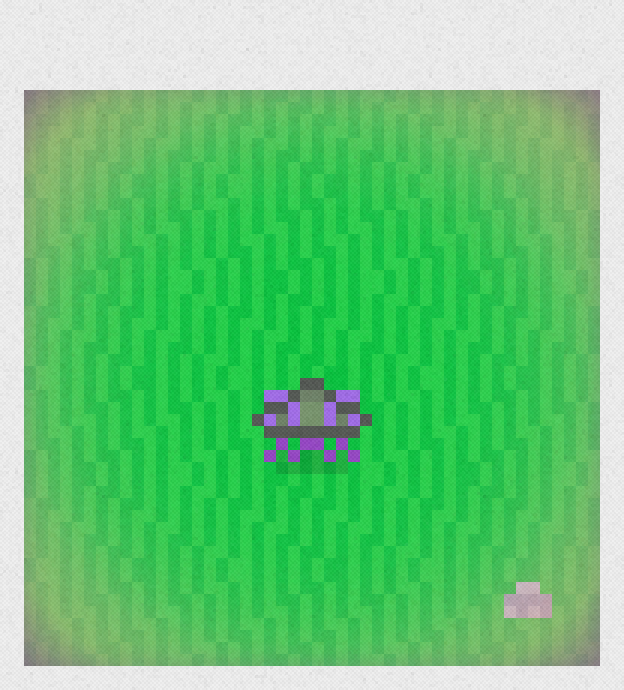
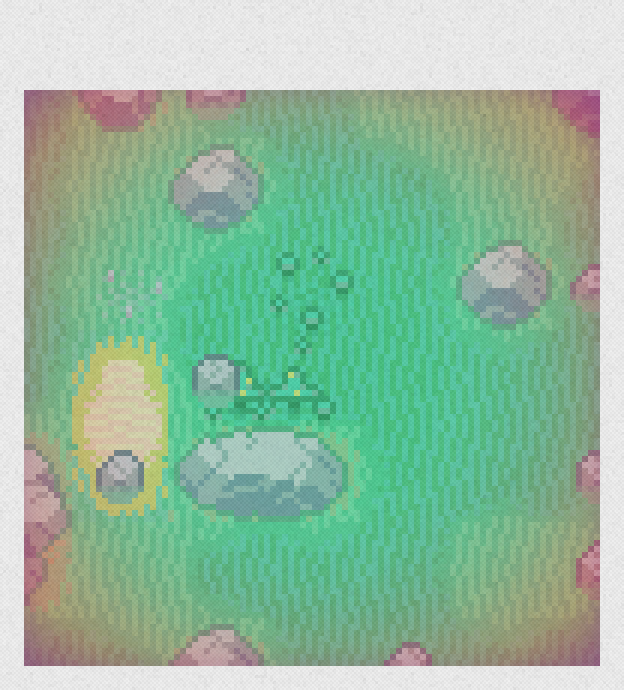
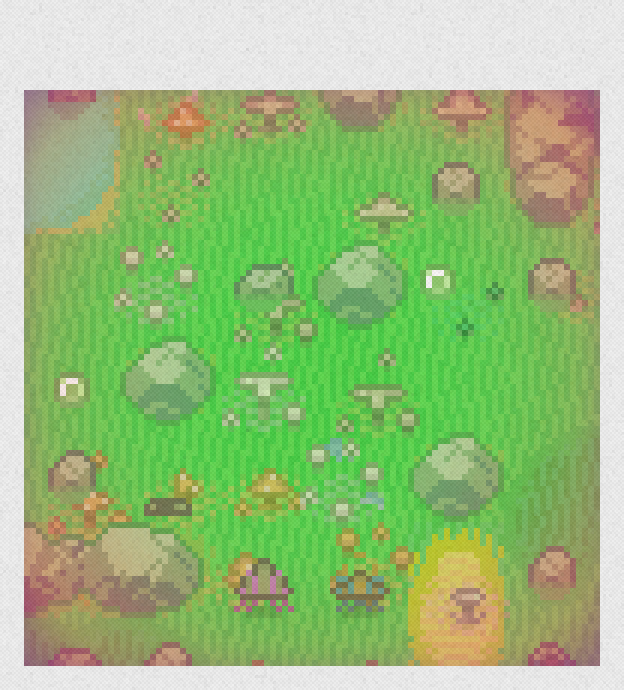
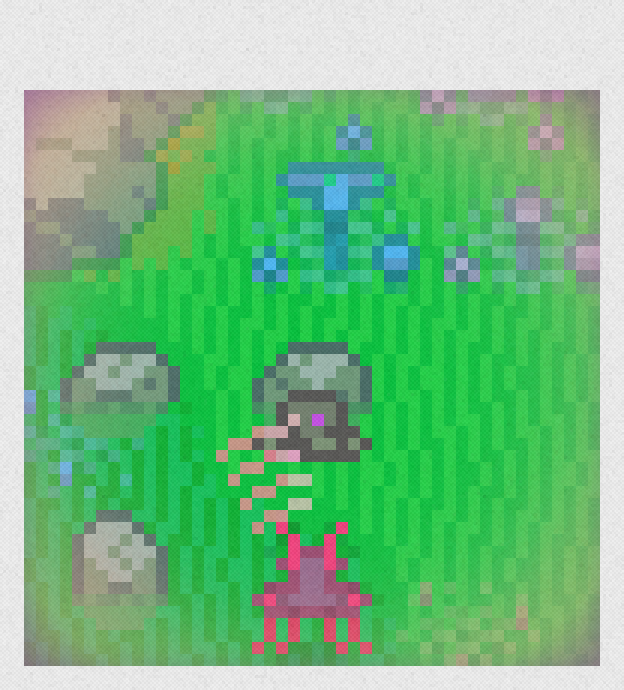
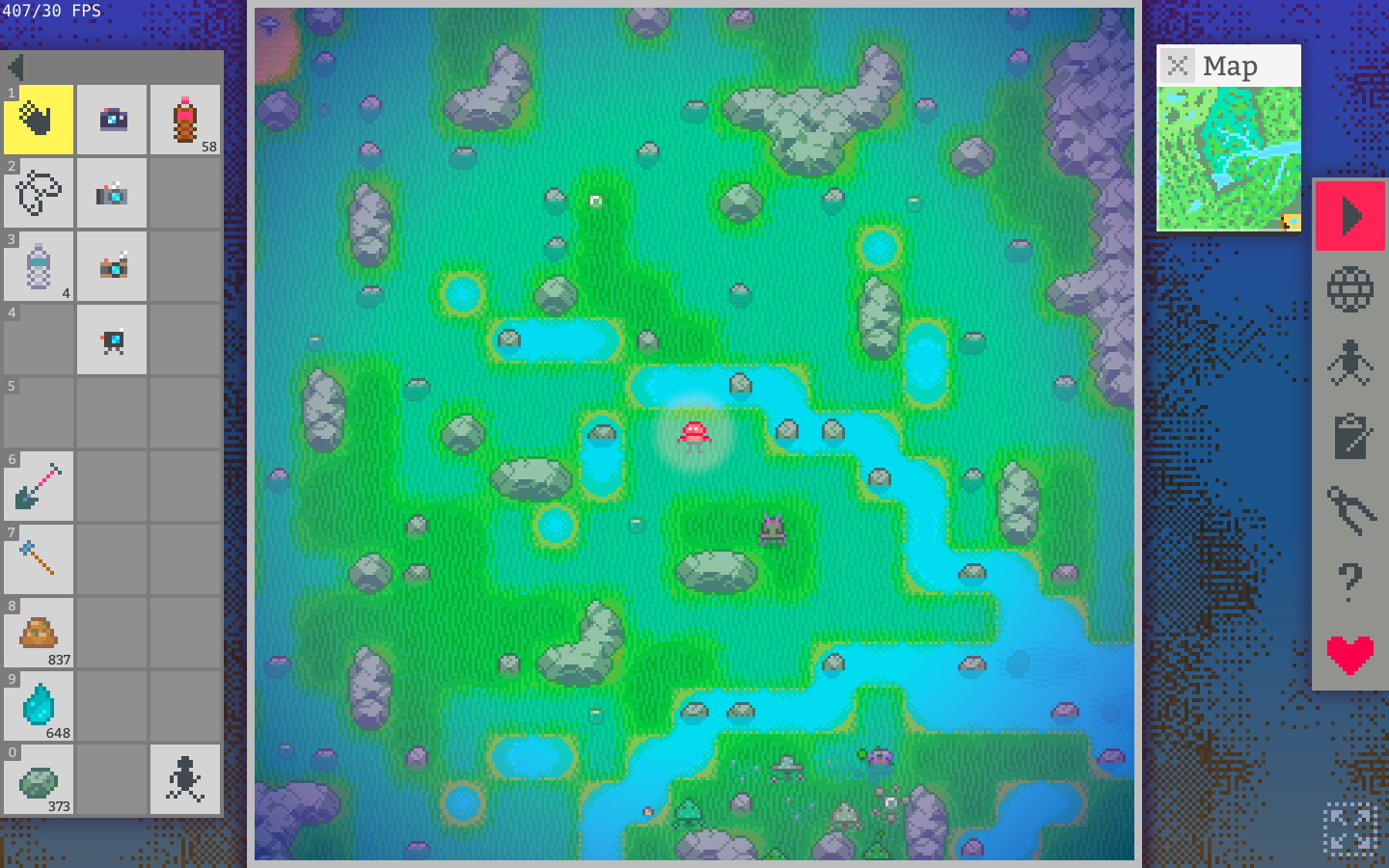
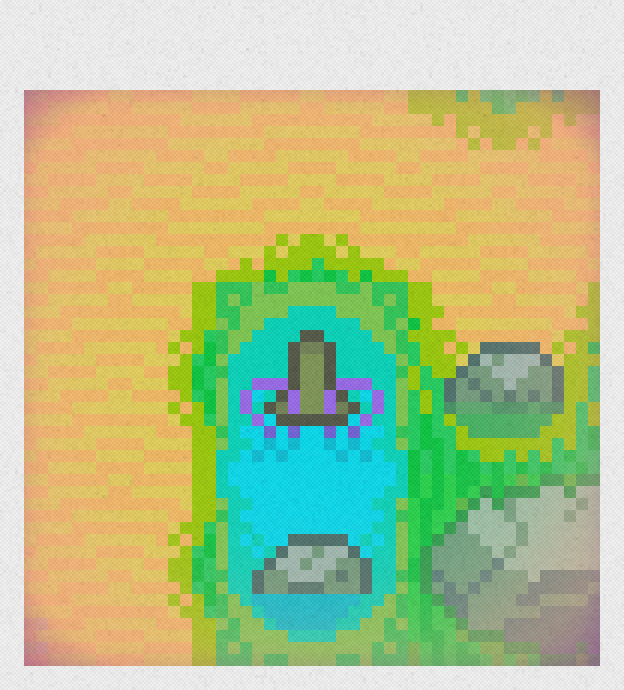
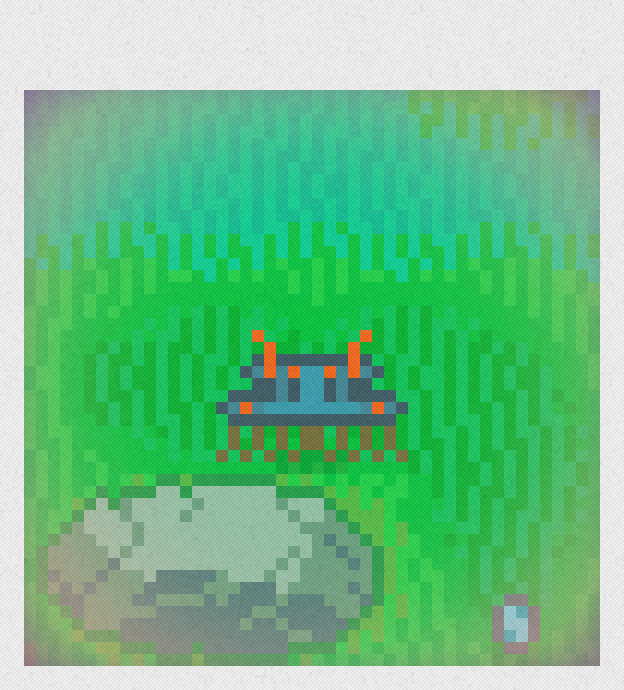
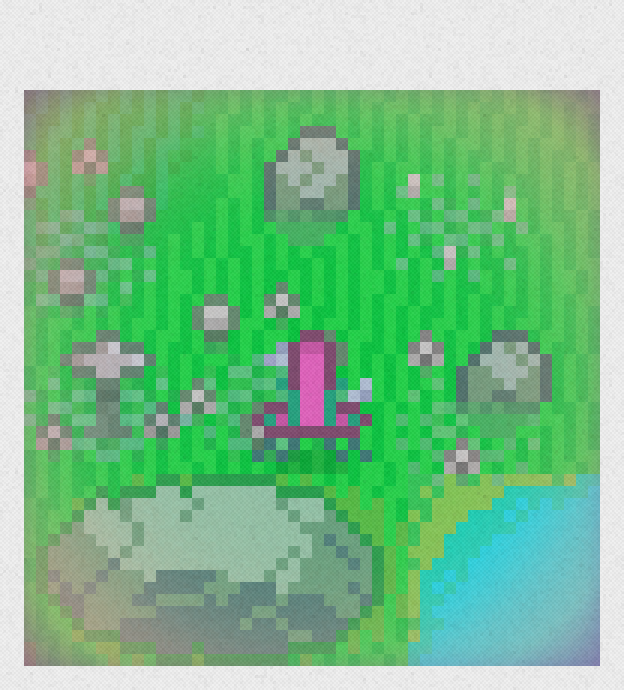
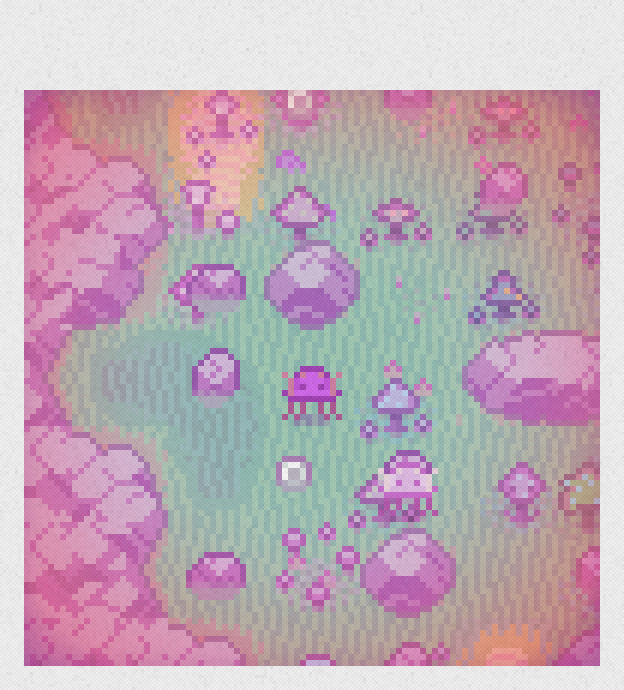
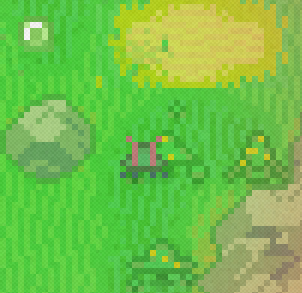
And so it begins! The egg of the progenitor has been placed.
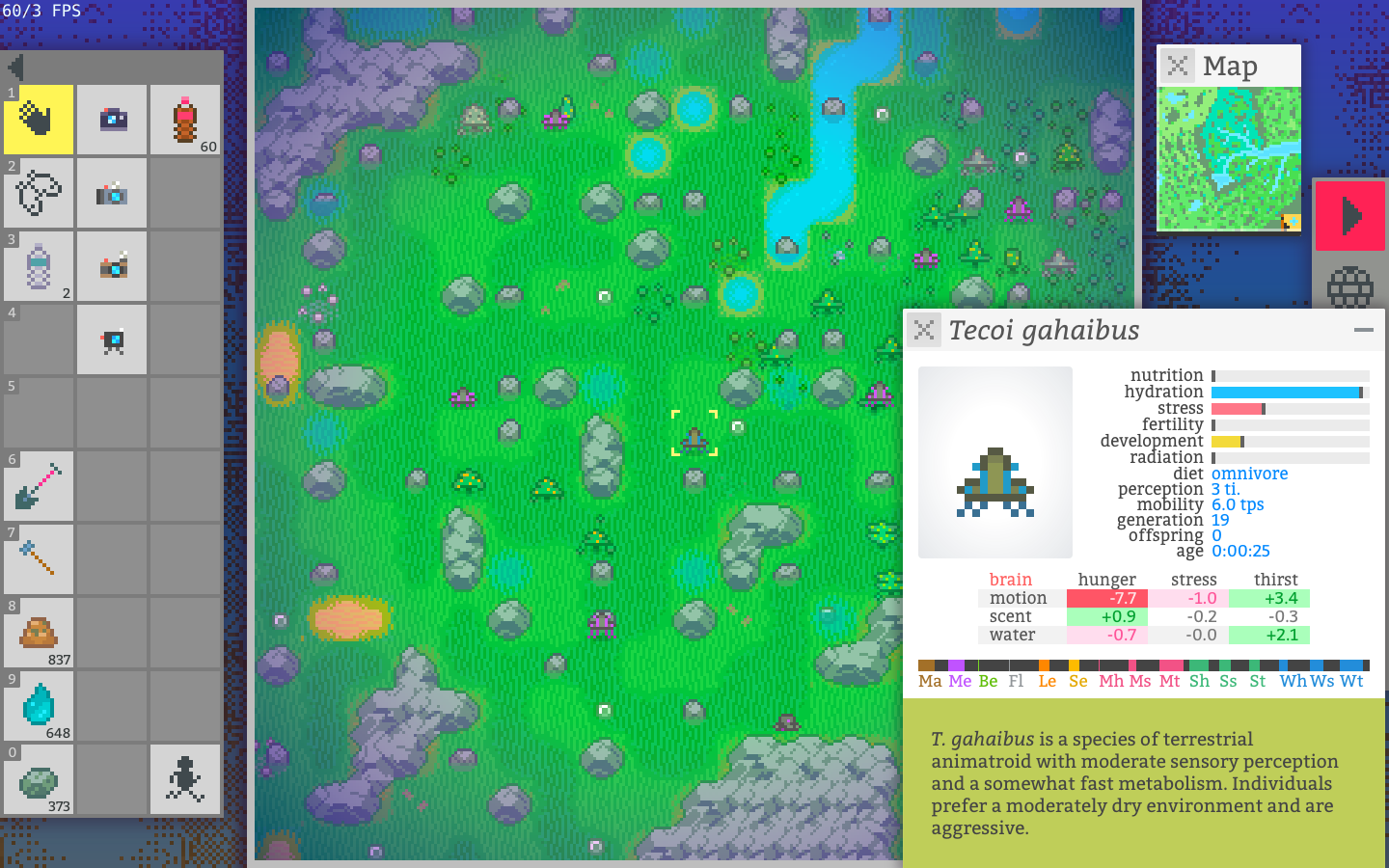
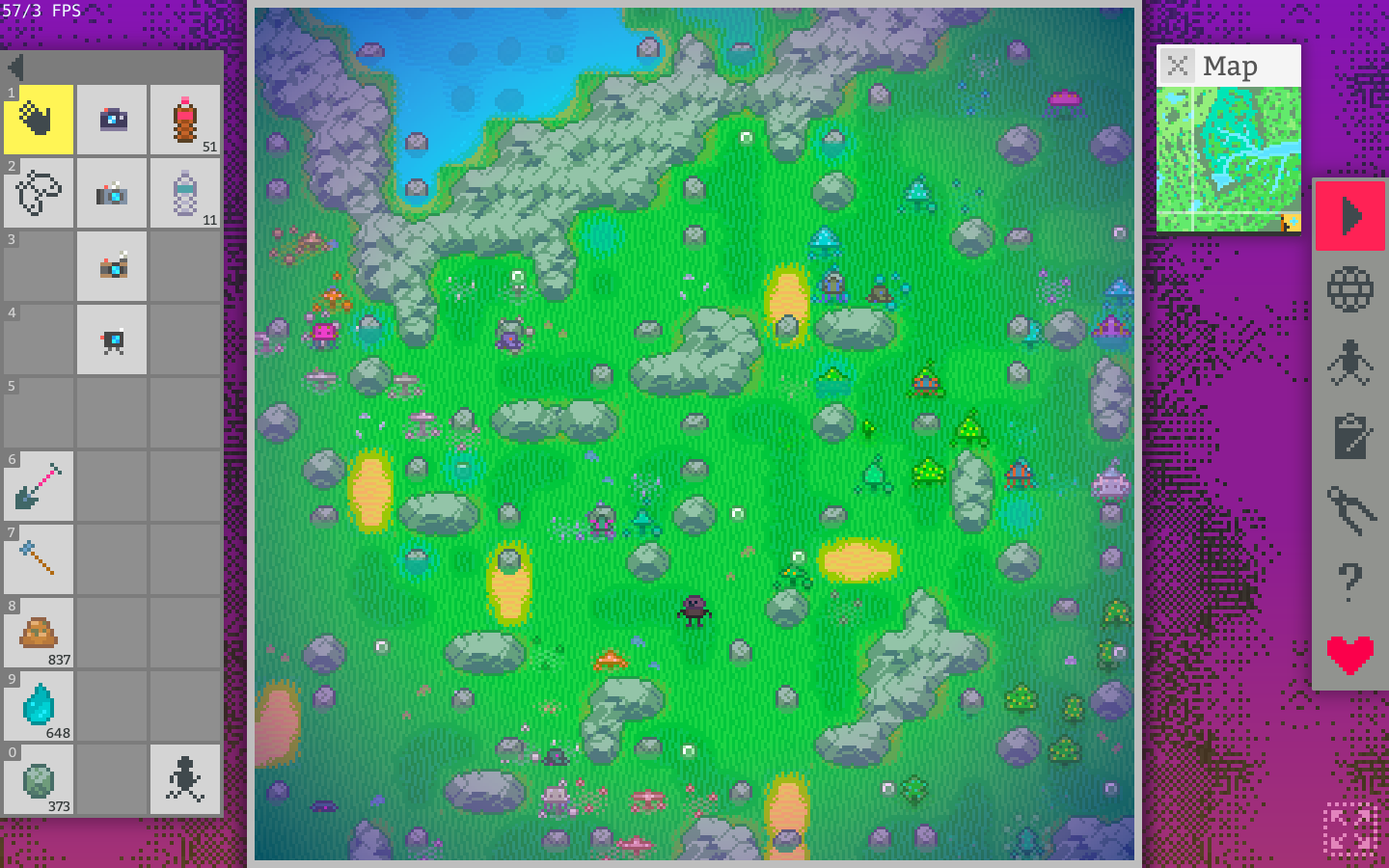
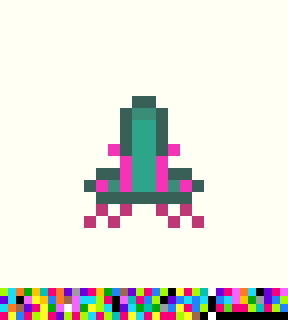
We begin with a single specimen: the progenitor anim of the species Tecoi Dehaibus, which will eventually give rise to all the anims that will end up living in this world. Some fungs inhabit the starting biome, but they have yet to spread to others.
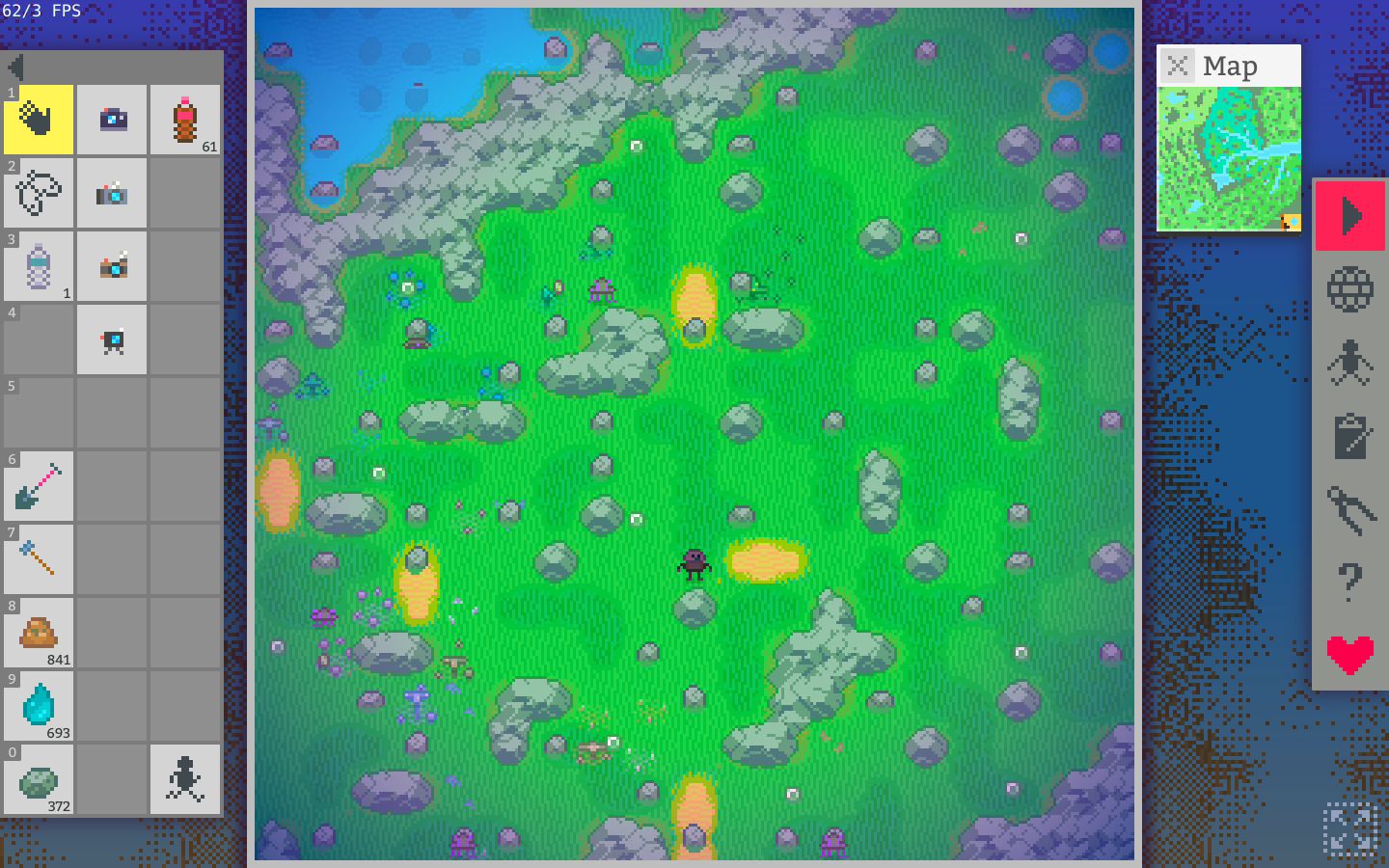
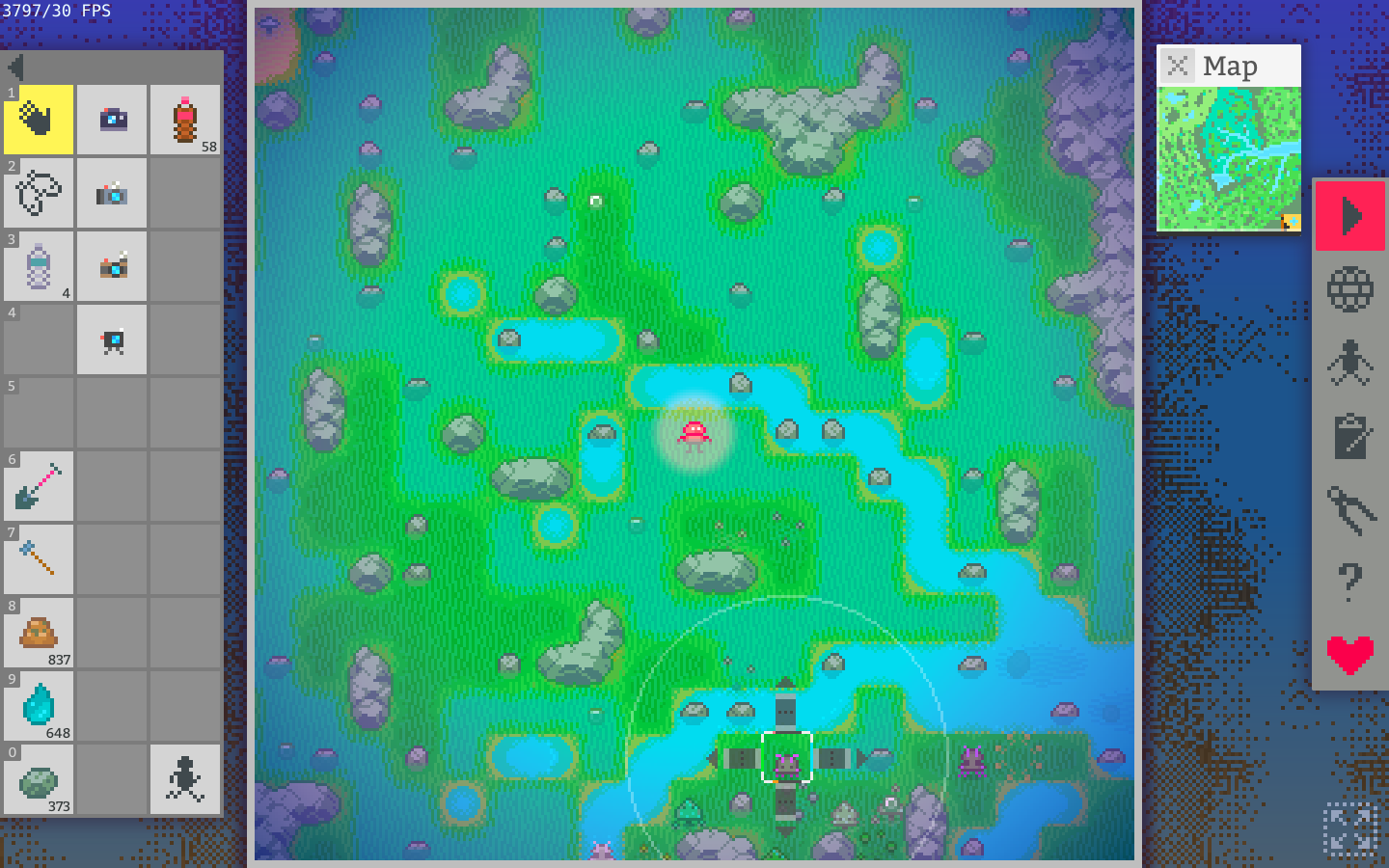
The first family starts to spread out.
In addition to its adaptable body shape, 3-tile sensory range, and 2-minute lifespan, Dehaibus starts out with a somewhat neutral brain— perfect for a progenitor.
A repulsion to motion (i.e. other anims) when hungry and stressed helps it spread out when food gets scarce; as anims become hungry (signaled by their nutrition stat decreasing), their stress increases, and only decreases if they’re sufficiently fed and hydrated. If a lot of the fungs in an area have been eaten and anims are having trouble finding food, this aspect of their brain will cause them to avoid other anims, causing them to drift to locations with fewer anims and therefore, hopefully, more food. This brain setup is ideal for colonizing anim species (as it encourages venturing to uninhabited areas), though it can also be useful for herbivores in certain environments.
The attractions to scent and water when hungry and thirsty respectively make Dehaibus a functioning herbivore; it will seek out fungs to eat when hungry and water to drink when thirsty. A repulsion from water when hungry, although perhaps not too influential, can help an anim move away from a shoreline after drinking. All its other nodes are neutral (±0.4 or less doesn’t make much of a difference), so they won’t affect its decision-making.
Dehaibus’s Brain
Dehaibus have spread throughout the plains.
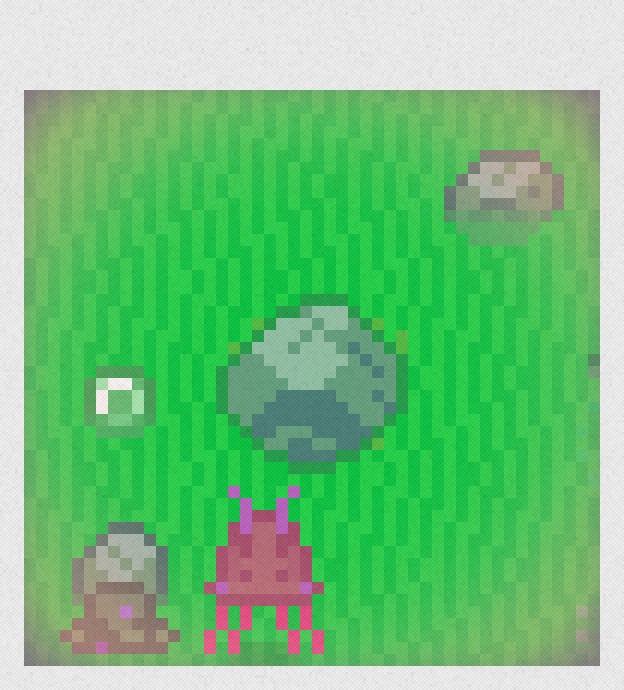
Dehaibus has successfully gotten established! Members of the species have spread throughout the plains (the starting environment) and seem to be living stably, though one area on the right seems to have had all its fungs eaten. Local fung extinctions like this happen constantly in all environments, and generally aren’t much of an issue; however, smaller biomes can occasionally have all their fung eaten, spelling disaster for its anim inhabitants.
We can also see our first physiological mutation in the species— a baby on the left with much longer antennae, giving it a 5-tile sensory radius. However, this shouldn’t matter much, since the abundance of fungs makes that costly mutation unnecessary; higher sensory perception requires more food intake, but there’s already plenty of food here.
The fungs have easily penetrated the dry cave to the north, as it’s composed of the same kind of tile as the plains, and to which the fungs are already adapted. However, these dry-adapted fungs don’t do so well in wetter environments like the lowlands to the East, and therefore the fungs haven’t been able to push very far in that direction. Anims can’t survive anywhere without fungs, so anim colonization will always have to be preceded by fung colonization. I started the world with some fungs living in the plains and everywhere else barren, so the fungs will have to spread throughout the world for anims to be able to do the same.
Fung colonizers on the plains/lowlands border.
Oh dear.
The anims on the plains-lowlands border seem to have pushed too far in before the fungs could properly adapt and stabilize, and have thus eradicated most of the fungs. These anims might be in for a hard time, as they’ll have to wait much longer for a population of fungs to establish itself in the lowlands.
It’s a [redacted]!
In other news, the high-senso anim seems to have reproduced— we’ll see if this lineage sticks around.
To differentiate this fledgling population from the original Dehaibus anims, I’m going to call these guys a a subspecies. I’ll call it ‘Dehaibus Longoculus’ to reflect its long sensory organs (“eyes”).
The total Dehaibus population is booming at 14 specimens; they’re doing quite well in the plains.
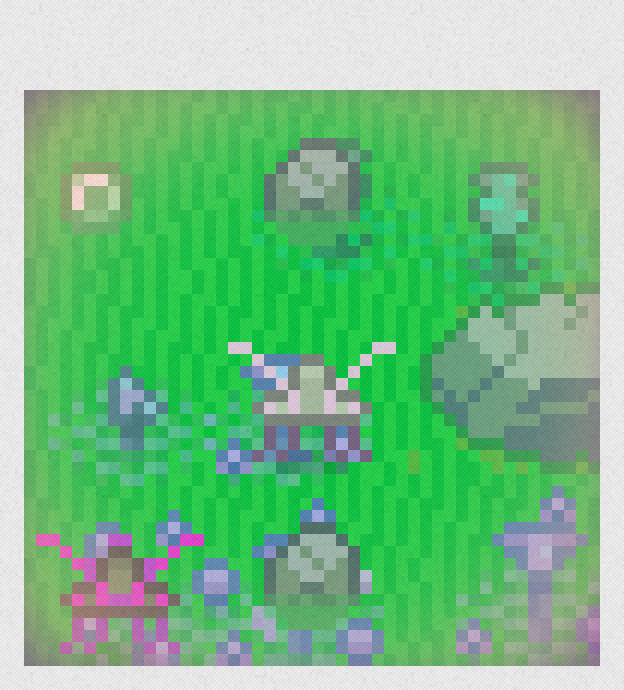
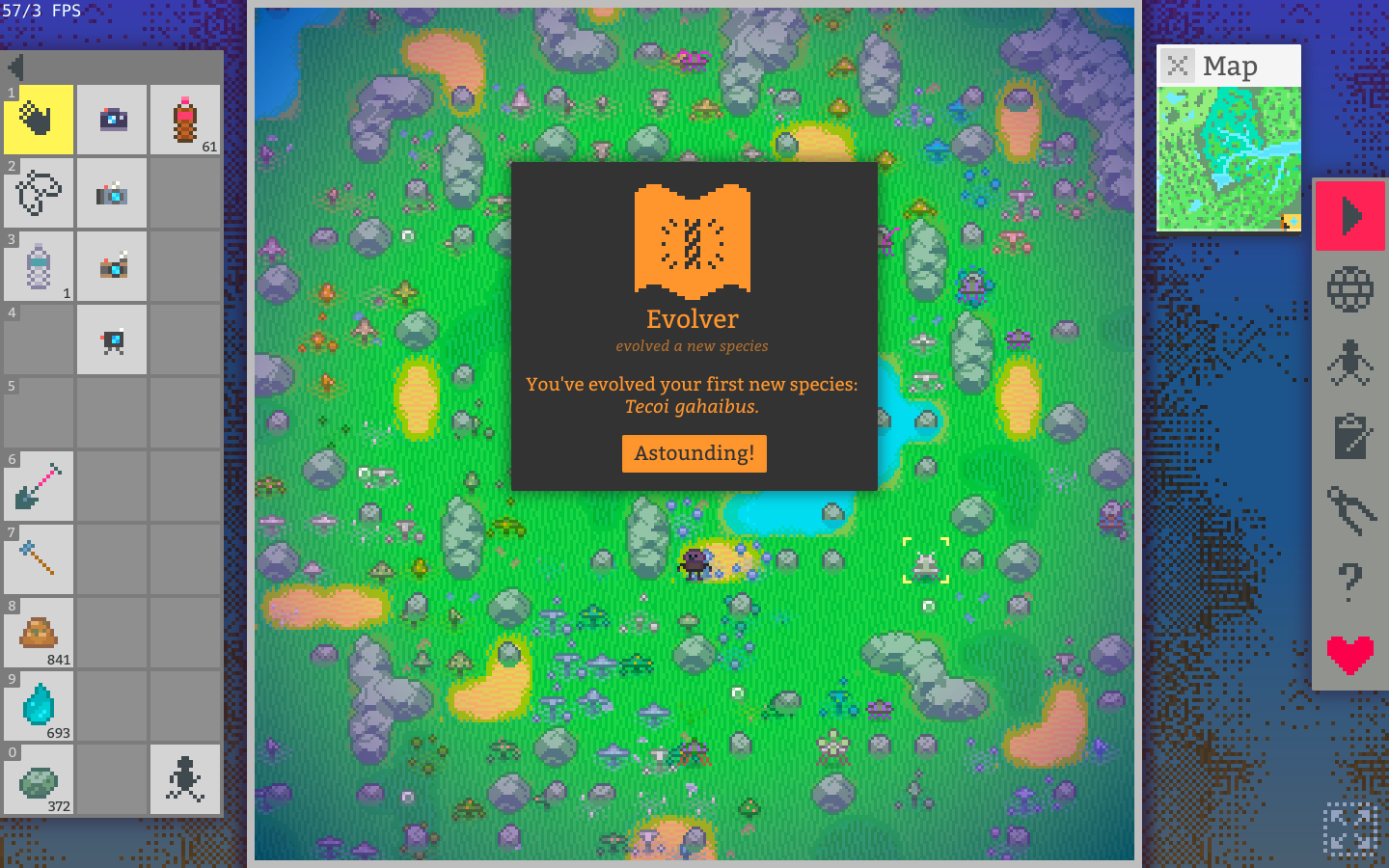
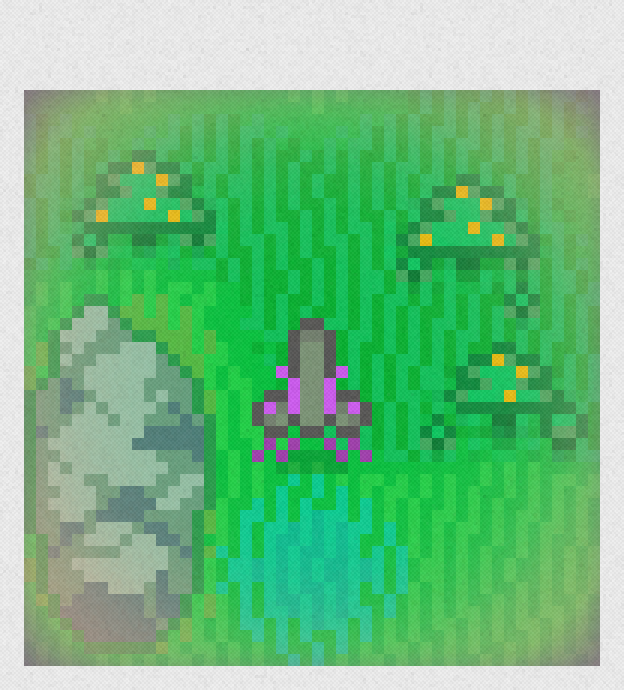
Tecoi Gahaibus on the right.
A freak mutation seems to have produced a new species (with, in my opinion, a quite silly name). This mutation, which gives it a more wrinkly body, makes it ideal for a wetter environment, but it’s unfortunately been born in the middle of the plains— chances of the lineage surviving long enough to occupy a better location are low. It has been born right next to a lake, though, so it’s possible it could take advantage of that and stick around a little.
Anims in the East are continuing to push before the fungs are ready, keeping the border on the lowlands relatively fung-free. It’s been around 7 minutes since the beginning, and Dehaibus populations are up to 20.
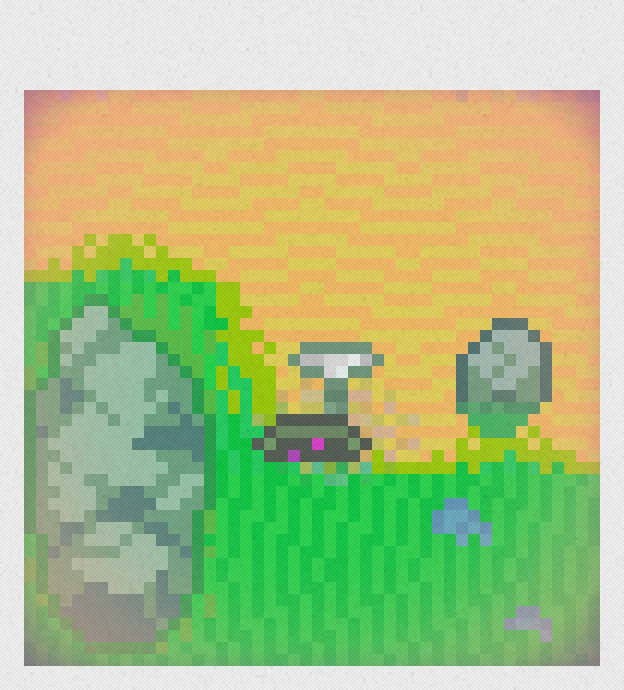
Such is life. Anim corpses have a distinct, recognizable sprite.
Gahaibus made it surprisingly far— halfway to the lowlands— but straying from its lake left it stranded without water, dooming it. There isn’t even available water on the lowland border anyway.
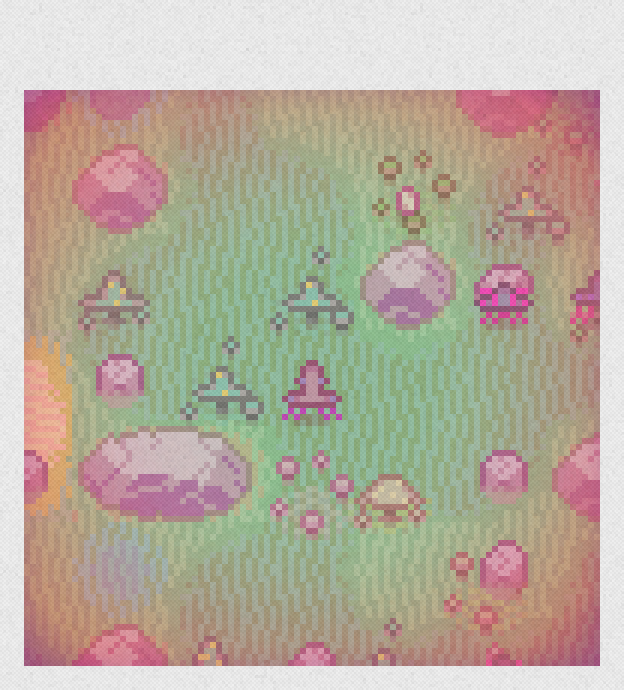
Violence! Anims attack adjacent anims by hitting them with a beam, increasing the stress of the assailed anim.
There seems to be a fledgling population of Dehaibus with a mutation in Motho (attraction/repulsion to motion when thirsty) causing a pretty large (+3.4) attraction to motion. I can definitely see this population surviving, especially in a place with relatively little access to water! These anims will be able to defend areas of water, since when thirsty they’ll prioritize chasing anims over moving towards water due to Motho being higher than Watho (attraction/repulsion to water when thirsty). Or, they might hunt anims to eat for their water content! Let’s call this subspecies Dehaibus Bellus, using the base “Bellicose”– aggressive. The game actually uses this root in the species name algorithm too– if you ever see an anim species name starting with ‘be’ or ‘bel’, it definitely has an attraction to motion somewhere.
The population is plateauing at around 18 anims, and, interestingly, a population hasn’t moved into the cave yet (despite the fact that the current anims should be able to survive in there). The situation in the East is as it always is— continual fungicide preventing anims and fungs from getting established further East. Dehaibus Longoculus has actually stuck around in the West!
I’m starting to realize that the difficulty anims are facing here is due to lack of water— I’m going to add some marsh pools around so anims won’t have to evolve too harshly (they’d either have to evolve to be tiny or highly aggressive w/ fast metabolism) to survive and spread. I’ll leave the bottom of the plains waterless, so perhaps the aggressive faction can survive down there.
Triangle!
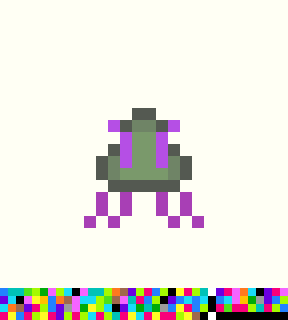
The anims seem to be spreading into the cave now, and a (mildly) interesting new body has developed. For its distinct triangular shape, I’ll name it Dehaibus Triangulus. Despite becoming larger, the increased flesh to skin ratio might actually make it better for the desert, but we’ll see.
He’s so small!
The first tiny anim has mutated, but we’ll see how it’ll do— generally, this archetype only works in the desert, as even on dry tiles it overhydrates.
A key mechanic in Vilmonic is the retention and loss of water: the ratio of light flesh pixels to dark skin pixels around the edges of the anim determines how quickly an anim loses water. Anims passively gain water when standing on any tile (with very little water from tundra and quite a lot from marsh), but the amount it loses at the same time determines whether it has a net gain or loss of water from standing on a tile. Most dry anims have a net loss and are therefore forced to drink, while wet anims and extremely small desert anims like the one above are often adapted to stay almost neutral in their environments, removing the need to focus on drinking.
Due to this, rounder anims with a higher flesh-skin ratio are more adapted to drier environments where they lose very little and gain very little water, and wrinkly anims with much lower flesh-skin ratios are more adapted (and indeed quite necessary) in wetter environments where they gain a lot of water and have to lose it to not overhydrate (in addition to being able to die of thirst, anims can also drown if they gain too much water. This can happen even on non-water tiles if the anim can’t shed its water fast enough).
In addition to factors like required food intake, smaller anims have a distinct advantage in terms of their flesh-skin ratio, especially for drier anims. This is due to how anims’ bodies work; a mutation in the bones of a large anim can drastically change its shape, which could be disastrous. Thus, smaller anims have a resistance to body shape mutations, which can be significant in smaller populations in environments that require very specialized bodies (like deserts and marshes).
This mechanic is arguably the most impactful in the game, and it defines the body shape of anims in different environments. It will be highly relevant throughout this documentary.
That’s not a Gahaibus!
Another anim with Gahaibus’s body has been born near the pool, but its genes aren’t different enough for it to be classified as a different species.
This anim has its own private estate.
A lone anim has moved into a section of the lowlands with a large fung population— it could definitely be successful there!
There are a few anims in the caves, but they seem to have depopulated the fungs, making it temporarily difficult to continue living there. In the south, the Dehaibus Bellus might be a majority now.
Heeeere’s Dehaibus!
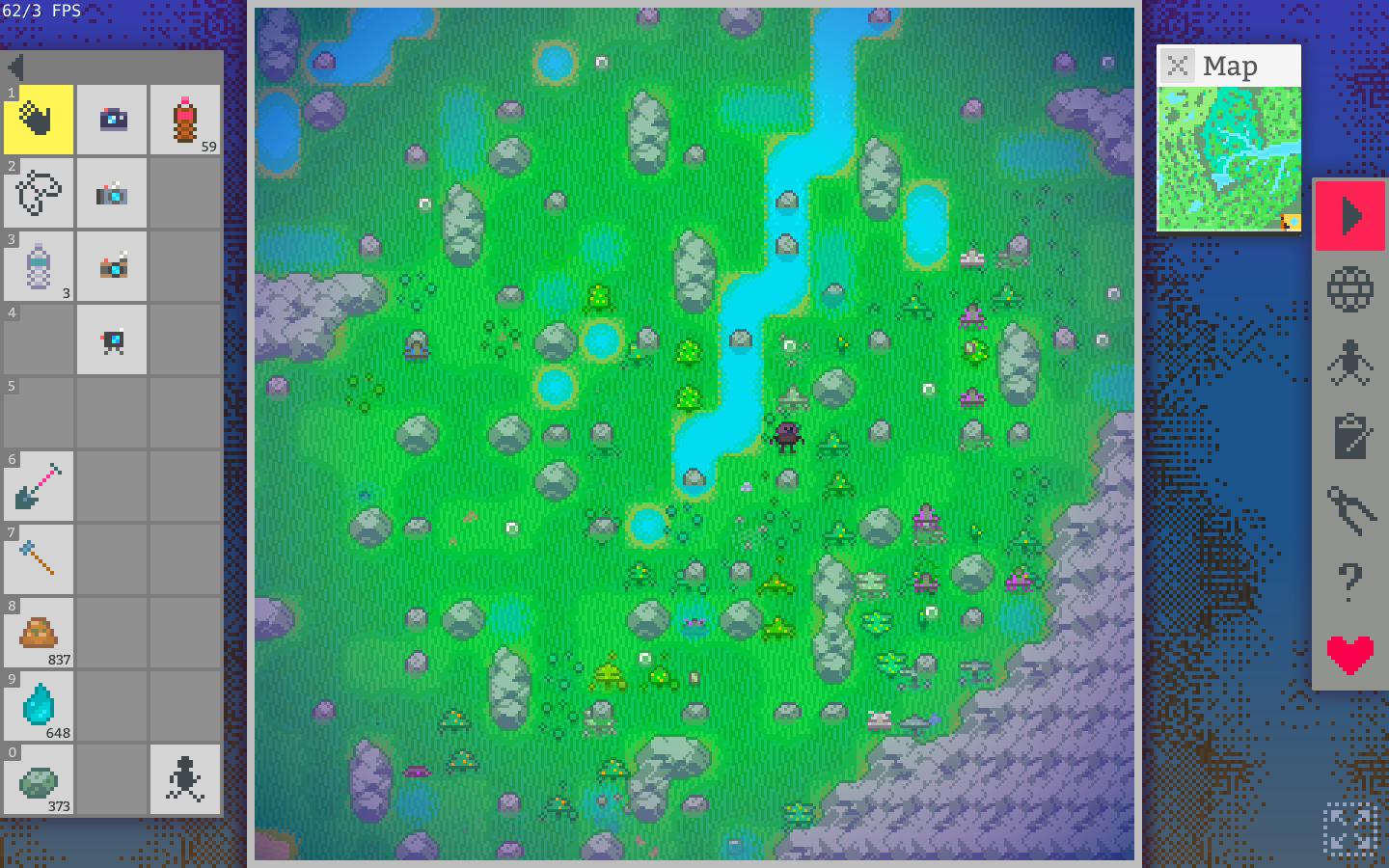
There’s been a disturbing development over in the west— an anim with a VERY high Motho was born to a Dehaibus bellus, and soon after was murdered by its own child (anims can’t recognize kinship; an anim sees motion as motion regardless of who produced it. Thus, the young anim became thirsty and quickly went after the closest anim, which happened to be its parent). It’s quite up in the air, but these guys could be pretty scary if they stay around. For their extreme aggressiveness, I’m naming these Dehaibus Hyperaggrus. Otherwise, the total population is still staying around 20, and it’s now been 10 minutes since the beginning.
Wrinkly
An anim more suited to a wet environment has been born on the lowland border, but the fungs are still having trouble spreading in everywhere except the area shown by this picture. This anim could certainly become dominant in the wetlands if allowed to spread, though!
This lad’s sealed his own fate— there isn’t another fung around for miles.
Like father, like son.
It’s going to be hard for Dehaibus Hyperaggrus to establish itself if all it ever does is eat its own eggs, or, if they hatch, get eaten by them. In the plains, Dehaibus Longoculus has gone extinct.
That doesn’t look like Gahaibus!
Dehaibus Triangulos in the cave seem to have produced a quite interestingly-shaped offspring that’s also taken the name of Gahaibus (new species can occasionally take on the names of extinct ones due to a bug). Definitely not a good spot for it, though; it’s quite wrinkly but lives in a dry environment.
RUN!
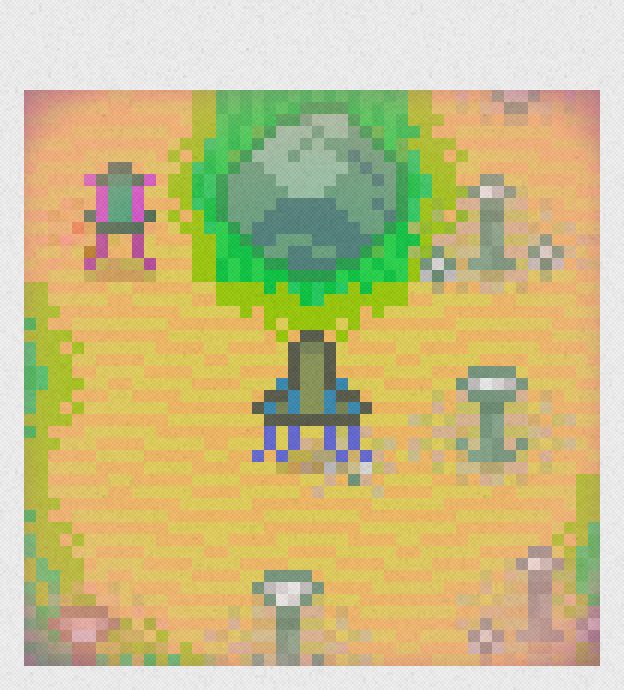
An anim seems to have strayed too close to Dehaibus Hyperaggrus’s realm— things are tense. Amazing! The anim slipped right by, and the Dehaibus Hyperaggrus continued on into the heart of the plains (where it immediately killed someone else). Thirsty for water, it’s going on a killing spree!
It’s a menace!
Current killcount: 4. Scratch that, 5. It’d better eat one of these guys before it dies of thirst!
A warrior leaves the battlefield.
The warrior’s end.
The anim seems to have honorably resigned, ending the lineage of Dehaibus Hyperaggrus. This anim left its homeland to wreak havoc in the plains— what a legend!
In the East, fung populations are extremely sparse again. There’s still a population of anims nearly identical to the progenitor surviving under the lake! Elsewhere, most anims have deviated genetically a little, whether it be their body shape or their brain.
Threat removed.
Yikes! The warrior seems to have had a secret heir, who was luckily bested in the far Southwest by a resident there after killing a few anims.
Oh dear. It seems this one had also given birth, continuing the lineage with an anim who relinquished its forefathers’ body in order to disguise itself with the body of the progenitor. It’s continued the family tradition of eating its first egg. Returning to the ancestral home in the cave, it’s valiantly defending its territory against invading anims!
A narrow escape from a fight; one more hit would have maxed its stress, killing it.
Aftermath.
And the lineage is dead! Bested in a fight against the cave Gahaibus defending its homeland in a lightning-fast gunfight the Dehaibus should have won. Perhaps it was the Gahaibus’s larger size that let it win! Larger anims take less stress from attacks by other anims.
Dehaibus body shapes are starting to diversify, but not to much effect. Total population have gone down a bit to 12, perhaps due to Dehaibus Bellus nearly eradicating itself (you can guess why), with only one emigrant anim continuing the line living in the lowlands.
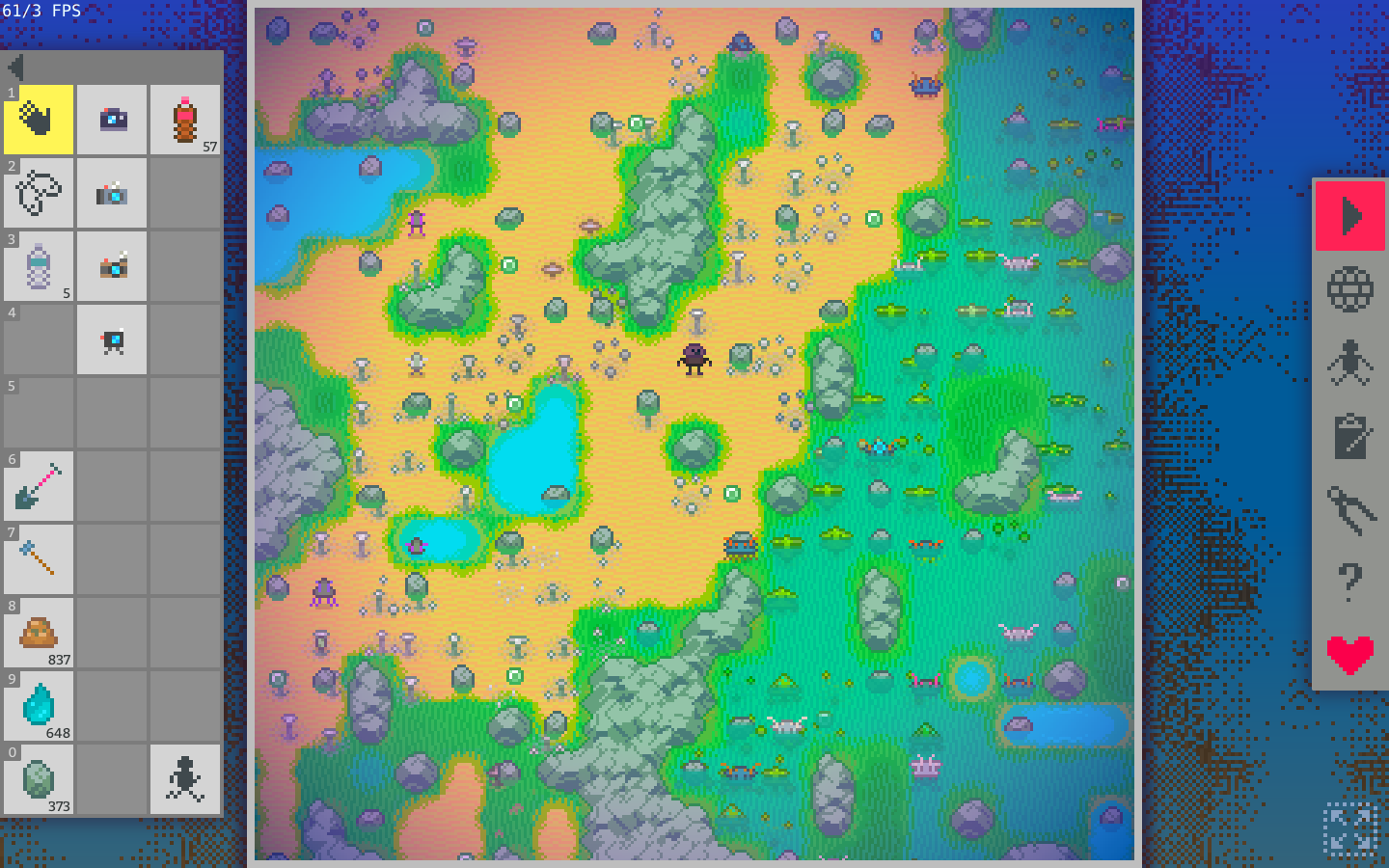
Anim populations everywhere are collapsing, with only 10 Dehaibus left! At 16 minutes, it’s taken more time than I expected to spread into the other biomes. Anims are still progressing in the lowlands, but the fungs are, as always, extremely sparse. With populations slowly rebuilding and little progress in terms of expansion, I think it’s time for a soda. Drinking the soda item speeds up the game by five or ten times, but it makes it more difficult to keep track of what’s happening; thus, I use it when things get dull. It can be easily canceled whenever I’d like.
Eastward expansion, and a new species!
A lot happened very quickly! Anim populations quickly surged back up to 25 individuals, fungs in the East spread and with them the anims, and the lineage of that single Dehaibus Bellus has produced a new species! Who knows how well it’ll do— it’s in a new biome and has good sensory perception and low metabolism, but it might be a little too wet for it.
Oh dear, I was correct. Beocorum has died. In just this time, though, Dehaibus is up to 35! Presumably, the fungs repopulated after having been eaten, and this allowed anim populations to soar back up. Still no stable populations of other species— this was only the third other species to exist, counting the two Gahaibuses as separate.
Reminds me of the beginning!
Dehaibus Dehaibus have re-established themselves in the southeast, forming quite the sizable population! There are anims pushing into the cave again, but the fungs still haven’t adapted to the desert North of it, so they won’t have anywhere to go. Dehaibus Bellus is the only population remaining in the lowlands, and they’re right at the horn.
Tecoi Dehaibus Minus.
This cute little anim has begun to establish itself in the western plains. With its smaller body, it could be more fit to this dry environment! Let’s call this one Dehaibus Minus, since it looks like a smaller version of Dehaibus Dehaibus.
Oh yeah, it’s big brain time.
A new species— Tecoi Depli— has mutated on the north shore of the lake. Not much to say about this one.
Expansion!
Dehaibus Bellus has pushed further into the lowlands, and the fungs seem to be taking up root stably! After 20 minutes, it’s looking like the lowlands will finally be successfully inhabited.
Unfortunately, the cute Dehaibus Minus have died out, but at least Depli’s reproducing.
I think I recognize that name…
The name Gahaibus is back, this time as offspring to Dehaibus Bellus. Even stranger, the body shape is the same as Dehaibus— why is this guy considered Gahaibus? I think it’s time for another cola.
Now, there are more new body shapes! Some things never change, though— there’s a few lonely anims exploring the cave, but the fungs haven’t yet inhabited the desert.
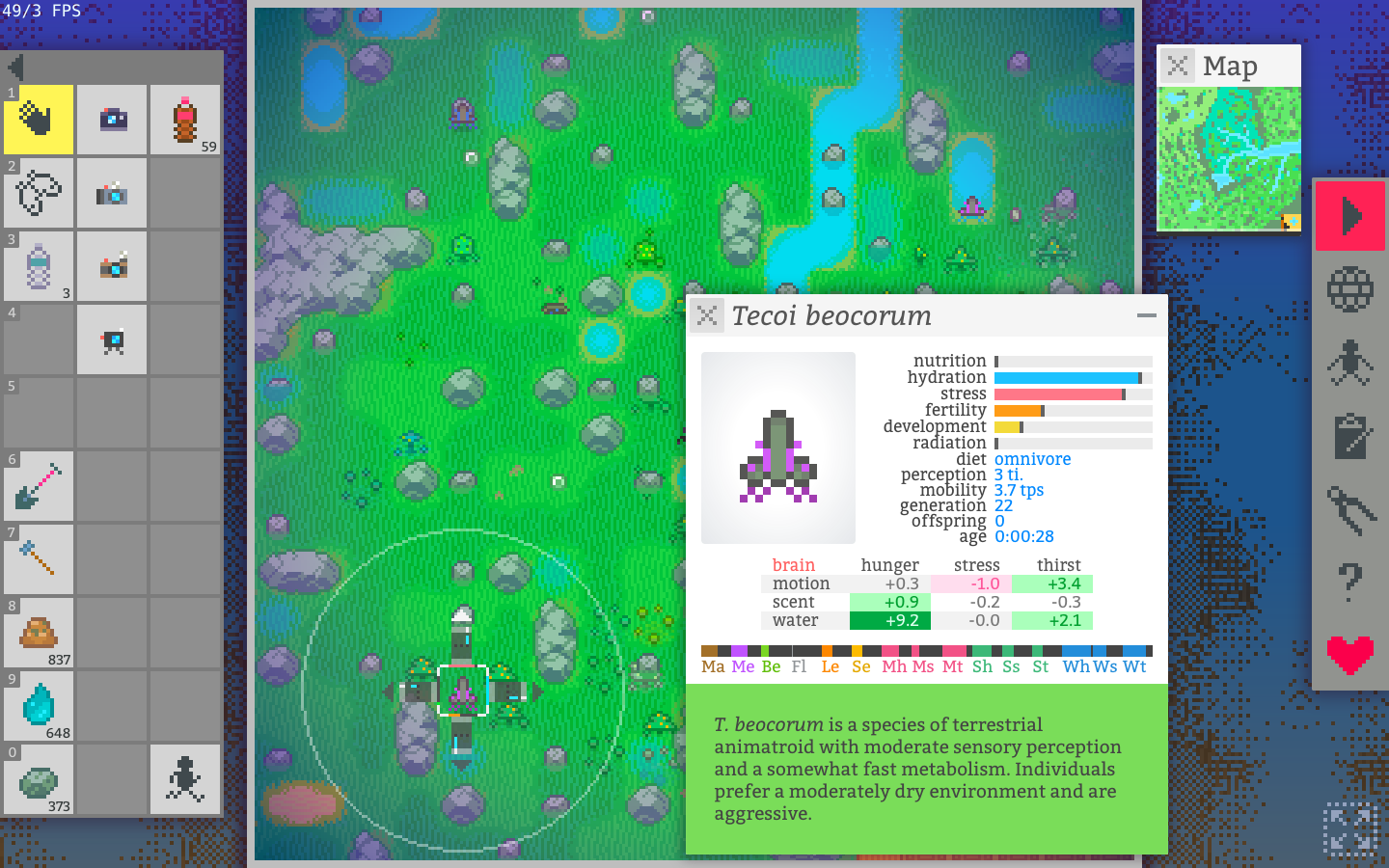
Tecoi Beocorum II
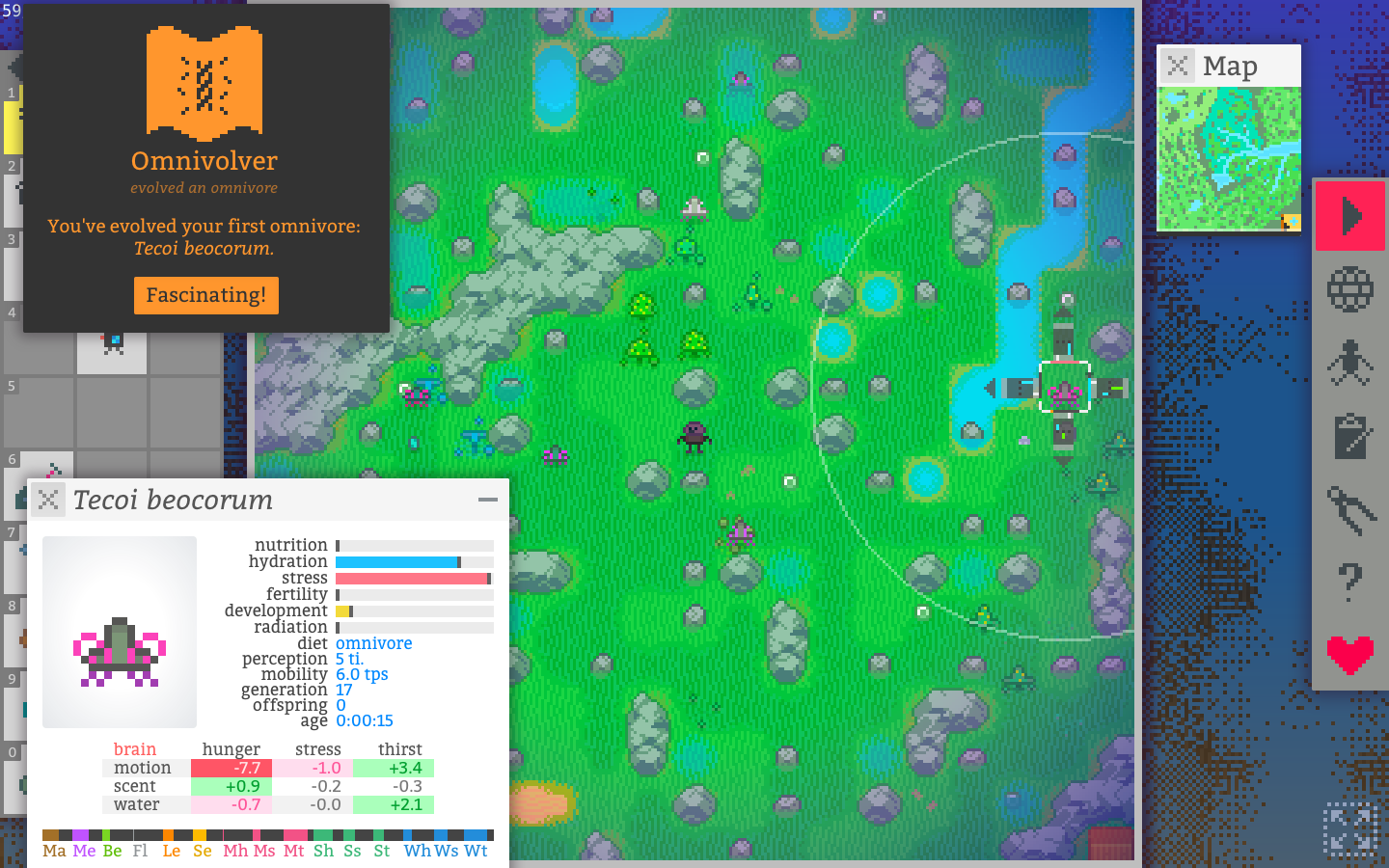
A new anim has evolved from the now-dwindling Dehaibus Bellus population near the lowlands border. Its name, Beocorum, betrays its aggressive ancestry with the root “be”, and its higher-surface-area body should make it better adapted to the wet lowlands. Unfortunately, it had a fatal flaw in its brain, stopping the species from propagating.
A dumb anim’s last moments, starving while surrounded by fungs.
A mutation (perhaps the one that caused it to be considered its own species) in Moho created a huge attraction to water when hungry— so huge that, rather than eat fungs when starving, it simply went to and from a water hole until it died. A great example of deleterious traits removing themselves!
Dehaibus Bellus survives!
Meanwhile, the anims at the horn are barely alive, but the far East anims are flourishing. Interestingly, despite the repeated evolution of wrinkly anims, the Dehaibus Dehaibus’s body seems to still be the most popular. Perhaps anims haven’t inhabited the lowlands for long enough for a wrinkly body’s small advantage to be statistically significant.
It’ll likely take fungs a long time to evolve to live in the marsh. First, anims will have to cross the river in the North, which usually only happens once the biome gets quite full.
While they’ve once again varied their colors and shape a little, descendents of Dehaibus Dehaibus still have an identical brain to the progenitor. This population could realistically stick around forever!
Desert at last!
Fungs have finally started living in the desert— once the currently unpopulated cave gets anims pushing through, they’ll be able to emerge and start a population on the other side! I’ll have to keep a close eye on the cave now.
It’s got a nose.
While I was at first simply going to comment on how silly this fellow looks, there’s actually something more interesting to talk about here. I believe the only difference between this Dehaibus and its peers is one bone— because it extends one pixel below the old body, the anim’s legs are forced to connect to it, giving it only two legs instead of four. You can notice that the top of the body is exactly the same as with most Dehaibus!
We’re at roughly generation 20 (but some populations are a bit younger, of course— this will only be compounded as the world fills up) and 25 minutes.
They’re coming!
These anims are pushing up the right side of the cave, but the fungs in the desert haven’t spread toward the right exit yet. This family has depopulated the East of fungs, so they might be forced to move up now!
Freedom!
And it made it! This anim should be able to set up a population in the desert.
Tecoi Beocorum III
In the lowlands, another line with the name Beocorum has integrated itself with the Dehaibuses— with the classic wrinkly archetype, it could certainly become the dominant population! Of additional excitement, that would make it the first stable new species that occupies its own important niche (wetland dweller)— something we should see a lot in the future.
Anims have actually moved all the way up to the shore of the river in the northeast lowlands, but there isn’t enough competition to force one to cross.
Tecoi Depli Rotundus
Depli’s actually still around, hanging out with a small population at the south opening of the cave for many generations. It quickly adopted a more compact body shape that’s better suited for the dry environment. Let’s call it Depli Rotundus for its rounder shape.
Tecoi Beder
Beocorum in the thriving lowlands have given rise to a new species— Tecoi Beder. Not much seems different aside from a more dry-focused body shape (and a slightly different color), so who knows if these will stick around.
Tecoi Beocorum Cephalopodus
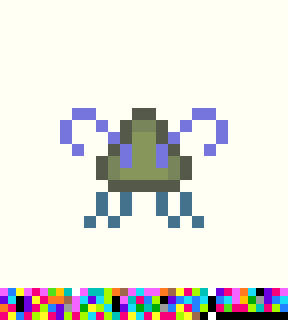
The wet environment has also allowed our first truly strange shape to arise— this family of Beocorum has a very wrinkly body that could suit them quite well, letting them worry a lot less about losing water. A body like this might be necessary to even survive up in the swamp, but that area doesn’t have fungs yet. I’ll call these guys Beocorum Cephalopodus, since they remind me of squid.
The current population count at 30 minutes is 27 Dehaibus, 16 Beocorum, and a handful of Beder and Depli.
Tecoi Dehaibus Minusxus
Another Dehaibus subspecies with the body of Dehaibus Minus (This one will be named Dehaibus Minusxus, using Vilmonic’s traditional -xus ending for repeated species names) has appeared and seems to have taken over the South plains. In the desert, a family of Dehaibus has eaten most of the fungs, giving themselves a hard time for the future. A Depli Rotundus also seems to have gone up through the cave and is nearly out— with its slightly rounder body, it could prove more fit in the desert. A tiny Beder-shaped anim mutated in the lowlands, but promptly died from overhydration.
Double Kill!
Classified as a carnivore, but really only seeking blood for water (like all Beocorum), the last Beocorum Cephalopodus fights viciously to survive. It’s just occurred to me that anims only eat corpses when hungry, which explains the warrior’s demise (it was thirsty, but not hungry). Thus, Dehaibus Bellus and its descendents the Beocorums’ Motho doesn’t make much sense.
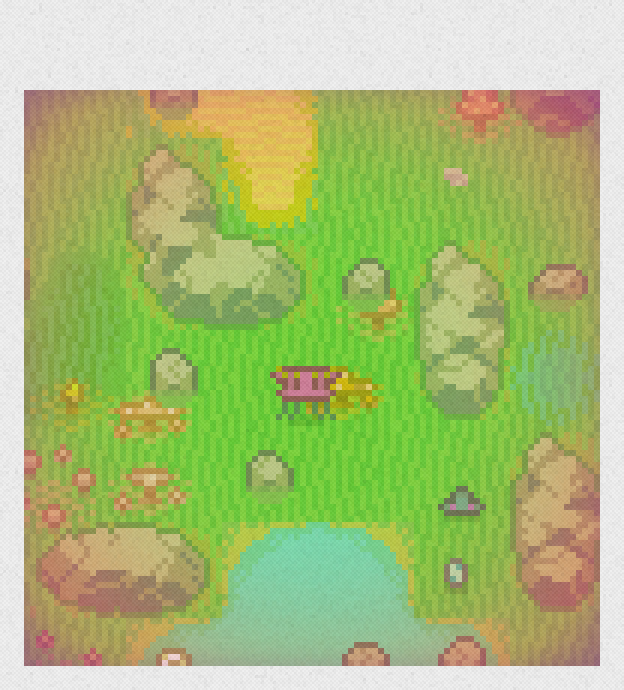
A relaxing area.
A Dehaibus Dehaibus, seemingly unrelated to Dehaibus Bellus, has rounded the horn and is living in a small, picturesque area next to the lake.
Fung extinction.
Having depopulated the desert fungs, the Dehaibus of the desert have receded back into the cave for now. The fungs should spread further over the desert in time, allowing the anims to stay in the future.
Two identically-shaped tiny anims seem to have been mutated in the lowlands at the same time— Desdiae and Debeum. They definitely won’t survive there, though– much too wet. If only one like that could appear at the mouth of the cave!
Somehow, the Dehaibus Cephalopodus is still surviving at no more than two individuals at a time. Even more remarkably, the South cave entrance is now empty of anims and full of fungs, allowing Depli Rotundus to repopulate and survive. In fact, with all the other cave anims dead, it’s looking a lot like Depli Rotundus will be the ones to inhabit the desert!
Crossing of the Great River
And suddenly, to my surprise, a northern lowlander has made it across the river!
A brave sacrifice.
I was going to talk about how crossing the river, this anim would bravely sacrifice itself to plant fungs in the uninhabited Rest, but it appears an anim had already done that without my knowing. Unfortunately, that happened too recently, so this anim simply ate the one living fung and died, replanting it for future anims.
Beder’s dead, but Beocorum Cephalopodus is surviving with 3 specimens now. There’s another new and uninteresting (it’s pretty much the same as Beocorum) species in the lowlands— Tecoi Benos. I’ll cover it more if it survives. There’s also a new anim with very long legs, Debeum (absolutely no relationship to the tiny anim from before), and this long-legged archetype generally seems to do well in watery environments. Close watch is needed to see how things progress in the lowlands— there’s lots of change happening.
Depli Rotundus comfortably inhabits the cave, but it hasn’t moved up into the desert. Beocorum in the lowlands are now the majority species! Dehaibus populations in the plains are sparse at just six specimens, with seven Depli Rotundus to the north. Luckily, there’s plenty of fungs in the Southwest, so the Dehaibus Minusxus that do live there should be fine.
“Lush” and “Desert” aren’t words that usually go together.
The desert is completely full of fungs now, and a Depli Rotundus might be moving up through the cave to take advantage of that.
Another Beocorum crossed the river to die, since the wet-adjusted fungs are having trouble growing on the dry tiles of the Rest.
Interestingly, the lowlands seem very prone to creating single-specimen species– anims considered a new species that aren’t fit enough to survive. What could cause this tendency?
A 5-tile sensory range is perfect for this sort of environment.
To deal with the mild scarcity of fungs, the remaining Dehaibus population in the southwest has developed a high sensory perception. To contrast this subspecies with Dehaibus Longoculus, let’s call it Dehaibus Circoculus for its curled antennae.
Quite a pretty desert, if you ask me.
Meanwhile, Depli Rotundus has finally moved into the desert!
All of the lowlands Beocorum offshoots have died, except for Beocorum Cephalopodus and the new and ridiculously-named Behaibus. Dehaibus populations are up to 12, roughly tied with Depli, while Beocorum is at 20.
Tecoi Depli Exter in a cave
A new population of Depli seems to have taken over the cave, though their poor sensory perception is not a trait you’d want in that environment. Their odd body shape is very strange (something I haven’t seen much of before), and perhaps not ideal for the desert. For their weird shape, I’m calling them Depli Exter.
It has arrived.
Another Beocorum crossed the river, but this time there’s some fungs on the other side. It’s possible, but I doubt it’ll be able to start a steady population. Somehow Beocorum Cephalopodus is still alive (still at 1-2 specimens), while the random new species keep popping up and dying. Depli is now at 20.
The progenitor’s body repeatedly re-evolves.
Nearly all the Beocorum in the lowlands are wrinkly, but they and Depli occasionally mutate to reproduce the progenitor’s body. Since these Depli have been somewhat successful, I’ll classify them as a new subspecies: Depli Dehaibiforme, to reflect that their body is identical to that of Dehaibus Dehaibus. Tragically, Beocorum Cephalopodus has finally died out.
Tecoi Desdileae
A tiny anim, Desdileae, has evolved in the desert. While an archetype like this would usually take over the desert (due to their ability to reproduce rapidly and survive with low fung and water resources), the abundance of water here might let larger anims beat it out through sheer bulk.
After eating most of the fungs, the desert population has thinned a little. I think it’s time for another cola.
What a journey!
While I was under cola, this MASTERMIND entered the swamp, pooped to plant fungs, went back to its home to eat, returned, and then ate the fungs it had planted! While I doubt its children will be able to survive, it eventually pushed deeper into the marsh before dying, spreading fungs even further. Hugely impressive!
At 50 minutes, Behaibus seems to be defeating Beocorum (13-5, and they both look the same), but Desdileae’s presence is still small. Depli is flourishing at 23, and Dehaibus is just hanging on at 4 Minusxus.
Depli Longoculus is common in the desert along with Depli Rotundus.
Desdileae died. Dehaibus is down to one specimen at the south entrance to the cave, but it seems to be surviving. These desert Depli (both Depli Rotundus and their high-senso branch, Depli Longoculus) have a surprisingly long lifespan— over 5 minutes! These guys are a full 10 generations behind Behaibus in the lowlands.
Depli Micrus
These tiny Depli, descendents of Depli Extrus, still comfortably inhabit the cave. For their size, I’ll name them Depli Micrus. In the southeast, the Depli Extrus is still around along with some Depli Dehaibiforme.
Tecoi Behaibus
The lowlands are still inhabited by wrinkly anims like this one, but most are now Behaibus instead of Beocorum. Fungs are getting pretty sparse, though.
The frontier!
At the entrance to the swamp, anims seem to be comfortably hanging out and are starting to enter the swamp more. Fungs appear to be adapting to live there, so they might start spreading more soon. Fungs have finally populated the Rest, so there’s now potential for a new population if a good anim crosses the river.
I see five corpses in this picture— most of them on the right, which was recently barren of fungs.
While the fung extinction took its toll on some of the inhabitants of the lowlands, the population seems to be fine. They might want to lower their metabolism a little, though— we’ll see if that happens. Currently, their lifespan is around 2:30.
The two remaining Dehaibus Minusxus, plus one’s egg.
Somehow the Dehaibus Minusxus are still alive, having moved through the cave into the east of the desert. What I find really interesting here is that the brains all around haven’t really changed much— all the lowlands anims have the original Dehaibus Bellus brain of attraction to motion when thirsty, strong repulsion from motion when stressed, and very slight attraction to motion when hungry; everyone else has the progenitor’s aversion to motion when hungry and stressed, and ignorance when thirsty; and everyone has about the same stats for attraction to scent and water.
Dehaibus is back up to 5, Behaibus + its random offshoot species + the 5 Beocorum is 27, and Depli + a few of its tiny offshoots are up to 31!
Successful explorations
The anims seem to be comfortably moving into the swamp now, and a population is starting in the Rest! I think this is a good time for a cola— we should see the anims and fungs spread further into the swamp and the Rest anims proliferate.
The newly-born Tecoi Indeae
At the southern mouth of the cave, the Depli Micrus have produced a new species: Tecoi Indeae. Somehow the Dehaibus Minusxus are still hanging by a thread, now pushed to the desert-swamp border. They’ve mutated a huge attraction to scent when hungry, but I doubt this’ll do anything— it’s just drift. The old Depli are still in the desert, but their numbers are thin due to a temporary fung extinction in the west. Though Depli Rotundus are always present, Depli Longoculus seems to be living to 8 minutes now!
Unnamed Behaibus and Behaibus Cephalopodus
Behas and Gabeum
In the lowlands and swamp, new and weird body shapes are becoming more common. The squid shape has re-evolved in Behaibus, and the towering new Gabeum seems to be proliferating. While some of these shapes will certainly die out, some could survive.
Dehaibus Minusxus has somehow retaken the desert, but Depli Longoculus is still surviving at one member due to its extremely low metabolism and ability to always find food.
Too late.
This one’s pretty funny— this species died almost instantly after it was born, so I was never able to catch an actual specimen of it.
Anims on the river shore of the Rest
Anims in the Rest will have to stay close to the river for a while until they can evolve to live in the waterless area inland. By evolving from the dry-adapted Dehaibus to the wet-adapted Behaibus, and now being forced back to dry-adapted, they could assume totally different characteristics from their ancestors despite occupying the same niche.
Depli Exter in the plains
I’ve been quite surprised by Depli Exter’s fitness— they’ve stayed around in roughly the same spot for 20 minutes now!
In the desert, the Dehaibus Minusxus have displaced all the Depli, unfortunately ending Depli Longoculus. The Gabeum in the lowlands have also proven unfit and died off. Populations after an hour are: Dehaibus: 6, Behaibus: 22, Behas: 5, Depli: 18.
Tons of anims in the South Swamp
A surprising amount of anims are coexisting in the swamp at the same time. This is relatively uncommon for such wet terrain, and I’m surprised by the abundance of fungs. I’m really not sure what the cause for this is.
Fuller anims in the Lowlands
In the lowlands, population density has cooled down from its earlier fever and a new, gumdrop-shaped population of Behaibus is emerging alongside the endemic wrinkly Behaibus; let’s call it Behaibus Rotundus.
Almost all of the desert Dehaibus have died, and I’m not sure why— the biome seems full of fungs. They should be able to safely recover, though.
Tecoi Beocorum IV
In the desert, a freak mutation created a high-senso species named Beocorum. This is the fourth time a new anim species has been given this name!
Tecoi Behaibus Planus
This platform body shape has become quite dominant in the marsh, with anims losing water very slowly due to their low flesh-skin ratio. If they ever do get low on water, they can easily drink to regain it, since they live in marsh tiles.
A more diverse time in the Plains and Cave
In the plains and cave, five major subspecies are coexisting: the Depli Exter and Micrus all along the West, their nose-shaped offshoots the Indeae/Inenum in the middle of the cave, Depli Dehaibiforme in the East, Depli Minus in the center of the plains, and, crazily, a new subspecies that looks just like the original Depli! Let’s name this one Depli Archeus.
The Depli: There and Back Again
An invasive force!
The swamp fungs have spread nearly to the top of the swamp, allowing the anims inside to proliferate further and reach the desert/swamp border. They seem to have wiped out the Dehaibus Minusxus living there, and I just missed it all! It’s really amazing how long Dehaibus hung on, only losing in the face of a huge invasive population. They survived for over an hour despite facing massive pressure from better-adapted species!
I do believe that this was the last Dehaibus.
Swamp anims can only visit the desert or at most have a population of a few anims living in pools (as I originally planned! How exciting.), but they’ll be a constant presence for anims trying to reclaim the desert.
At around 70 minutes, anim populations are now tending to be a bit denser. Species count: Behaibus (Behaibus and Rotundus in the Lowlands, Palustrus and Planus in the Swamp): 45, Behaorum (Behaibus Palustrus offshoots): 12, Behas: 4, Depli: 29, Indeae + Inenum: 4.
Tecoi Indebeae
Dehaibus actually left a tiny offshoot species population, Indebeae, after its death, but its chances of survival look slim. If it doesn’t survive, then the only two significant species produced by Dehaibus were Depli and Beocorum. This makes sense— one adapted to the dry West and the other to the wet East, filling the only two meganiches in the map.
Swamp anim siege
Also, yikes! The high population density of the swamp has naturally forced quite the number of swamp anims into the desert, where most will surely die. Unfortunately, I watched with my own eyes as the last Indebeae searched in vain for water, eventually dying of thirst and finally ending the last lineage of the Dehaibus survivors.
Tecoi Pldei
On the plains/lowlands border, the interestingly-named offshoot of Depli called Pldei seems to be holding a comfortable niche. The plains/cave seem to be having a diversity boom similar to that of the lowlands a bit ago, with many small populations of new species popping up!
As of yet, there’s still no permanent population in the Rest. To get one, a species will need to evolve to the drier environment and then spread sufficiently throughout the biome that they won’t experience an extinction event— if they do, the whole process will have to start over with a new mutation. The Rest is turning out to be a LOT harder to colonize than I initially expected, and I’m certain that the lack of water is at fault.
Depli Rotundus circa 30 minutes and Dedier Dedier circa 80
Somehow, a family of Depli descendents, Dedier, re-assumed the body shape of their ancestors and followed their same path up into the desert! This body shape hasn’t been seen since Depli Longoculus 10 minutes ago!
Tecoi Deini and Desdileae (II or III; most small anims that evolve seem to get this name)
The Plains melting pot has produced small families of two key body shapes we had been missing: tubes and micro-anims. Usually, one of these two body shapes takes over the desert, but this has interestingly not been the case in this world. The tubes are fantastic at retaining water, and the micro anims reproduce unimaginably quickly— if one is born, it can reproduce before it can die of thirst if given no water. That’s actually why I think these haven’t been successful in the desert; with so much water around, larger and more powerful anims have been able to live there, preventing weaker anims from getting established.
Two factions approach each other.
A war is brewing in the desert as Dedier Dedier and Dedier Micrus (a subspecies of tiny Dedier) near the swamp border. If Dedier can get established, then what’ll likely happen is that they’ll have to perpetually endure raids from the swamp— the desert anims can’t survive at all in the swamp (they’d die very quickly from overhydration, and they wouldn’t do anything to the anims there anyway due to their nonaggressive brain), but the swamp anims can reliably enter the desert and stay there in the pools, wreaking havoc (especially with their attraction to motion when thirsty, turning them into vicious killers when in the parched desert!).
Behaibus Mutations
There’s been some crazy towering bodies in the lowlands, but none of them have stuck around. Population check at 75 minutes: Behaibus: 66, Behaorum: 17, Behas: 3, Depli: 13, Desdileae: 1, Dedier: 19, Inenum: 4.
Pldei has died, Depli Exter still inhabits the westmost plains where it’s been for so long, Inenum is still barely alive in the cave, the swamp is absolutely full of Behaorum and Behaibus, and the Rest is still unconquered. Behaibus Rotundus continue to occupy the lowlands, as they have for a while now.
The sad end of a rebellious Dedier Micrus.
This is what the desert anims are up against— an absolutely constant supply of aggressive anims from the marsh that can kill them in a single attack. Scenes like this pass with regularity in the modern desert, and many of the swamp anims now have a mutation in Moho (attraction to motion when hungry) that makes them vicious carnivores!
Oh dear. The desert anims have already been wiped out. I think it’s time for a cola, as nothing new really seems to be happening— just the constant churn of genetic drift. The main two things I’m waiting for now are the reconquest of the desert (which might never happen), and the settlement of the Rest. Since Behaibus Planus and Behaorum are currently the closest population to the Rest (having displaced the Behaibus Rotundus from the Northern lowlands), they’re quite unlikely to be able to adapt to the biome.
An unfortunate end.
This anim’s high sensory perception was its downfall; despite having fungs right next to it, this starving anim saw motion quite far in the distance and was so afraid of it that it avoided that direction, preventing it from eating. A good example of how higher sensory perception isn’t always better!
It’s quite rare to see a desert inhabited purely by amphibious anims!
The swamp anims have depopulated the East desert of fungs, and there’s a small population surprisingly deep into the desert!
Unnamed Behaibus Subspecies
A more dry-suited Behaibus individual has migrated into the rest and seems to be reproducing comfortably. This could pose a good chance of starting a new population!
While most anims are still the same green color of the progenitor or the slightly different turquoise common in the swamp, a few new colors are emerging. Pink has always been common as a mutation (though it hasn’t ever stuck around to proliferate), but now we’re seeing blue, purple, and even orange! Colors don’t have any effect on anims, but they really help to spice up the aesthetic diversity.
The progenitor green, in Dedier Minus and Behaibus Rotundus
(dominant color in the plains and lowlands)
The common green-blue, in Inenum and Behaibus Palustrus
(dominant color in the swamp)
The common Pink mutation, in Inenum and Behaorum
The new colors, in Behaorum Caeruleus, Behaibus, and Denumxus
Given that colors don’t have any effect, it’s interesting that they seem to correlate with certain populations. It’s possible that the colors are based on some of the other genes, since there isn’t a gene dedicated specifically to color.
Tecoi Behaorum Gigantus
This huge anim went all the way from the Northern lowlands to the West side of the swamp in its 5-minute lifespan! It successfully reproduced at the end, so its lineage could survive despite the lack of fungs in the area; its huge size means it’s most resilient to attacks, making it a potent predator along with its huge attraction to motion when hungry from Moho. For its huge size, I’ll call this subspecies Behaorum Gigantus.
The desert has been reclaimed, for now.
The descendents of the recently-mentioned Denumxus, the orange Pladeae, have retaken the desert. Their mix of high metabolism (with lifespans of less than a minute) with high sensory perception is quite odd, so they’ll probably lose that trait. Depli are now quite a minority, only surviving at 6 species with a couple Depli Exter (though now there’s also several Dedier Exter that look the same) at the South end of the cave and some mini-progenitor-shaped specimens in the North. Species count at 85 minutes: Behaibus: 31, Behaorum: 21, Depli: 6, Dedier: 14, Pladeae: 6, Hadeas: 3.
While populations are still booming in the Northern swamp, the South has lost almost all its fungs and anims near the river. The fungs in the lowlands are sparse, but still populated by spaced anims. The plains are quite similar.
A divided population.
The lowlands are now inhabited by two main groups: Behaorum Caeruleus (“Blue Behaorum”) in the West and the old Behaibus Rotundus in the East. Both are pretty fit in this environment, only being limited by fung population.
A group of Tecoi Hadeas.
On the plains border, there’s a small population of the very cute and small species Hadeas. They’re in a good spot now, but they don’t really have anything that would make them more fit than other anims here.
The Pladeae have died already, this time displaced by both Dedier Minus and Exter. Dedier really just seems like a Depli 2.0, retracing everything it did (which Behaibus also did with Beocorum; a new species refilling the same niches). While the Behaorum Gigantus wasn’t successful in the swamp, it’s reproducing in the North lowlands. Unfortunately, the dry Behaibuses in the Rest couldn’t get a hold. Could be worth doing another cola now.
Tecoi Dehaor
The other desert anims have died, but the species Dehaor has revived the progenitor’s body a whole 100 minutes after the beginning. Hadeas have spread through the East plains, and are still especially strong at the border with the lowlands! Depli are just barely hanging on— will they go extinct or will they manage to hang on for generations longer like their Dehaibus ancestors?
Population count at 95 minutes: Behaibus: 24, Behaorum: 44, Depli: 4, Dedier: 14, Hadeas: 15.
The new desert
It seems I was mistaken— Dedier Minus have pretty easily retaken the desert. These anims never inhabit the border, which is often free of fungs and frequented by aggressive swamp anims.
Behaorum Gigantus (two center) and Belligahaus
Behaorum Gigantus has stayed around and spread a bit. Most notably, one of their descendents Belligahaus obtained a startling yellow color from a mutation— something we haven’t seen before in this world! The large, long-living, and aggressive build of this family seems to work well— I’ll have to keep my eye on this population.
Behaorum Caeruleus still inhabit most of the lowlands, but the Behaibus Rotundus seem to have finally died off.
Hadeas Campus (left, dark green), Hapli (center-right, orange), Belligahaus (right, Yellow and Pink), and Behaorum Caeruleus (right, blue)
Hadeas Hadeas, compared to its modern descendents Hadeas Campus and Hapli.
On the border, Hadeas has flourished and split into two main groups. The first, the tiny green-blue Hadeas Campus, live on the drier side of the border, while their brethren, the orange and pink mat-shaped Hapli, live on the wetter side. This is a really great example of divergent evolution; both species came from the same Hadeas anims on the border, but they’ve specialized for different roles; the smaller Hadeas Campus is better suited for a drier biome, while the higher-surface-area Hapli is better in a wet one.
A newly-depopulated desert
It seems like the desert can’t handle itself now with all the swamp anims. The only remaining anims in it are the last Depli specimen (top right, along with its egg, though I doubt the family will survive long next to the swamp anims) and Hadeas Exter— as we saw, a different offshoot of Hadeas (Hadeas Novus) spread along the ridge to the East, and managed to make it all the way up into the desert. Dedier still controls the West cave, and the Southwest plains are still a mosh pit of species with few specimens.
Tecoi Hadeas
Wait, Hadeas Exter? Depli, Dedier, and Hadeas all individually evolved this body shape (which makes sense, since they share roughly similar bones from the progenitor), and it’s proved highly successful throughout the West. I’m not as used to body shapes like this, so this was a surprise for me!
Depli gets assassinated.
Unfortunately, Depli is gone— it strayed too close to the swamp and paid the price.
A newly-wiped lowlands.
Big changes in the lowlands too: Belligahaus have killed all but one of the Behaorum Caeruleus, and the Hadeas Campus are dead too. Hapli’s still doing well, and the species Hadeas is continued by a few that moved Westwards a bit ago.
Another cola could be nice here. I’m mainly just waiting for a stable population in the Rest now, but who knows when that’ll happen.
Tecoi Behaorum Rediitus in its ancestral home
A family of Behaorum has made it all the way through the cave to the plains! In this, they’ve come all the way around the ridge, in a grand journey through 4 different biomes!
The lowlands dominated by Hapli and Belligahaus
Variants of Hapli have moved throughout the lowlands, and both they and now again Hadeas are prominent at the border!
The desert lives again!
During the cola, a new species of micro-anim, Indeasxus, became established and overtook the West cave and desert! Who knows how they’ll do; the desert has seemed to be a pretty unstable place.
Tecoi Indeasxus
These anims have a unique stripe that most micro-anims don’t have.
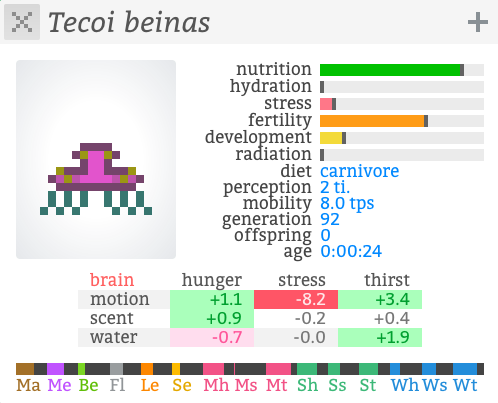
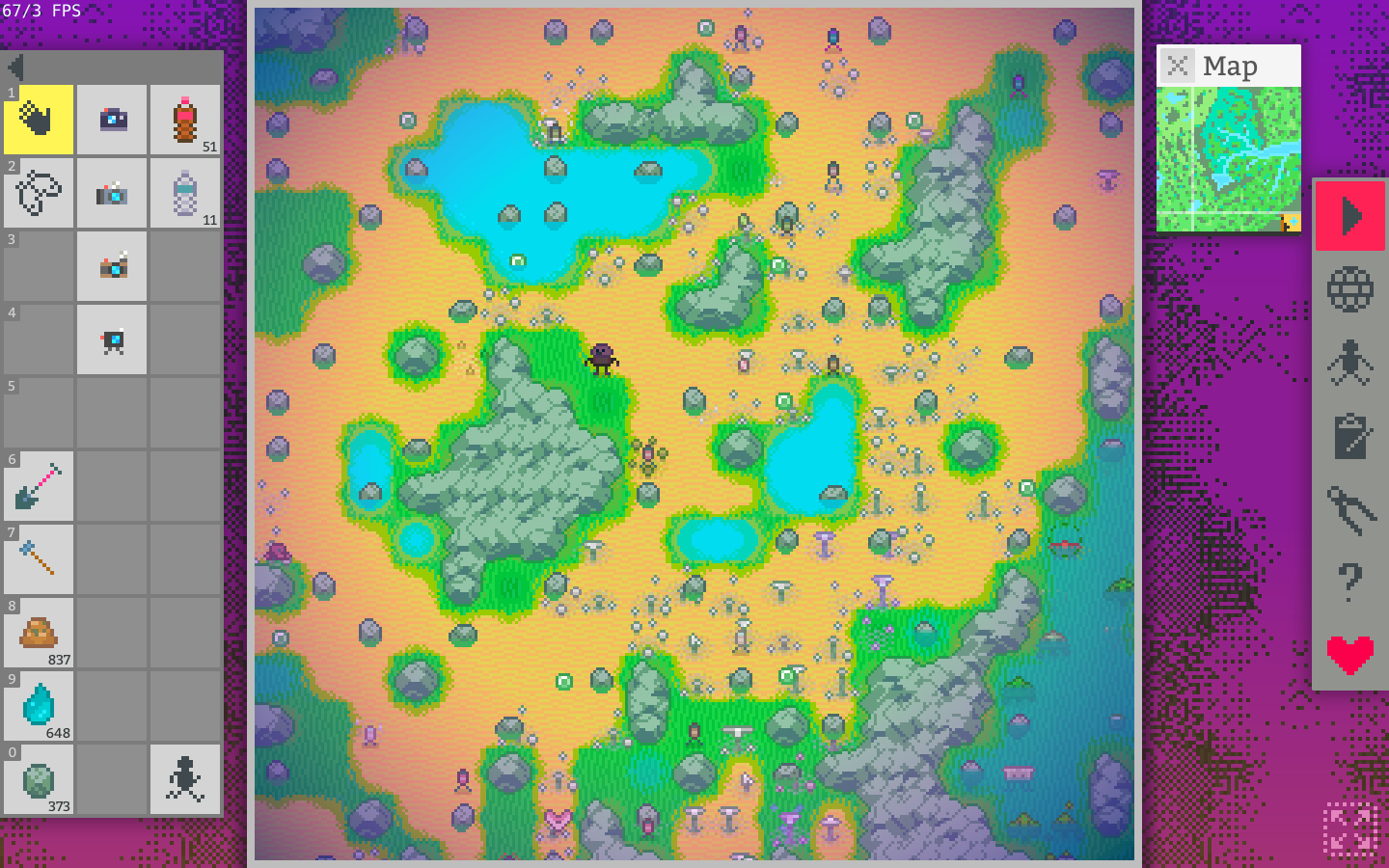
Tecoi Beinas in the plains, with Dedier on the lower left.
The Behaorum that reached the plains have been surprisingly successful, spawning the new species Beinas. Perhaps their predatory brains are what allow them to make up for having to be based around one small lake (elsewhere, they would die of thirst).
A lone anim succumbing to the temptations of the Rest
I think I’ve figured out why anims have such trouble adapting to the rest. After eating and drinking at the shoreline, anims are enticed deeped by the abundance of fungs or perhaps pressure from other shoreline anims, where they die of thirst (as they aren’t yet adapted to deal with the lack of water). This cycle makes it very difficult for a population of anims to live on the rest long enough to evolve to be able to live deeper into the Rest.
Tecoi Beinamxus Corallius
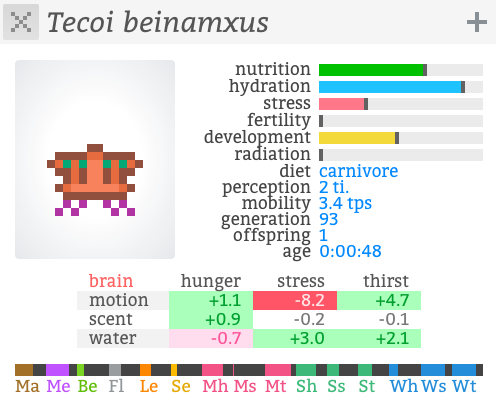
In the swamp, a funny faction has arisen: the coral-like Beinamxus.
After two hours, things seem to have really calmed down. There’s still no permanent population in the Rest, and it might take another hour for that to happen, so I’d rather call it now. Now, I’m going to go on a tour of the world to check everything out.
Population check: Behaibus and associates: 7, Behaorum and associates: 25, Beinamxus: 20, Belligahaus: 11, Dedier and associates: 6, Hadeas: 6.
The final state of the lowlands.
In the lowlands, Belligahaus killed the last of the Hapli and continue to be dominant along with the blue Behaibus that have long inhabited the region.
Belligahaus have a highly predatory brain, allowing them to capitalize on their bulk (improving their odds in a fight) and make up for the large amount of food they need. The strong Mostro lets them escape when the odds are against them. The vestigial Motho doesn’t really do much, and it is seen in most of the wet species; it’s an old relic from the ancestral Dehaibus Bellus. Additionally, Belligahaus is of the lowest generation out of all the final anims. This makes sense, as this species has existed for a reasonable amount of time and has a decently long lifespan.
Behaibus Novus, which occupy the same niche Behaorum Caeruleus used to, have a similar brain, but without the predatory focus, causing them to be more docile. Note the higher generation due to their shorter lifespan.
The final state of the North and South swamp.
Like usual, the north swamp is brimming with life while the south swamp is nearly devoid of fungs. The swamp was one of the things I paid less attention to during all this, so I’m not sure what produced the curious outcome of the perpetually-empty South.
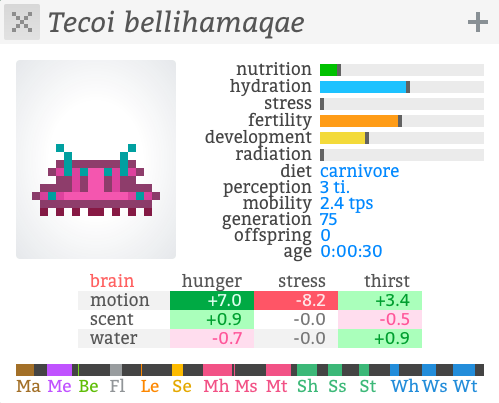
While the brains of swamp anims are roughly similar, there’s a little variety. Most (like this Behaorum) still have a predatory brain similar to Belligahaus, but some (like Bellihamaqae, who I picked from the pool of species with this brain purely because of its ridiculous name) have started to lose an attraction water when thirsty; an understandable mutation in an environment filled with water. The Western Beinamxus are less aggressive, which could keep them safe around the larger inhabitants of the swamp (who they couldn’t beat in a fight).
The range of generations is actually quite interesting here, and could be useful for identifying lineages!
The final state of the plains/lowlands border.
The border is populated by Hadeas Novus, with some Beinas visible to the West.
Hadeas have a relatively simple brain like the rest of their plains brethren, still quite similar to the progenitor. It gets them to food and water when they need it, and encourages a little exploration when things are dense. Hadeas also ended up adopting the classic shape of Dehaibus (and Depli and Dedier) Minus; this body plan seems really effective, as we’ve seen it stick around even more than the body of the progenitor!
The final state of the plains.
The plains are still how they usually are, with a hodge-podge of different anim species that look and act roughly the same. Unlike earlier, though, the North and cave mouth are dominated by Beinas, whose family traveled around the entire map to end up back in the plains. The most dominant of the plains anim is Hadeas (brain above), and all the anims of this sort have nearly the same brain. The body of Dehaibus Dehaibus and Dehaibus Minus has been extremely successful in the plains all throughout the run!
Beinas have a very similar brain to that of Behaibus Novus, but they come from an entirely different area— the Northern swamp. This further shows the legacy of Dehaibus Bellus, whose brain ended up dominating half the map.
The final state of the desert.
Amazingly, the Indeasxus (now mostly its descendent, Desindiae) have proved resilient enough to permanently occupy the desert and Northern cave!
Desindiae again has a similar brain to the progenitor; like many species, its most important trait is its body shape. This pill shape allows it to live comfortably in the desert without needing much water. While Indeasxus has minute-long lifespans, Desindiae continued the helpful desert tradition of having long lifespans, at around 4 minutes. In a desert often ravaged by fung extinctions and invasions from the swamp, the lower metabolism helps these anims tough out the hard times and live to see better conditions.
And finally, for reference, here’s the progenitor’s brain. All the dry anims are very similar to it, and the wet anims’ only difference is a more predatory top row.
This experiment went far better than I had expected! When you really focus on how things evolve, it turns out there’s so much to see even in only two hours. Let’s go over a few highlights from the run.
The first major event was the appearance of Dehaibus Bellus and its eventual colonization of the lowlands. I can’t imagine how its Motho aggressiveness when thirsty could have been beneficial— it (and its descendants) live in wet areas where there’s always plenty of water— so it’s likely just a random mutation. If so, it’s a great example of the founder effect, where a small population colonizes a new area and all the later inhabitants of the area carry whatever evolutionary junk the founders had; all the descendants of Dehaibus Bellus (eventually occupying half the map) carried the mutation.
Around this time, Depli started to establish itself in the cave, where it would stay for nearly half the run. It took a surprisingly long time for the anims to get established in the desert, though. Depli Rotundus was eventually able to push through, and the desert flourished for a while, even harboring the last extant Dehaibus. The desert is clearly a more challenging area to live in than the lowlands, given that Depli wasn’t able to occupy it until it evolved a decently specialized body for the task. The desert might be the most challenging of all the biomes, which could explain its later instability.
Next was the colonization of the swamp. The swamp reminds me of a rainforest; there’s plenty of food and water, so species can easily proliferate. The population density stayed quite high, which led to a large biodiversity, similar to in rainforests. Another factor was the absence of movement-obstructing rocks; while water makes it harder for fungs to spread, anims can move freely, and this is one of the most important factors in the difficulty of life for an anim. In the future, I should definitely make the terrain more rocky; while it’s interesting to have such a biodiverse environment, all the species sort of blend together and I end up not focusing much on it (after all, observing the tenth species to occupy the same niche isn’t very interesting).
When the swamp anims reached the swamp-desert border, trouble started. The hardy, adaptable swamp anims had the ability to survive for a decent amount of time in the desert oases, and with an absolutely constant flow of them from the crowded swamp, they upset the delicate balance of the desert and caused an extinction of its inhabitants. This may actually have been related to Motho, as the swamp anim presence lessened after the extinction of the desert; it’s possible that the swamp anims were so vicious due to thirst from the dry tiles they were on. After the desert cleared, anims twice came in to occupy the open niche before being wiped out again. Through all of this, Depli (especially Exter) continued to live in the cave– it was clearly an extremely successful species in this environment. Depli gave rise to Dedier, which did about the same thing— surviving in the cave and occasionally pushing into the desert.
The final major event was the return of Behaorum to the plains. After a 90-generation journey through 5 environments around the entire map, the wet descendants of Dehaibus finally made it back to where they originated. Beinas, the species descending from the single Behaorum that returned, was surprisingly successful in the plains, quickly becoming one of the most prominent species. This is interesting. It may be possible that, unlike the plains inhabitants that had been able to live there the whole time without changing much, Beinas’s ancestors were repeatedly forced to adapt to new, challenging conditions, and this made Beinas much more hardy and adaptable than the plains inhabitants.
One major failure, and probably the only complaint I have about the run, is that the Rest was never occupied. It seems that the lack of water and its geographical position made it nearly impossible to occupy permanently (not helped by its small size, increasing the risk of extinction events in fledgling populations).
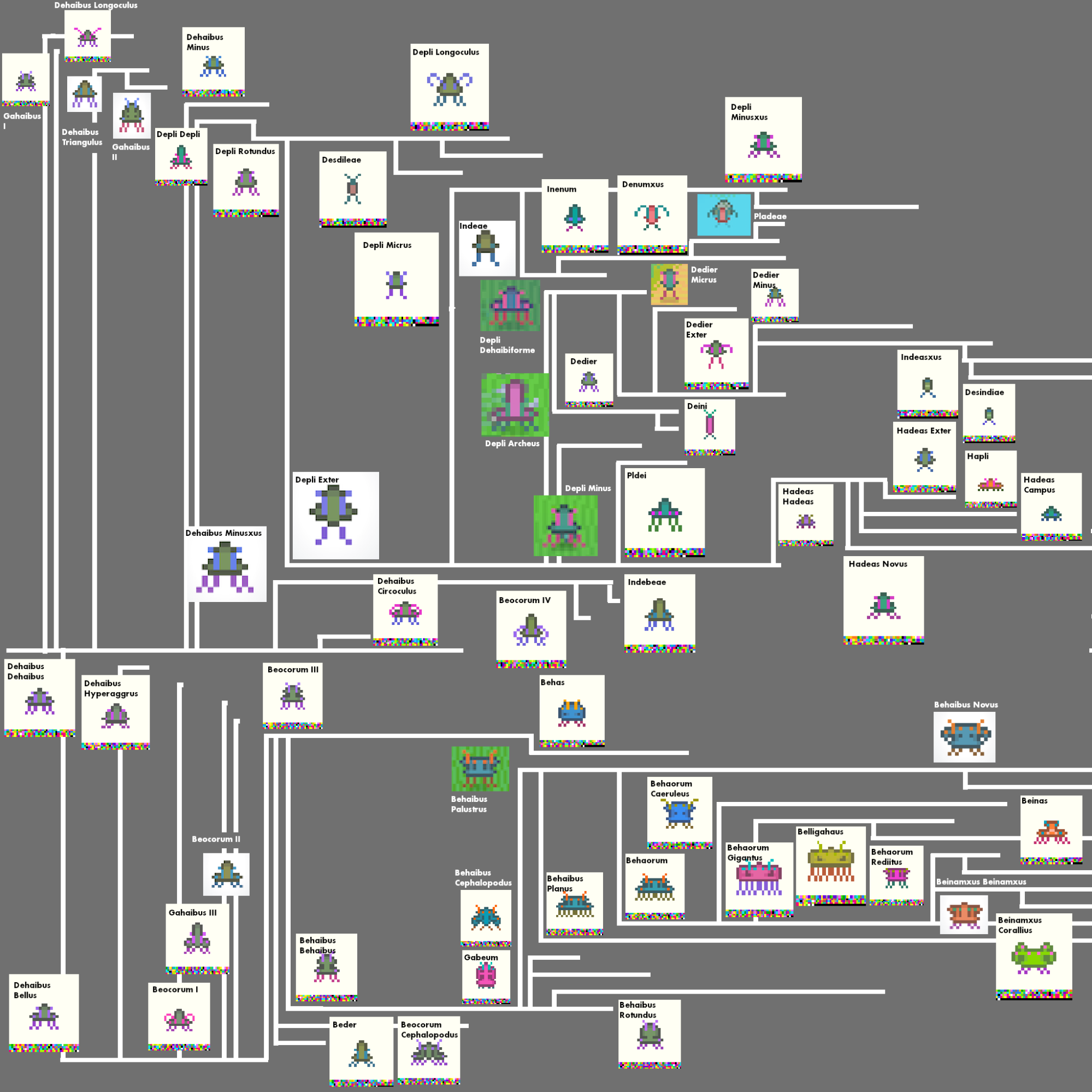
After doing the run, I had the idea of making a phylogeny for Tecoi. Because I wasn’t able to see the whole map all the time during the run (and I’m sometimes missing photographs of certain subspecies), it’s sometimes ambiguous what subspecies was the parent of a new subspecies, and the phylogeny has to make a reasonable guess about it. There’s also a bunch of species I didn’t have enough data on to include! It’s also possible to compare anim DNA to figure out clades, but I’m not experienced with that and haven’t done it here. With practice, it could be possible to take a bunch of extant species in a vacuum and use their DNA to determine information about their common ancestors!
Please zoom in!
Time-accurate cladogram of relevant species and subspecies during the run. The start and end of horizontal bars shows when a species evolved and went extinct.
FIN
Here’s some highlights of the dry species from the Cladogram.
Dehaibus:
Ah, Dehaibus Dehaibus. A great example of a generalist dry anim, with an unspecialized herbivore brain and an average lifespan. There’s a reason this was chosen to be the progenitor.
Despite being the progenitor, individuals of this subspecies never really accomplished much; their greatest achievements were birthing new subspecies. They mostly hung around the plains, and the most excitement an individual ever saw was rounding the horn and living in the South swamp for a little.
Identical to Dehaibus Dehaibus other than a mutation in Motho, Dehaibus Bellus unexpectedly colonized the lowlands. It’s unclear whether the Motho mutation helped it survive in the wetter environment; I find it more likely that it simply happened to live around that area when fungs got sufficiently rooted to support a population.
After doing decently well early on, Dehaibus Bellus ended up with only a single individual living for a time. That individual reproduced and gave rise to the entire clade of wet anims— the majority of anims that lived in the map are descended from that one anim! (The cladogram focuses more on the dry anims, as does the run; however, the wet anims were always more numerous.). Bellus gave rise to Beocorum III, which was slightly more adapted to the wet lowlands.
Dehaibus Minusxus followed the trend of most late Dehaibus subspecies– better adaptations for a dry environment (including a distinct, slightly smaller body).
After the other Dehaibus subspecies had long since evolved into Depli and Beocorum III, very low populations of Dehaibus Minusxus kept the Dehaibus species alive in the cave and desert for a startlingly long time. They were only wiped out during the great desert invasion, with no surviving descendants.
And of course, the vicious Dehaibus Hyperaggrus lineage. With a defining mutation in Motho that turns it into a killing machine when thirsty, these anims will typically reproduce once before going nuts, hunting down other anims, and eventually dying of thirst.
The Warrior killed 5 anims— an unusually high amount for a carnivore— which the Warrior wasn’t! It’s one thing to kill anims to eat, and something entirely different to kill without reason. This behavior could be considered territorial; it did keep the lake free of foreign anims that could have displaced its lineage, but territorial behavior doesn’t work very well in Vilmonic: anims can’t tell the difference between their own relatives and outsider anims. Hyperaggrus was eventually defeated by its own methods: it challenged the wrong anim to a fight. Due to the lineage’s tradition of killing their parents, only one or two Hyperaggrus could exist at once, so there wasn’t much opportunity to be survived by any relatives.
Depli:
Not much is known about the original Depli, Depli Depli. Its adaptations didn’t appear very helpful in the plains, and it quickly spawned and was replaced by Depli Rotundus. The jump from Depli Depli to Depli Rotundus is quite large; it must have been a large and rare mutation that happened to result in a pretty fit anim.
Depli Rotundus and Depli Longoculus were key species that were very successful in the early cave and desert. With a round, highly water-retaining body and a long lifespan, these species were perfect for the dry, fung-sparse circumstances of the desert and cave.
After being the first anims to colonize the desert, Depli Rotundus quickly spawned Depli Longoculus, and both inhabited the desert together all the way until the great desert invasion.
Depli Exter was the most surprising anim for me. Its weird body shape is essentially a slightly less wrinkly Dehaibus, but with only two legs instead of four. Each leg increases the nutrition intake an anim needs, so it’s possible that the lower leg count helped Depli Exter survive on less food.
This was one of the most successful subspecies of the run. Surviving over an hour, it thrived in the cave and gave rise to many other important species and subspecies.
Depli Micrus opts for a much smaller body that the other Depli, presumably to reduce the amount of food it needs to consume in the cave (where fungs can sometimes be hard to reach).
Depli Micrus lived with Depli Exter in the cave for a while. Despite having pretty different adaptations, both were similarly fit for their environment. Micrus eventually specialized further, spawning Indeae and its descendent Denumxus, but it wasn’t outmatched and lived beside them for a good while.
Like Dehaibus Minusxus, Depli Minusxus was a smaller form of Depli that hung around for a while in the cave and desert. Various anims adopted this body plan and lifestyle over the run, and they repeatedly ended up as the last extant population of some species. It seems that this plan is particularly stable.
Dedier:
Dedier Dedier and other members of the species followed the same trend as Depli: following Dehaibus’s general lifestyle and ending up with about the same mutations. Dehaibus, Depli, and Dedier can all be considered roughly the same; they just lived at different times. Like Depli, Dedier developed an Exter subspecies that was quite fit in the cave as well as having a smaller Minusxus subspecies that lasted for a while in the cave and desert.
Hadeas:
Hadeas Hadeas has a typical small dry body, though it evolved in the east plains rather than the cave. It lived there for a bit before being displaced by its more specialized offspring, forcing it to move North into the cave. It survived there for a bit longer, and eventually turned into Hadeas Novus.
Hadeas Campus and Hapli split from Hadeas Hadeas to specialize in the different sides of the plains/lowlands border. Hapli, with its long extrusions that increase water loss, had a much easier time suriving in the lowlands and generally lived further East than Hadeas Hadeas was ever able to. Hadeas Campus was also slightly more wrinkly than Hadeas Hadeas, perhaps giving it an easier time on the border.
Hadeas Novus, evolving from the Hadeas Hadeas that migrated north, adopted about the same traits all the cave anims did, similar to Dehaibus and Depli and Dedier. It happened to be one of the major populations in the plains when the run ended.
Indeae/Denumxus:
Indeae and its descendents continued to take advantage of Depli Micrus’s small body shape, which worked quite well in the cave area. This lineage varied the shape a bit while keeping its general size and wrinklyness the same.
After evolving from Depli Micrus, Indeae and its descendants lived alongside it. Denumxus moved into the desert after it was cleared in the second desert extinction (the first being the great swamp invasion), where it and its offspring occupied until they succumbed to the pressures of swamp anims and fung scarcity that all post-invasion desert populations struggled with.
Indeasxus/Desindiae:
Indeasxus and its identical successor Desindiae are highly adapted to desert life, having a small and very water-retaining body. Their size allows them to survive with much less food, and this is augmented by Desindiae’s late adaptation of a long lifespan– unusual for tiny anims like these.
These anims are notable for being the first pill anims to achieve a large population. In most worlds, anims like these quickly evolve and take over the desert, but despite anims with this body shape evolving repeatedly during the run, they were never able to get established. This is likely due to the water available in this desert, which allowed much larger anims to thrive. As to why they were able to take over in the end, the desert always operated in periods of growth and extinction after the great swamp invasion, and these anims happened to get lucky at some point after an extinction (as others like Dehaibus Minusxus and Denumxus did before). Desindiae’s ability to survive on very little fungs may have helped its stability in the swamp-anim-plagued desert by significantly reducing the impact of fung scarcity (caused by visiting swamp anims).
When I created this map, most of the geographical features were very deliberate. I had specific evolutionary goals in mind when I designed and terraformed the map, and many of those goals were realized during the run.
I start the map creation process by sketching out an idea on paper and annotate it to elaborate on my ideas. Once I’m satisfied with what I have, I can start terraforming and use my sketches as reference.
My brainstorming page for the map
Every map starts with a rough idea of goals or a particularly interesting formation I’d like to explore, and this one was no different. I opted for a more open layout to allow for large environments, which I hoped would make the world a bit more exciting than more cramped maps; large environments allow several species to coexist and significantly decrease the risk of extinction events. I included two special features in addition to basic biomes: a desert/marsh boundary and a pair of near-identical but separated environments.
For added flavor and worldbuilding, I always give each environment a name (plus, it’s much more fun to write details next to a named environment than next to “environment A” and so on). As detailed on the brainstorming page, the environments are as follows: Northern Desert (abbreviated desert), a mostly open desert (all tundra tiles) with rock canyons rather than small rocks and a few oases for water; Rocky Cave (abbreviated cave), a dry/tundra cave (tightly restricted movement); Tecoi Plains (abbreviated plains), a standard dry environment (standard: some movement-blocking rocks, but not enough to be exceptional) with perhaps a few rivers; The Lowlands (abbreviated lowlands), a standard wet environment quite similar to Tecoi Plains; Warrior’s Rest (abbreviated Rest), a dry environment very similar to Tecoi Plains; and Amviua Swamp (abbreviated swamp), a rocky marsh with patches of wet tiles. Tecoi Plains is named for the genus of Baseworld’s (the blank world I use for terraforming) progenitor and anims (genera can’t change in Vilmonic, so every anim in the run was in the genus Tecoi), which I’ve interacted with so often over the years (I almost exclusively play on Baseworld, of course) that I’ve become extremely fond of. Amviua Swamp is named for the original shark anim (explained later) from a friend’s world.
As mentioned in the brainstorming page, the desert/marsh boundary serves almost exclusively in an attempt to create sharks, a rare and exciting anim archetype that leaves its marshy home to hunt desert anims. The goal of Warrior’s Rest was to see the difference between a progeniting area (Tecoi Plains), where the progenitor’s build could reasonably stick around the whole time and which also receives gene flow from both of its side, with a terminal area (Warrior’s Rest), which only receives flow from one area and whose inhabitants must be descended from anims that first evolved to fit in a different environment. Ultimately, the desert/marsh boundary was more successful than I could have hoped, while the Rest failed.
On a larger scale, the environments were placed in order to promote a specific dynamic of propagation and exchange. Anims were to generally spread out smoothly through the world, and neighboring environments could exchange genetic information with each other (which in Vilmonic is to say, members of one environment can travel into an adjacent one and potentially stay there and propagate, which could eventually displace the current population). Thus, a few buffer zones keep key environments separated; the easy but long lowlands separate the plains from the Rest, forcing populations to evolve to the lowlands first before inhabiting the Rest, and the cave prevents the anims in the desert and plains (both of whom could reasonably survive in the other’s environment) from too easily mixing. The goal was to create distinct populations in these locations, so these buffer zones prevent a homogenous population from taking over.
There’s a lot of patterns and tips I’ve learned from the many worlds I’ve terraformed. There’s five things I like to focus on: obstacles in any biome, specific biomes, biome location (i.e., what biomes are adjacent?), fung density and ability to spread, and water. One of the most important factors that determine how an anim population evolves is the “easiness” of an environment: is it full of rocks like a cave, or are there no rocks? Does it consist of various different tiles, or only one? Are there plenty of fungs or very few? The easier a biome, the more anims tend towards densely-packed populations with high metabolism (which I generally don’t like; it’s hard for me to focus on specific anims when there’s so many).
Rocks are one of the biggest parts of the easiness of an environment— through a process I don’t fully understand, blocking anims’ movement consistently lowers the population density of an environment. Doing this also makes it more difficult for anims to maneuver towards food or water, usually causing them to develop better sensory perception.
Tile diversity is also quite important; since it’s much easier for anims to adapt to one tile type in particular (e.g. developing a body that barely loses water when standing on that tile), having several they need to live on encourages them to be more hardy, which takes evolutionary resources. However, this usually results in more homogenous body shapes, since the more exotic ones are generally specialized for one tile type.
Fung density is understandably important. The abundance of food always affects those that eat the food, and this is no different here; with sparse fungs, anims generally have to either evolve higher sensory perception or evolve very low metabolism to be able to survive on one meal for longer. Usually, the result of very sparse fungs is both. While controlling fung populations is difficult (and I have less experience with it than with anims), rocks and especially tile diversity help a lot.
In addition to what I’ve mentioned about general trends, specific biomes also tend to evolve specific traits. While deserts are sometimes populated by larger, round anims that lose water slower than any other kind, deserts (even ones with water) are most often taken over by some variation of the micro-anim.
Deserts typically end up inhabited by either tiny anims that reproduce rapidly and barely require any food or highly-water-retaining tube anims that can survive for longer in the waterless conditions.
Dry and wet environments are mostly anything-goes (except for highly specialized anims like micro-anims or very wrinkly marsh anims), though the anims do tend to be less or more wrinkly for dry and wet respectively.
Depli Rotundus has a skin/flesh ratio of 20/18 (= 1.1), while Beocorum III has 30/10 (= 3).
Depli evolved in a dry environment, where losing water slowly meant it didn’t have to spend as much time finding water to drink; Beocorum evolved in a wet environment, where the fast water loss meant it wouldn’t drown easily.
Marshes are the opposite of deserts; their extremely wet tiles force anims to become so wrinkly that they also need to grow larger to accommodate more wrinkles. In the past, I’ve had trouble getting stable populations in marshes, which I don’t fully understand. It seems like fungs have trouble growing there, but I didn’t have any issues in this run.
Availability of water is another huge factor, but it’s one I haven’t explored much. A lack of water generally seems to encourage aggressive or high-metabolism anims that can reproduce before dying of thirst, or it can make an environment inhospitable to any but the most specialized (waterless monotile deserts can really only be inhabited by micro-anims).
The last thing is an environment's neighbors. If anims are forced to adapt to one environment before they can move into the next, the anims in the second environment might retain traits from their ancestors from the first. This is what I attempted to explore in the Rest, but my decision to have no water in the Rest and to separate it with a large river made it fail. However, this effect was still demonstrated by Beinas; it roughly kept the body shape and brain from the marsh despite living in the plains.
Terraforming the world can be an oddly zen process. I first start by establishing an outline of the key formations— the large rock ranges and the river— and then fill in the tile type of each biome. Then, I begin to flesh out the smaller rock placements, and I start detailing and varying the tiles. Once I’ve done that for everything and the map is in a state I like, I drop rock items EVERYWHERE. From what I can tell, this doesn’t have a noticeable effect on the anims or fungs in the environment, but it significantly improves the aesthetics. A terraformed world is always as much art as it is functional!
Through its simple mechanics, evolution in Vilmonic parallels the real world to a great degree. All physiological traits of anims are controlled by the anims’ genes, which mutate randomly. Thus, the evolutionary mechanisms present in the real world can be observed in Vilmonic.
The basic concepts of environmental pressures apply; the shape of anims’ bodies change to survive better depending on the tiles in their environment (compare the wrinkly anims in the marsh and the small, smooth ones in the cave at different points in the run), the length of their antennae reflects the density of fungs where they live (consider Depli Longoculus in the desert), and an anim’s brain can give insights into how and where it lives (for example, marsh anims can lose their Watho from the abundance of water, as happened with, say, Bellihamaqae). There are also some traits for which I haven’t yet observed clear pressures (For example, what pressures encourage carnivorism? What benefit do longer legs give?)– these could be a good opportunity to explore further.
Convergent evolution is common and occurred multiple times in the run, and other evolution-related things like the founder effect were observed as well.
Here’s the most overt example of basic evolution from the run. Hadeas Hadeas, which lived on the border between the dry plains and the wet lowlands, split into two species: Hadeas Campus, which was more adapted to the dry side, and Hapli, which was more fit for the wet side. Hadeas Hadeas was displaced by these two (as they were specialized and more fit), and was forced to migrate north, where it remained as Hadeas Novus.
GIF comparing Hadeas Hadeas to its two specializations, Hadeas Campus and Hapli
Hadeas Campus and Hapli are more genetically divergent, but they’re still visibility related.